Tara DiLullo Bennett surveys the diverse array of vfx in such new shows as Journeyman, Chuck, Pushing Daisies and The Sarah Connor Chronicles.

The depth and breadth of vfx used in contemporary television series is increasing by leaps and bounds every season now, especially with film savvy viewers expecting more and more from their small screen entertainment. It doesn't hurt that sci-fi/fantasy and high concept shows are all the rage nowadays with network execs. This season finds a load of series from Pushing Daisies to Chuck that all have intensive visual effects work embedded into their DNA. VFXWorld talks to the visual effects teams on several of the most buzzed about shows and gets the skinny about how these new broadcast offerings are raising the bar on what viewers can expect from television.
Journeyman -- NBC, Mondays at 10:00 pm
The concept: Dan Vassar, a contemporary reporter from San Francisco, discovers that he can jump back in time to correct things in recent history.
Andrew Orloff of Zoic Studios is the visual effects supervisor on Journeyman. Orloff explains that the most-important effect his team needed to create for the pilot is how Dan Vassar [Kevin McKidd] actually "jumps" through time. "The first thing [the producers] wanted to do was a time jump effect that let the audience know what was happening from a story stand-point. They wanted it to be known he was jumping through time but they wanted to stay away from standard visual effects, like a time tunnel. Alex Graves, the exec producer and director of the pilot, had a very, very specific idea for the show. He wanted it to be a seamless vfx show, where they supported the story and didn't get in the way of the story. The idea of the time travel effects came from thinking about how time travel might actually be physically possible like if there was a wormhole and a tear in the space/time continuum, or a singularity that would basically suck him in through the fabric of space/time. The show isn't treating time as time travel, but that he's journeying through time and space simultaneously. We broke it down into components like there's a disturbance in space/time. There's a good visual example that [Stephen] Hawking talks about with the classic example of how space/time and gravity are the same thing, like if you put a bowling ball in the middle of a trampoline and then add a tennis ball, the fabric of the trampoline will bend and roll around, creating a funnel shape in time and space. That's the genesis of the idea of the time ripple effect. There's a rippling disturbance in the fabric and it's becoming malleable.
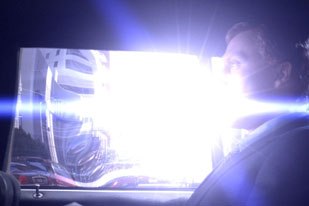
"In the first couple episodes, [the jump] was flat to camera and now we've dimensionalized it in some episodes," Orloff continues. "The basic methodology is pretty simple in that we get Dan against a greenscreen and a clean plate of the background, so we can effect the background separately from him, or whomever is time traveling. It's accompanied with the singularity effects, which is a very bright light source ingrained with the camera. It was very important that the flare effect have a character that was away from a CG lens flare. It needed to look more of an optical feel to counteract the CG intensive ripple effect. It's more of a David Fincher-esque, anamorphic lens flare, which gives it more of a feel that it might have been shot on film with a hot lens source. It started in the pilot and now it has evolved and we're building on it every episode. We've seen it from other people's points of view and in multiple shots."
With budgets for episodic television almost always shrinking after the initial pilot, vfx tropes established in the first episode often need to be trimmed as the season progresses. For Journeyman, Orloff says the effects were created to remain viable through the course of the series life. "We built it to play for the series and that was important for us and what Zoic is known for. Alex is a fantastic client and he understands the process. He works with us and gives the right comments at the right point so we were able to mitigate the more typical disasters by his ability to participate in the visual effects process. He guided us to where he and the studio wanted to be, so we got all that done in the pilot and we had a recipe tailored to their production schedule and budgetary needs. By the end of the pilot, we had it all approved and a menu they could choose from and they know how much it costs so they could step it up and put more into it if they needed."
Orloff says Zoic assigns three or four artists, a producer, and a coordinator to complete the shots needed for Journeyman. "For each episode, there is a lot of invisible work on the show with set extension and replacement. We do a lot of Los Angeles for San Francisco, so a lot skyline replacements and anachronism replacements, like billboards. There is a continuing set piece of the San Francisco Register, which does not exist, so we do the facade for it. Sometimes when Dan goes back in time, he meets himself so we are doing spilt screens. We kicked up the conventional thinking with split screens. There has been a lot of pre-planning and they have been good about letting be involved in production. Our onset visual effects supervisor, who delivers the shots here, is George Loucas and he goes on set. We're doing split-screens with Steadicams. It's all about lining up the video and having the operator be really precise. We have an episode where Dan puts himself in a headlock, so there are greenscreen dummy heads, compositing and more. So for a big episode, we do about 15 shots-per-show. It's a lower volume and it works well for the show. What Alex wants is to do less shots but spending a lot of time getting them right. Alex is really good at saying, "These are the shots we need. Let's make them photoreal."
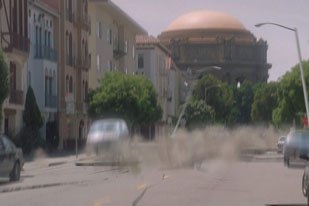
While the season is still young, Orloff maintains they already have a favorite episode. "We're most proud of 'Game Three,' where Dan travels back to the 1989 Santa Cruz earthquake. There were a couple shots completely created by Zoic. One shot is down the street toward the Palace of Fine Arts, and the sidewalk crumbles towards camera. There is one shot looking up at a Victorian as glass breaks and falls onto the camera. There's also a shot with Dan jumping forward and the whole façade of the building falls to the ground. In those three shots, they were all lock-off, clean plates of San Francisco with no damage. Through a lot of different means, CG, matte painting, and Zoic runs a vfx insert stage where we shot a lot of miniature elements; we were able to create those three shots."

Chuck -- NBC, Monday at 8:00 pm
The concept: Chuck Bartowski is a computer nerd that works as a tech expert at the big box store, Buy More. On his birthday, he accidentally downloads a top-secret government file into his brain that allows him to access world secrets -- thrusting him into the spy world.
Zoic also handles the bulk of vfx work for Chuck and Andrew Orloff details his company's involvement with the series. "Starting with the pilot, the Visual Effects Supervisor/Coordinator Mike Leone and I worked together with production to find the overall vfx credo. McG, who is the exec producer and the director of the pilot, was very interested in having it playing like an old-fashioned James Bond spy drama. He didn't want to do anything too overt or crazy, but there was a lot of work designing the cool, retro-look to a lot of the stuff in the pilot."
A key moment in the pilot is when spy Bryce Larkin hacks into a super secret room with hundreds of video screens that contain the secrets Chuck will eventually absorb. Orloff explains, "Zoic was really involved with The White Room, with the supercomputer in the pilot. We did all the concept art and basically the room was a white room at LA Center Studios. When the lights go down and the images come up, that's completely fabricated by Zoic. All the images were designed by Zoic. We actually have a design department, so Shawn Berry, who is our compositor, did a really great job of designing all the wall panels. A lot of animatics and concept art was done to get the look and feel of the room. The most interesting thing about that sequence is there's no CG in it at all. It's all done with 3D layers in After Effects. It was so editorially intensive and it was important that all the footage be timed properly for it to work right. If we did it with CG, we'd have an extra step with every change. It's a big deal. There are a lot of mosaics and it all had to be cleared by legal and put back into editorial for the right balance of speed and clarity. If every time there was an editorial change, and we had to feed the textures back and re-render, we would have been sunk in the pilot. This way, every way was a pre-composite built in After Effects and mapped as 3D layer in a four-walled room. Also, Mike was instrumental in working with some of our artists in our Vancouver BC office. We outsourced to them because of the amount of work for the pilot, so they did a lot of compositing for the explosions. For that, Mike shot a VFX element on black of fire rushing toward the camera and it was composited into the room to make it look like it blew up."
Orloff says Zoic staffs two compositors and a CG person working along with Mike for Chuck. Detailing their episodic work on the show, he continues, "We do about 10-15 shots-per-episode. There is the fictionalized mega strip mall where Chucks works at, The Buy More store. There's no Buy More sign, so that has to be created and tracked in for every episode. As new businesses are introduced (in the strip mall), those don't exist so we do all those CG exteriors as well. There is also the show specific stuff like all the gadgets and gizmos. There's an ejector seat and Chuck's Nerd Herd vehicle has been converted into a spy mobile with nav systems and controls. It's a TV show, so they don't have the ability to build a mechanical solution so it's all CG. It's photo-mapped onto a clean plate of the interior of the car. There is a lot of stunt enhancement and stunt work that we get into as well as typical virtual sets and greenscreens outside of windows."
Last but not least, Orloff explains, "The other big thing is the "mind flashes," which is all the information in Chuck's brain. Every time that he sees something, a piece of the puzzle, we zip inside his mind and see flashes of the random images coupled with some pertinent data so he has to figure out what these messages from the supercomputer mean. We designed the mind flashes with production. Blake Robertson is one of our motion designers and did a really great job pulling from everywhere, from stock footage to crazy pieces from student films. It's kind of fun because there's a TiVO factor to pause through and decipher what's happening in the flashes."

Pushing Daisies -- ABC, Wednesday at 8:00 pm
The concept: Ned is a pie maker that has the remarkable ability to bring dead things back to life for one minute. One second more, the thing remains alive but someone or something has to die in its place. But if Ned touches the thing before the one minute is up, it goes back to being dead forever. Together with his re-animated childhood sweetheart and a private detective, Ned uses his gift to solve unsolvable murders.
Entity FX of Santa Monica is working on a big chunk of the massive effects needed for each episode of Pushing Daisies, the whimsical, fairy-tale from Barry Sonnenfeld and Bryan Fuller.
Kymber Lim, exec producer at Entity FX, explains how they came to the project. "Initially they hired one studio to do the visual effects for Pushing Daisies without realizing how much work there was, so that's when we were called to help them from the second episode. We have been working very closely with Bill Powloski, the visual effects supervisor of the series. It is a very ambitious show in terms of budget and schedule just like most TV shows. Even now, there are a lot of creative aspects that are still being developed and worked on and they do want the overall aesthetic of the show to be magical."
Visual Effects Supervisor Eli Jarra at Entity FX continues, "We've gotten a certain guideline that we are trying to abide by. It has a really nice rich and saturated look to it that's truly unique. I love working with the color palette. The whole premise is told in storybook fashion and it's not common at all. Trying to match into that really gives an artist a way to flex their muscles. The [producers] like it over-the-top with the feel, mood, animation and the color. Something where you feel it might be too heavy, usually hasn't been heavy enough. But I feel really confident that we have a really strong talent base to work the strategies so we can get everything done, because the show has to air!" Lim laughs and adds, "In our case, we've literally had days to turn shots around and final them. Obviously working in this style and type of show is a challenge to turn around good work in a very short amount of time. From the time we get the scripts and the QuickTimes, which are the offline, in the last episode we turned around 56 shots in about five or six days."
Detailing the type of work they do on any given episode, Lim adds, "There are a bunch of flashback sequences and we are doing a lot more of the creative work in those sequences." Jarra continues, "The biggest challenge has been bringing things back to life. In the third episode, 'The Fun in Funeral,' Ned is bringing back fireflies and is experimenting as a kid to discover his powers. We were bringing back fireflies and spiders were being animated to die. It's a wide variety of things to do." Lim continues, "We modeled and animated the flies, a spider and for a series of maybe 19 shots that we did for that sequence."

Jarra adds, "For the same episode, we did a blue screen sequence where the character in the plate is phobic of the Earth moving, so we actually had to play out his phobia. There's a lot of turbulence in the air and this guy is sitting in a booth inside of 'The Pie Hole.' He looks up and there's a picture of a cherry pie on the ceiling and as that gets sucked up into a whole whirling vortex, to simulate the whole atmosphere getting sucked out into space. It was pretty neat. There were a lot of dynamic effects involved with creating the vortex element with debris, as well as things come off the table and fly out into the air. We used Maya, After Effects and Flame to achieve that sequence."
As to the size of the team assigned to the show, Lim says, "Our team fluctuates based on the nature of what we are capable. I would say we have ten or twelve artists on the show. They all feel very motivated and excited by working on a project like this."
The Sarah Connor Chronicles - Fox, January 2008, Mondays at 8:00 pm
The concept: The Terminator film franchise is spun-off into an episodic series that follows the continuing adventures of Sarah Connor and her son, John Connor, who will eventually be the savior of humanity in the war of robots versus humans.
The ever-busy Zoic Studios also takes point on this series with Jim Lima leading the team as the visual effects supervisor. Orloff details how Zoic jumped into the iconic franchise to make it work on the small screen. "One of the things [the producers] really wanted to do was to be true to the original films and the original Terminator designs, the T-800. They didn't want to see T-1,000s and TXs, with hot chicks and arms that turn into big guns. They wanted to go back to the original steely-eyed, badass Terminator. Outright, one of the biggest challenges was that we needed to upgrade the franchise without just rehashing what [audiences] had seen before. It's why we brought Jim Lima into the fold, because he's worked with James Cameron before and he's a very accomplished concept designer in his own right.
"He went ahead and developed with the producers the new model T-888, which is a new model based on the original film. We did a lot of Photoshop comps and concept art from Jim until we got it right. The model that we ended up getting done was very, very complicated and had a huge amount of polygons. If we had gone to a film pipeline with modelers and texture artists and lighters and doing it all in mental ray or RenderMan, where we'd need to have shaders to tweak each shot, we never would have gotten it done. But our experience with LightWave from Battlestar Galactica and Firefly told us we could crank out this hard surface, metallic stuff and make it look fantastic and use our entire render farm without any addition cost to us or the client to gear up. Fortunately, we also through our videogame work had developed a pipeline, because LightWave is notoriously not as flexible at Maya is with character animation, we wrote a proprietary software to translate our Maya animation, with all the scripts and gears, automatically happen inside the Terminator and give the character animator the chance to use Maya's told to animate the face and do the secondary stuff on top of the mo-cap data, and then translate that and send it off to LightWave for rendering. It's worked out well and we are doing that for the duration of the series. It gave us a lot of flexibility. Now we have every single shot of a Terminator split between LightWave and Maya. We can render interchangeably between the two softwares and have the cameras and the animation line up exactly."
With the timeline and turnaround for TV vfx particularly brutal, Orloff says they had to find a way to be able to incorporate the Terminators into the production cycle -- both render-wise and budget-wise. "During the pilot, I was very involved in just getting the production endoskeleton to a point where we could do a certain amount of Terminator shots per episode without blowing the budget. That really involved a lot of the work we've been doing elsewhere in Zoic with motion capture for videogames. We have a very experienced crew and MoCap directing staff and a good relationship with House of Moves. We know what we are doing in a motion capture studio. We know how to bid it, direct it and take care of all the data ourselves, so that was something special we wanted to bring to television.
"To cut down on the number of man hours it was going to take to animate everything by hand in the show, we actually got the stunt actors and trained them to walk and talk like Terminators so we could bring them in and capture their performance. That pipeline helped us out. Also on the technical side, we had to find a way to render all this stuff in that volume in the amount of time we had. Although the full T-888 does not appear in every episode, but parts of the T-888 do appear in every episode. You may see part of the skin get blown away and the endoskeleton underneath be revealed. Or you'll see his hand pop up from around a corner. There's a lot of glowing eye stuff and it's not typical circle out the iris and put a glow on it. It's composting a piece of the metallic eye for depth to harken back to the prosthetic makeup in the film.
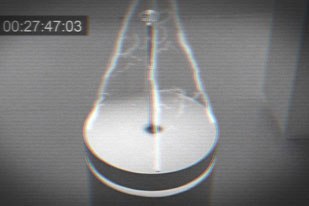
"SCC is our biggest show in-house per episode," Orloff admits. "There's a lot of stunt enhancement. There's a good amount of digital matte painting for worlds that need to be created. A lot of shows need that now with basic virtual set construction. There's a lot of stunt enhancement like pulling off a bank vault door. There's always a lot of gun fire muzzle flashes and digital squib hits. There's always a car crash or whenever the time bubble happens, which is a big thing from the pilot." Like the films, the time-bubble occurs every time a human or Terminator jumps back in time. "The time bubble was interesting because a lot of that lightening from the original films was done the old-fashioned with hand roto and animators who drew the lightening in by hand for every single shot. We started off doing that type of shot for the pilot using lighting generation software. We quickly found that it did not hold up. Fortunately, I know a lot of guys who know how to draw and animate, by hand, frame-by-frame. We pulled them in and we did all the animation frame-by-frame. The CG crew is really great. We have a big team with three CG people and maybe four compositors."
Tara DiLullo Bennett is an East coast-based writer whose articles have appeared in publications such as SCI FI Magazine, SFX and Lost Magazine. She is the author of the books, 300: The Art of the Film and 24: The Official Companion Guide: Seasons 1 & 2.