
London-based Men-From-Mars cranked out 1,454 shots with only a team of 30 for Mutant Chronicles. We find out how they did it.

Nowadays, it is not rare to see a movie featuring more than 1,500 vfx shots. The work is usually spread among many different vendors in order to ease up the pressure on any particular team. These mammoth projects typically require hundreds of vfx artists and a substantial budget. So, one can only wonder how London-based Men-From-Mars managed to single-handedly produce 1,454 multilayered shots for Mutant Chronicles with only six 3D artists, 2 to 3 matte painters and 20 compositors... Moreover, this team of 30 was able to deliver the bulk of the work -- 900 shots -- in less than six months, and on a very tight budget.
Opening in limited release today from Magnolia Pictures, Mutant Chronicles tells the grim story of our near future. It is the year 2027. Planet Earth is on the verge of complete ruin, as four giant corporations battle over the world's last resources. During the conflict, an ancient buried seal is broken, which releases a horrific mutant army. Soon, the mutants threaten to wipe out the whole human race.
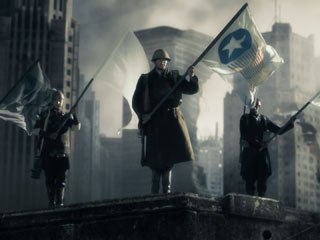
When he embarked on this ambitious project, director Simon Hunter knew that he didn't have the budget to shoot a movie with such a grand scale using traditional means. He thus adopted the cost-effective strategy that had been so successful on such movies as Sky Captain and the World of Tomorrow and 300: shoot live action on minimal sets and create the environments digitally. That meant that almost every shot would eventually be a visual effects shot. Indeed, Mutant Chronicles features some 1,645 VFX shots, a new record for the British visual effects industry.
replace_caption_mutant02_MutantChronicles-04.jpg
A Runaway Train
Serving as Overall Visual Effects Supervisor, Simon Carr mainly worked with lead vendor Men-From-Mars, while additional shots were assigned to Dinamo Prods. (VFX Supervisor Llyr Williams), Baseblack (VFX Producer Stephen Elson) and Lipsync Post (VFX Supervisor Glen Pratt).
Carr faced the challenge of achieving the scale and scope of the Mutant Chronicles world while working within the constraints of a very modest budget. "On a practical level, it meant there were no armies of vfx people on set -- in fact, for much of the project it was just me!" he laughs. "So, we had to find ways of streamlining approaches, such as ensuring that the camera data for each set-up was then available to vfx via a database. Since the film was shot on the Thompson Viper camera, we had access to every frame that was shot and, in many cases, it was also possible to put the camera data info into the headers."
Preproduction took place over an intense eight-week period, which didn't give Carr much opportunity to plan shots. He compares the shoot to a runaway train. "Our record for set ups in a day was, I believe, 62, and our average was about 40... Although we did do some previsualization and temp composites during the shoot, I generally did much of that myself on my laptop using C4D and some basic models and animations. In most cases, it was simply a case of trying to picture how the environment we'd imagined related to the minimal environment in which we were shooting."
In postproduction, the budget determined how much time the team was able to spend per shot. Knowing this, the director kept iterations down to a minimum on as many shots as possible. The lengthy postproduction process allowed the team to develop looks and environments in a less pressured way. The really heavy period of vfx post only started six months after the end of principal photography.

Additional shots were assigned to Dynamo Prods., Baseblack and Lipsync Post .
Artist Authorship
At Men-From-Mars, the team headed by VFX Supervisor Phil Attfield and VFX Producer Simon Frame was getting ready to tackle an in-house record of 1,500 shots. "I guess the 'secret' is in the project planning and how you run your facility with the artists you employ," Attfield says. "MfM has a depth of experience working on independent features with the budget restrictions that go with that sector of filmmaking. We've often had to reverse engineer vfx solutions to match the available budget, but the scale of Mutant Chronicles made it stand out from all other shows we'd done before. Director Simon Hunter wanted to be able to review a shot, or scene, know what time had been assigned to it, know what time had been expended, and decide whether the shot required more work, or was ready to finalize. The theory being that he would have the ability to divert resources to the scenes that would benefit from more artist input. In the event, Simon was mostly too busy with other aspects of the movie to make those calls, but he trusted Simon Carr and me to make them for him."
Men-From-Mars Line Producer Richard Graham estimated the time allowances, and created Gant charts in Microsoft Project to structure the workflow. All the information about shots, assets, tasks, elements, time allowed, time used, iterations, comments and finals was held in a Filemaker Pro database. Once the scale of the tasks and the timeline were established, Men-From-Mars set about matching individual artists to some scenes and creating teams for others. "Simon Carr and I both tried to empower the artists to stretch their creativity and have a level of authorship, but within the parameters of our resources," Attfield notes. "This isn't too hard to do with 30 artists over a six-month period, but I'm not sure that the approach would work with a team of, say, 300."
Hunter took advantage of having the freedom of creating his environments digitally to build a very elaborate universe. In Mutant Chronicles, our planet had become a grimy, muddy and decayed world. There is no electricity or computerization.
The environments were largely developed in post, with Production Designer Caroline Greville-Morris producing a bible of looks and textures for reference. "Textures were built from a number of sources," Carr explains. "Extensive photography of the sets was enormously helpful as it allowed us to tag the post textures closely to any that we had on the shoot. In addition, Miniature Effects Supervisor Leigh Took at Mattes & Miniatures created a series of miniature environments that also helped to set the look and feel of our Mutant world. We also spent a lot of time photographing mud and rust!"
The cityscapes were created in a number of ways. The main city that the heroes journey through started life as a series of miniatures that were photographed to match foreground plates shot on stage. Matte painters then added the midground and background buildings from a variety of sources, both photographic and straight painted. Other cityscapes borrowed from real world cities, all heavily enhanced and modified to suggest a glorious era that has passed.
Men-From-Mars utilized a Softimage/mental ray/Shake software pipeline, with Boujou being used for tracking and matchmove. Photoshop helped create the matte paintings. Throughout the process, Carr and Attfield served both as compositing supervisors and matte painting supervisors.

Matte paintings, miniatures, practical effects, set extensions and a variety of other work was done within a very short amount of time.
Mixing Practical and Digital
One of the trickier environments was a giant ancient underground machine that processes human victims into mutant killing machines. "Having seen how successful the environments that used miniatures had been in other sequences, Simon Hunter asked me in September 2007 whether I thought it would be feasible to build a miniature, shoot it and composite 300 shots before the end of the year," Carr recalls. "What followed was possibly the greatest triumph of the entire process. Using our early concept work and plenty of his own ingenuity, Leigh Took and his fantastic team of model makers created a miniature from concept to shoot-ready in just eight days (and several long nights, I suspect). It allowed us to cover backgrounds for the entire sequence at the heart of the machine. In addition, he built a large cavern containing the mutant spaceship and a mechanism to lift it. Using a Phantom Digital high-speed camera, we shot over 50 miniature set ups in 10 days. Using a mix and overlay system on set, we were able to match foreground and background plates, which ensured a smooth post process. Then, Men-from-Mars blasted through over 200 shots in less than four weeks, adding steam, flames and mutants by the dozen. The remainder of the sequence was completed at Baseblack."
Miniatures also played a key role in the lift shaft descent sequence. The live-action element was restricted to actors on a 30-foot section of rope. Compositors were then able to join up the individual actor rope performances and get them to interact with the miniature lighting. The technique was also put in great use for the battlefield sequence, a scene that contained the highest density and variety of visual effects per minute in the movie. "Every shot had digital rain added to augment practical rain," Attfield notes. "It had every type of weapon effect; a variety of wounds, including disembowelments, head shots and facial punctures; animated 3D vehicles; combined particle and practical steam effects; matte painting environments; set extensions; miniatures of enormous steam artillery had to be populated with soldiers, etc. We applied the whole range of skills and resources we had in this scene!"
On the other hand, a fully digital approach was favored for a scene that takes place in a bone tunnel: This creepy environment, that looks like a catacomb, most closely fitted the workflow that both Hunter and Carr would have liked to have followed for the entire production, but which would have proven too costly for this production. "An artist drew up a rough model for how this might look, based on images of the catacombs in Paris, and various other images. During the shoot, the art department provided a floor made of sterilized (but no less smelly) bones for the actors to walk across, as well as a long greenscreen. Attfield supervised the shoot for this, and was able to place some simple tracking markers that allowed the camera to track along with the characters as they proceed down the tunnel."
According to Attfield, this scene was an example of where a single vfx artist, Steven Bray, had creative authorship over most of the scene by creating the environment in C4D and compositing hero shots for other artists to reference. "The Bone Tunnel is a perfect example of the marrying of on-set material with vfx set additions that add good screen value whilst not breaking the bank," Carr observes. "It also reflects the fact that the scene is used in exactly the way it was intended when written. This is so rarely the case in any filmmaking as editing often shifts the emphasis or requirements of a scene."
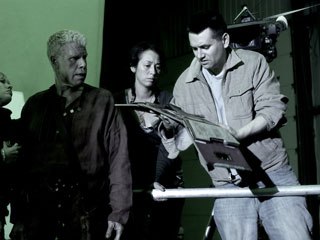
More than 900 shots were created in less than six months.
Steam-Powered Spaceships
The various vehicles were to be the one major area that would primarily require 3D modeling and animation. Only last minute shots made use of miniatures, as time constraints made that approach most viable. The 3D vehicles were designed in-house at Men-from-Mars or by Concept Artist Kevin Hunter. The team then concentrated on building a texture library that would provide a gritty, steampunk feel. Carr tried to retain an agricultural feel to the Armoured Troop Carriers in common with WWI tanks, and also the sense of a cramped gun turret and impossible driving position.
At the start, no one really believed in the concept of flying steam-powered spaceships, but the "don't ask, just make it look cool" tenet eventually managed to change minds. "We smoothed some of the lines initially inspired by the Mallard, and resulting in the 'VW Combi' styling of the civilian transport," Carr notes. "Our thinking was that, in a world in which war has taken control of everything, all industrial processes would have been streamlined. So, the flying vehicles have a common rear-end, which houses the boiler room and main thrusters. For the ship that is donated to Samuel's mission, Simon Hunter wanted something that looked like a steam locomotive. Head of 3D Amaan Akram produced a concept painting to establish how it might look. Once that had been signed off, we set out to add as much detail as possible and to build something which had at least some element of a locomotive's driving elements."
On all these CG elements, Men-From-Mars tried to avoid 3D rendering where possible. The team often used a single frame render, with additional painting for detail. This approach was particularly effective in the city square, or during an attempted escape by mother and son, in which high-resolution stills were used to place the transporter behind the greenscreen live action.
Atmospheric effects played a crucial role in merging the various elements and creating a sense of gritty realism. "We built a large library of practical blood, fire, explosions, smoke, debris, snow and salt plates to use as both snow and waterfalls," Carr says. "But some of the more specific interactive elements needed to be computer-generated. To this end, one of our Junior Artists, Ben Turner, developed a niche role of 'elements guru,' creating rain, snow, debris explosions, steam trails, gun shells being ejected and many more. Because of the nature of the project, it was not possible to consider complex effects animations and simulations. So most of the techniques we employed were at the plug-in level: we used both Particle Illusion and Particular in After Effects. This said, we did create our own simulations for distant collections of mutants walking about the landscape. In general, it was a blend of shot and created material in order to aim to get the best of both worlds, whilst not really having full access to either. I think that, in most cases, it was successful although -- as is always the case -- there are inevitably areas in which it would have been good to have had the luxury of hindsight." The steam coming out of the 3D ships' engines was created via a 3D simulation using BA volume shaders in Softimage.
For Amaan Akram and his 3D team, the most significant challenge was getting the shots out to the compositors as quickly as possible. "With a very small render farm, and a tight deadline to work with, we had to come up with new methods of reducing the number of full 3D render iterations. We tried to do as much work as possible in 3D pre-composites or via projections, before sending out the passes to the compositors."
Pushing Boundaries
Having delivered a whopping 1,500 shots, Attfield now looks back on this project with a sense of awe, and is especially proud of his team. "I was struck by the number of artists who said they were glad to have worked on Mutant Chronicles. The show gave a lot of our artists an opportunity to expand their skills, experience and to shine. It's a good buzz, seeing and hearing artists develop their craft."
For his part, Carr, now a full-time vfx supervisor at Men-From-Mars, is very pleased with what was achieved: "It felt like we worked well with the resources that we had to show that it is possible to create scale and ambition beyond the normal scope of B-grade science-fiction. By tailoring the solutions, and by minimizing wasted work, I think we helped to achieve a unique look and style for the film, and hopefully pushed the boundaries of what is possible."
Alain Bielik is the founder and editor of renowned effects magazine S.F.X., published in France since 1991. He also contributes to various French publications, both print and online, and occasionally to Cinefex. In 2004, he organized a major special effects exhibition at the Musée International de la Miniature in Lyon, France.