ILM raises the character animation bar with Pirates of the Caribbean: Dead Mans Chest, and Bill Desowitz gets an overview from John Knoll and Hal Hickel.

With the help of the Imocap system, Bill Nighys creepy Davy Jones is the next great CG performance after Gollum and King Kong. All images © 2006 Disney Enterprises Inc and Jerry Bruckheimer, Inc. Photo credit: ILM.
When undertaking back-to-back sequels to Disneys surprise blockbuster, Pirates of the Caribbean: The Curse of the Black Pearl, Industrial Light & Magic quickly realized that it needed to significantly raise the bar. Not only did the shot count triple from 324 to 979 on this summers record-breaking Dead Mans Chest, but also the CG creatures were more complex and closer to the action. This required several R&D wrinkles and getting the creature pipeline up to speed on the new Zeno platform in San Francisco.
As most of you have seen by now, the results of the character animation are very impressive. Theyve already begun talking about the creepy Davy Jones as the next great CG peformance beyond Wetas Gollum and King Kong. Lord of the Deep and commander of the mysterious Flying Dutchman ghost ship, Jones is a delicious mutation: part human and part squid, with a beard full of wiggly tentacles, and crab-like claws.
Unable to rely on traditional MoCap or hand animation, ILM created an innovative new system called Imocap that allowed onset and on location motion capture to elicit the most believable look and performance possible out of actor Bill Nighy.
The characters required a lot of careful examination of human performances and then trying to combine that with the animation, explains animation supervisor Hal Hickel. We knew that there were going to be actors cast to play Davy Jones and his crew, and that those actors would be on set in the plates that we were going to be put those CG characters into and that somehow we had to extract the motion of the performances without having to reshoot later. We didnt want to bring the mocap stage onto the set. So the R&D and MoCap groups came up with a solution: special [sensor-studded] suits that would be worn by Bill Nighy and other actors playing his crew. We would take reference cameras onto the sets and untethered cameras out on location with lightweight tripods and position them at angles off of what the main taking camera was seeing. This allowed us to track the movements and provided great data from the hero plates with the actors in them, casting their real shadows and making good eye contact with the live actors, and then we were able to extract their motion and apply it to our CG characters and put those characters right on top of the actors. Theres still a lot of animation artistry in there because theres a lot of interpretation. This is just about getting the skeletal motion of the character; we still did all of the facial animation by hand [in Zeno].

A second R&D project at ILM involved creating Davy Jones tentacle beard itself. Many tests were done to get the behaviors right.
But more about Imocap in part two. Suffice it to say, Davy Jones is the most complex and human looking CG character in Dead Mans Chest and hes all-CG. The animators incorporated as much of Nighys face as possible. However, the eyes proved to be an interesting test case. As a backup, [director] Gore [Verbinski] asked us to put some makeup in a T-zone around his eyes and mouth, in case he wanted to do a blend for an extreme close-up, Hickel continues. But we never used it. We knew it would be difficult, but we figured we could get there pretty quickly. What was just as difficult was the whole spark of life. Theres always that last percent of realism thats hardest to capture. The closer you get to the goal of it being real enough that people will stop worrying about it and thinking about it, the more glaring the omissions are. On top of which, theres the gray area of his performance. The thing about Bill was he wasnt a stone-faced villain. It was a very mercurial performance he was constantly changing his expression and delivery. Nobody expected it. Every scene wed stare at it and study it. I know there are animators that are leery of any technique that takes away some of their authorship. I totally understand that. Pure animation is wonderful. But I also think the collaboration between an animator and a live actor is an exciting thing too. I imagine its what makeup artists feel.
Zeno added an additional challenge. ILM came into Dead Mans Chest with only a small portion of its creature pipeline function intact. War of the Worlds and The Island, the two previous projects done with Zeno, were primarily hard surface works. The creature work on those didnt need cloth, sim, flesh or hair. A large part of the effort was re-enabling the pipeline, particularly the facial animation.
Meanwhile, the second R&D project involved the tentacle beard itself. Our R&D folks worked with James Tooley, our sim guru [creature development supervisor], and Karin Derlich [creature technical director], who came up with behaviors, Hickel adds. And wed do tests and Id say, This one is too tentacly and this one feels too much like an elephants trunk and this one feels too much like a snake. We would look at tons of octopus references. After we got it, then those behaviors were added to the solver through what we call Joint Motors, so all the tentacles were divided into little joint segments and each segment was essentially a little motor that was directed to move this way or that way. So those joint motor impulses were sent out at the same time the tentacles were receiving force information: I need to swing this way, I need to swing that way and so it would all happen together.
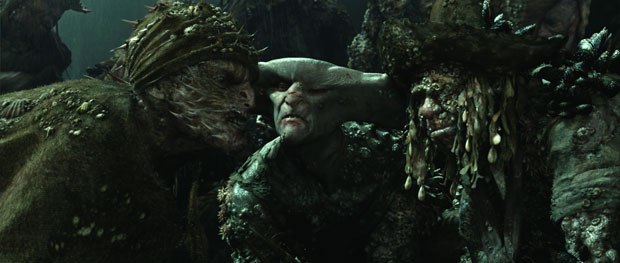
The crew of The Flying Dutchmen features a cast of characters with visual references to the ocean and its creatures, including coral, sea sponges, barnacles, mussels, hammerheads and puffer fish.
Once we added those behaviors to our sim engine, the last thing we needed was something called Sticktion, which is a combination of friction and stickiness. The problem was that without Sticktion, the tentacles would just slide onto each other. We really wanted them to be this heap of viscous tubes that would stick to each other and stick to his chest. And the ones at the bottom of the stack would stick there in a big matte. The biggest ones out in front that hang from his chin and moustache-like tentacles could really swing around.
Imagine a piece of spaghetti sticking to a leather jacket, suggests visual effects supervisor John Knoll. That was the effect I wanted to get. R&D added this subtle stickiness to the engine.
The great thing, Hickel continues, is that as complicated as it was, once Karin came up with basic settings for all of the controls, the sim artists got up and running very quickly. Im pretty amazed by that, actually, because this was very stressful for me. Back in December, when we really didnt have this working yet, there was no plan B. We couldnt animate it by hand and we looked at other sim possibilities, but they didnt achieve what we had in mind. There are more than 200 shots and 15 minutes of screen time of Davy and we had only one artist who knows how to do this.
With as many as 50 animators working together on a total of 18 CG characters, there were plenty of technical and artistic challenges. What makes these characters so complicated is that they are encrusted with sea life and we had to figure out ways to cover them with barnacles and such, Hickel observes. We wrote tools that the modelers used where they had a sea life picker, where they could pick a mussel or a barnacle. As our model supervisor, Jeff Campbell, said, it was a little like flower arranging. And they also used ZBrush for displacement textures for the sea life and for the characters themselves and our usual suite of modeling and paint tools.
The crew of The Flying Dutchmen include Ogilvey, who has a sea sponge head; Palafico, whose head is a red fan coral and very translucent; Koleniko, in which one side of his face is a puffer fish and can puff up with spines; and Knolls favorite: a crab-like creature whose head rotates in and out of the shell.
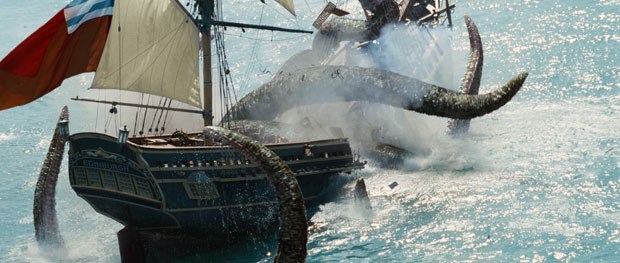
The Krakens tentacles modeled in Maya. The creature was keyframe animated with some flesh sim enhancements in Zeno, courtesy of the new creature pipeline.
Then theres the Kraken, the mythological squid monster that most are familiar with from 20,000 Leagues Under the Sea, which plays a prominent role in Dead Mans Chest as the instrument of Jones destruction. Tentacles were crucial here as well. Modeled in Maya, the Kraken was keyframe animated with some flesh sim enhancements in Zeno, courtesy of the new creature pipeline. They even had to procedurally tweak the suckers on each row of tentacles because they were too clean looking, so they randomly replaced suckers that were more rough and worn looking.
Utilizing ILMs new fluid dynamics engine, developed in cooperation with the Stanford University research program, Dead Mans Chest, like Poseidon, contains improved CG water, in which nifty algorithms are put through multiple processors. And thanks to Zeno, which has been described as Maya on steroids, you can introduce particle controls, Soft Body, Rigid Body controls and other techniques.
We started out in parallel with Poseidon, but they got into a bit of a crisis and we loaned them my entire water crew, Knoll admits. They wrapped in April and I got them back to finish my shots. They really pushed the envelope. The development they did at the end of Poseidon really paid off here. We did a lot of difficult water shots right up to the last day. The crew really knew what nobs to turn to get it to look good. We used CG water around the bases of the tentacles when theyre sloshing back and forth underwater. The Flying Dutchman travels underwater and reaches the surface like a submarine, so those shots were done with CG water as well, and the Dutchman is 380 feet long. We got realistic droplet size and realistic dispersion of particles.
The scenes on Cannibal Island, where Captain Jack Sparrow (Johnny Depp) narrowly escapes, contain a large number of shots where you see different variations of the same view under different lighting conditions, so Knoll and matte supervisor Susumu Yukuhiro needed to think about a 3D solution. We saw ads for a product called Vue. Its designed for organic landscapes and getting realistic renders. We started playing around with it and it became our primary tool for big, exotic landscapes.
Overall, Knoll believes Dead Mans Chest takes character animation another step forward at ILM, especially considering Nighys performance. There are not as many shots numerically as on Sith, but its [a greater accomplishment] in terms of the amount of shots in the time that we had. Sith had 2,400 shots in about two years and this had 1,000 shots in about five months, but the average shot complexity was higher than on Star Wars.
Bill Desowitz is editor of VFXWorld.

Bill Desowitz, former editor of VFXWorld, is currently the Crafts Editor of IndieWire.