
Rich Hoover of Sony Pictures Imageworks tells Ellen Wolff about the crucial vfx issues for Valkyrie, including dealing with the two missing fingers on the hand of the German protagonist played by Tom Cruise.

Director Bryan Singer has a track record with digital visual effects, having made two X-Men movies. But his latest project, the MGM release Valkyrie, was the polar opposite of a CG "look-at-me" assignment. This World War II tale based on an actual plot to stop Adolf Hitler demanded invisible effects that would help the production recreate 1940's Germany.
For this, Singer called upon veteran VFX Supervisor Rich Hoover and Sony Pictures Imageworks, which had previously worked with the director on Superman Returns. "Valkyrie is obviously not an effects movie per se," says Hoover, whose many credits include Armageddon and Seabiscuit. "There are really two key issues in this film. One is that Colonel Von Stauffenberg, the German officer played by Tom Cruise, lost an eye, a hand and two fingers on his other hand after a battle in North Africa. The second issue was restoring Berlin to a 1943 period look, creating vintage airplanes and augmenting explosions."
While the majority of Valkyrie takes place in Germany, the film opens with the North Africa battle where Von Stauffenberg is gravely injured. "There were real aircraft used, but we also added additional aircraft," explains Hoover. "We had two vintage P-40 airplanes flying overhead and we had strafing runs and bombs going off. The production went all-out to get vintage planes but we had to augment these. Bryan had in mind that there were six planes making strafing runs in pairs from various directions. There are times where we see about four."
"We made both CG planes and we cloned the planes that we filmed, whichever looked best for a shot."
"We also added digital muzzle flashes on the planes, but the battle was primarily practical effects that we rigged. This made it feel very real for the actors and it looked very real in the shots," Hoover notes. The production chose a stretch of California desert to stand in for North Africa, though they scouted Spain, Jordan and Morocco before settling on a location halfway between L.A. and Las Vegas. "In the end," says Hoover, "it was a place close to home that won out."
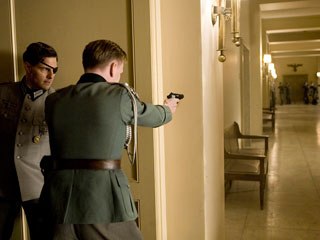
Very little dressing of this desert locale was needed in order to create a credible battlefield. But Hoover did have to deal with the inherent problems of filming 200 "soldier" extras with seven cameras rolling. "It was almost impossible not to see multiple cameras and crew huddled around them in many of these shots. We also had shots where 200 extras were running in front of crew members, so we had to do a lot of rotoscoping to get the crew out of shots. But watching the movie, you'd never know it."
While Valkyrie doesn't contain digital extras, Hoover recalls, "We did a fair amount of cloning and patching of actual elements. There are scenes with thousands of soldiers forming squadrons, but we just used one squadron over and over again. We used real photography in the smartest and most realistic ways we could. My attitude was that if there was a way to shoot something in camera that what's we did, even if that meant shooting things in pieces. And it worked flawlessly."
When filming in Germany, every effort was made to achieve historical accuracy, says Hoover. "The filmmakers went way out of their way to research everything. Many of the locations where we shot were the actual locations in Berlin where the real events took place."
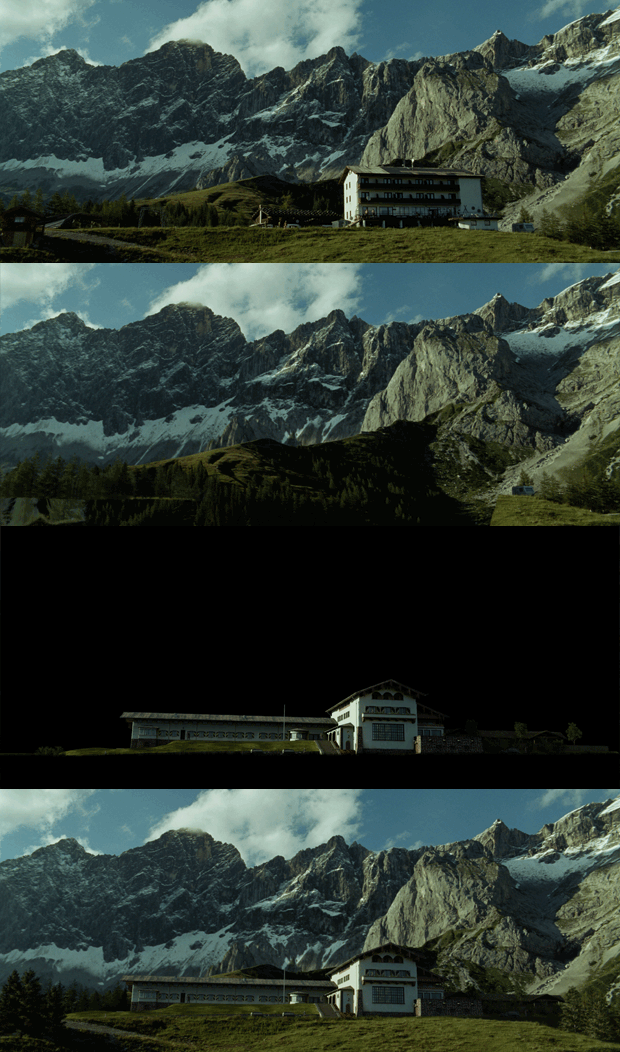
"The movie has a lot of conversations that take place on interior locations, and some were stage and some were locations," explains Hoover. "We had a huge set of the German headquarters. There were a few shots where we put ceilings in and added environments outside the windows. In one mountain estate in Austria there was a spectacular view out a picture window. This window worked like a garage door that could rise up. We built the exterior totally digitally and matted it into plate photography of a ski area in Austria. It wasn't the actual location, because there wasn't really anything of that left to shoot, but it was similar in terms of the terrain and what you'd see out the window.
"We also shot on streets in Berlin, where there are blocks of buildings from World War II that are still in existence." Hoover recalls being amazed by what the city of Berlin was willing to do to accommodate the filming of Valkyrie. "The city took down power poles and modern lighting and pretty much restored those streets to what they were back in the '40s. Then we removed everything else, like security cameras. In one day, they took down the whole street so we could shoot over the weekend. And when I drove by on Monday morning it was all back up."
Hoover says the production did exhaustive research of what Berlin's buildings looked like in 1943. If background buildings visible in a shot weren't from the period, Sony Imageworks' digital team removed them and painted in authentic- looking buildings based on research photos. Additionally, Hoover asked matte painter Robert Stromberg to do a matte painting for the ceiling of a famous bombed-out church. (Stromberg, an Oscar nominee for his work on Master and Commander, had previously contributed to effects that Hoover supervised for Seabiscuit.) For this film, Hoover explains, "The roof of the church had been blown away, and people had cleared away the debris and held candlelight services. We had historical photographs, and Robert's matte painting was based on that."
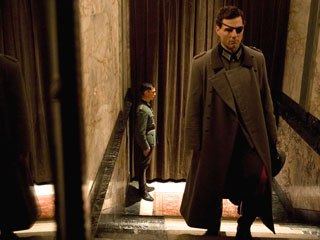
Greenscreen techniques were actually used sparingly, according to Hoover. "There were some buildings where the entrances weren't true to the period. We put up greenscreens so we could replace them with digital versions that were historically correct. But that was pretty minor." And greenscreen was decidedly not Hoover's choice when it came to the tricky business of altering Tom Cruise's hand to appear to be missing two fingers. "I had tried little green sleeves, but they spilled green on the fingers we wanted to keep," he says. "I'd much rather keep greenscreen and bluescreen out of shots if I possibly can. It just ends up looking more realistic. In this day and age, with the level of resolution that we have and the criteria of audiences, it's what you have to do. The only thing I did for the shots showing Tom's hand was to have his makeup artist paint two lines on his fingers where they would have been cut off, using a shade of makeup that matched the color of his skin when it was in shadow."
When the footage got to Sony Imageworks, the digital team built a version of Tom Cruise's hand and then rotoscoped everything he did, frame by frame, to erase the "marked" fingers. Hoover remarks, "It was probably, in a subtle way, the most spectacular work that we did. We rotoscoped Tom's every movement -- while he's building bombs, signing his signature, answering the phone and handling a gun. There were a lot of close-ups where we had to roto every finger and carefully blend between his real hand and the digital hand. I kept as much of Tom's real hand as possible. On a shot by shot basis, it was a different process."
Once Sony Imageworks had rigged the digital hand, they tracked it in the plate photography using boujou. Hoover explains, "Once the tracking was done, we did a proof-of-concept match move. Because it's really on a 2D plane, it's hard to tell if the hand is actually in the right position in three dimensions. So we had to pose the hand so it looked perfect to the camera. Then we'd load it into the computer and spin it around and if it looked all twisted in that position, we'd know it really wasn't right. It took a ton of very delicate, specific tracking."
Hoover observes, "Tracking is one of those frontiers that everyone takes for granted, but actually it is quite an important step. You're building the foundation of the shot. So if it's not really right you'll see problems during rendering and have to start over. You can get it 80 % of the way and think 'It's going to be fine.' And then you render it and see all the problems. So you just have to work and work at it to get all those subtle things right."
Because there were a lot of extreme close-ups of Von Stauffenberg's scarred hand, the texturing was crucial. (Sony used Maxon Body Paint along with Flame tools to achieve these looks.) Hoover says, "The scarred hand is quite important to the character, and Bryan and I came up with some rules of what to show the audience that would be tasteful. We had a lot of photographs of what the scars would actually have looked like, based upon what the surgical procedures were in 1943. We followed that quite religiously. On a shot by shot basis we delicately dialed up or down how rough or detailed his hand appeared to be."
Cruise himself conferred with Hoover before scenes in which his hands figured prominently, asking to be told if he was moving his hands in ways that would make the post process more difficult. But there was no getting around this effect, especially in post-surgery scenes where Von Stauffenberg struggles to dress himself only using three fingers. Or where he intertwined his remaining fingers with his wife's hand during a dance sequence. Hoover says, "We know from historical accounts that Von Stauffenberg didn't stick his hands in his pockets to try and hide his injuries."
Because this visual effects requirement was so central to the character and so pervasive, it meant than this "non-effects" movie wound up having a subtle visual effect in many, many shots. "We touched about half the movie," Hoover says. "But I don't think anyone watching it will know that -- at least I hope they don't!"
Ellen Wolff is a southern California-based writer whose articles have appeared in other publications, including Daily Variety, Millimeter, Animation Magazine, Video Systems and the website CreativePlanet.com. Her areas of special interest are computer animation and digital visual effects.