Joe Strike connects with the filmmakers behind TMNT to discover the mystical secrets behind Imagi Ent.'s first CG feature and the relaunch of a popular franchise.

When Peter Laird and Kevin Eastman first doodled up a funny-animal turtle dressed as a ninja warrior, it's a safe bet they had no idea of the entertainment franchise they were about to unleash on the world. The tongue-in-cheek terrapin evolved into a quartet of heroes who debuted in a 1984 self-published, black-and-white comicbook as the Teenage Mutant Ninja Turtles. The foursome became a surprise comics phenomenon that led to mega-licensing deals, several cartoon (and one live-action) series, along with three live-action movies. The franchise got its second wind in 2003 with a new Saturday morning 2D cartoon series and is about to return to the big screen with a fully animated CGI version.
You just can't keep a good turtle down.
It might have worked in the 1990s, but actors in turtle suits (even ones designed by Jim Henson's Creature Shop) won't cut it in the all-digital 21st century. The new movie, opening March 23, 2007 in the U.S., comes from the Hong Kong-based Imagi Studios. The film is being distributed in North America by Warner Bros. and overseas by the Weinstein Co. As with 2D animation, budget-driven producers and distributors are searching outside the U.S. for lower cost CGI -- and what they're finding is looking better all the time.

replace_caption_tmnt02_PaulWang.jpg
"Everyone is wired in Hong Kong with broadband, everyone has cell phones you'll see a year from now," observes Paul Wang, who finally has a few moments to relax after producing (with Thomas K. Gray and H. Galen Walker) TMNT, the latest chapter in the Turtles' adventures and their first theatrical feature since their third film in 1993. "They have latest fashions as far as technology goes. When I'm over there I see stuff I've never seen before -- now they're advertising real time cell phone video delivery at 30 frames per second. Hong Kong is a hi-tech city. They've been heavily influenced by Japanese anime and western blockbusters. They get both things and you see that reflected in their own cinema and the sensibility of the people there."
Wang's CGI experience dates back to 1995 and Pacific Data Images (now PDI/DreamWorks), where he did effects for movies like The Peacemaker and The Arrival before leaving hands-on work behind to become the lighting supervisor on Antz.
Imagi got its start in 2000, producing CGI TV series like Zentrix and a direct-to-video feature based on the Digimon franchise. The studio always had its eye on the prize, though: theatrical feature animation, beginning with the Ninja Turtles.
Wang joined Imagi's TMNT team in 2005, while director Kevin Munroe was still working on the film's script. Gray, the producer of the Turtles' three previous features, had convinced their co-creator Peter Laird to go to the well one more time and Imagi, formed in 2000 was ready to play with the big boys. Towards that end, they had opened up a creative development office and production facility in the Los Angeles area, the better to tap into the local talent market and pitch to the studios in town.
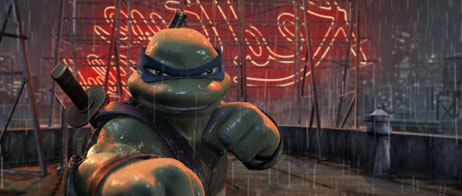
Wang didnt just want to revive the Turtles franchise, but to push CG animation to another level. Above, Leonardo squares off for a fight.
"The whole point was not just to revive the Turtles franchise, but to push CG animation to another level," Wang recalls. "In 2006 six furry animal movies were released; we thought it was time to do something more edgy, dark -- basically a live-action movie.
"We didn't have the rights to the characters yet [in early 2005]," Wang recalls, but with all parties on the same page and a signed agreement a formality, the L.A. studio began staffing up, ultimately employing some 70 people. As with most U.S. TV animation, character and concept design, creation of a story reel, etc. took place in L.A. The studio created the bare bones CGI cinematography, which was ultimately sent to Hong Kong for full animation by its staff of 300. High-speed Internet data transfers shipping problems and their attendant time delays a thing of the past.
By the end of 2005 things were ramping up, with Hong Kong doing its own pre-production and producing CGI assets for the film. "Two-thousand-six was the really the year of Hong Kong Imagi production. Here in the States, Kevin and (production designer) Simon Murton [Charlie and the Chocolate Factory, I, Robot] were approving thing and giving notes, along with a few artists guiding that effort. We did the last bits of post the end of February: mostly audio cues, tweaking some of the dialog and trimming a few shots."
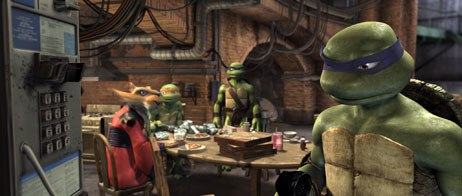
Imagi used Maya, with Pixars RenderMan for the production pipelines back-end. Wang found that Mayas front-end, with its tools to move models and place lights, very interactive and is what Mayas good at.
Imagi used Maya, today's default CGI software, with Pixar's RenderMan used for the production pipeline's "back-end." "Maya's front end, its tools to move models, place lights and so on are very interactive, it's what Maya's good at," Wang explains. "What it's not so good at, it doesn't have a great render -- it has a sufficient render.
"What people do when they become higher-end studios, either they write own software like DreamWorks, or they'll buy high-end off the shelf software, which is what we did: Pixar created RenderMan. They keep us a year behind the version they use in-house, but it's pretty cool. We upgraded to it to get the better quality for the Turtles."
TMNT's animation and rendering are indeed impressive. The Turtles' body language and facial expressions convey distinct attitudes for each member of the quartet; no Turtle suit could ever come close to the CGI characters' mouth articulation. (Check out their face-spanning smiles.) Skin textures boast convincing texture and translucency (courtesy of RenderMan). A rooftop battle in the rain is a showpiece of effects animation and light reflectivity as raindrops visibly splash off the Turtles' glistening faces.
In fact the Turtles, hewing to their previously established comic book/2D cartoon/live-action appearance, look more "real" than their human supporting cast. It's a decision Wang ascribes to making the shelled heroes "the center of the story. We wanted them to have more detail and visual interest, and have the humans support the Turtles from the design viewpoint."

It was a conscious decision to make the Turtles the center of the story and to make them look more real than the human cast. Skin textures boast convincing texture and translucency and there is more detail and visual interest.
Definitely a wise decision: after several disastrous flirtations with photo-realistic people (The Polar Express and Final Fantasy: The Spirits Within come to mind, as does Pixar's early short Tin Toy), CGI producers now realize that computer-generated human beings (in CGI movies as opposed to live-action special effects) need to be stylized (if not completely cartoony) or risk falling into the `uncanny valley' of audience rejection.
The contrast between the animation in TMNT and Imagi's previous high-profile effort -- the NBC primetime TV series Father of the Pride -- is particularly striking. "That was a TV show produced on a TV schedule," Wang points out. "Instead approving 50 or 100 shots a month, you'd be approving 100 a week; your throughput has to be so much faster. They had two weeks to complete a 22 minute episode -- that's 11 minutes a week through the pipeline."
FOTP's cast of furry felines suffered as a result, with their textures appearing more painted on than homegrown. "We couldn't afford to render anything more on them than texture mapped fur with little patches of [3D] fur in it. It was a product not only of the time the animators had, but the time available for rendering and tweaking shots. Back then the pipeline was Maya all the way through, including the render."

The contrast between the animation in TMNT and Imagis previous high-profile effort, Father of the Pride, is particularly striking. © DreamWorks.
Today, Imagi's goal is to produce CGI movies that "serve the high-end market" at a fraction of those film's $100 million-plus budgets. "We're doing them for $35 to 40 million," Wang says. "Other CGI films in that range don't have our kind of production quality" and goes on to admit, "our production staff is essentially all in Hong Kong which pretty much cuts our costs."
According to Wang, language barriers aren't a problem because "all the creative supervisors and production management in Hong Kong were hired for their English. We hold English classes for the animation staff" and adds with a touch of hyperbole, "there are no Cantonese [language] classes in the U.S."
"Our animation director has spent most of his life outside Hong Kong. He's Chinese, but he's been around the world -- he grasps the meaning rather than just the words. You can use the adjectives and he'll know exactly what you mean. When you say `thoughtful,' he'll know the Turtle needs to look like he's actively thinking, not zoned out."
With Imagi's first feature under its belt, Wang (now their vp of development) is overseeing the company's next two high profile releases, both based on classic anime TV series. The first is Gatchaman, featuring the exploits of a Power Rangers-style superhero team, but the second one is likely to get the most attention: a long-overdue movie version of the show that first brought anime to the U.S., Osamu Tezuka's Astro Boy. "Sony spent several years trying to do, but for whatever reason they were unable to get it off the ground, so we picked up the rights.
"In one sense, Astro Boy is the Mickey Mouse of Japan and Tezuka is their Walt Disney. There are a lot of post-World War II themes in his story, but it's about a robot who wants to be a boy -- there are shades of Pinocchio anda lot of movies. AI is especially similar in the beginning; large parts are borrowed from Astro Boy. I believe Spielberg came forth and said as much."
Might there be more Turtles in Wang and Imagi's future as well? "We've talked about it. If it happens, we're ready to hit the ground running."
Joe Strike is a regular contributor to AWN. His animation articles also appear in the NY Daily News and the New York Press.

Joe Strike has written about animation for numerous publications. He is the author of Furry Nation: The True Story of America's Most Misunderstood Subculture.