J. Paul Peszko uncovers the secrets of The Spiderwick Chronicles, thanks to Industrial Light & Magic and Tippett Studio.

The Spiderwick Chronicles (opening Feb. 14 from Paramount Pictures and Nickelodeon Movies), directed by Mark Waters, is a fantasy-adventure based on the best-selling series of books illustrated by Tony DiTerlizzi and written by Holly Black. It's chock full of ogres, goblins, boggarts, fairies and sprites that populate the Spiderwick Estate, where the Grace family -- twins, Jared and Simon, their sister Mallory and Helen, their mother -- have relocated.
The amount and variety of unusual creatures from the five volumes was so daunting that the visual effects had to be shared by two studios: San Francisco's Industrial Light & Magic and Berkeley's Tippett Studio. Visual effects pioneer Phil Tippett was creature supervisor for the overall production. On set during the entire principal photography, he worked with the visual effects team from his own studio along with the team from ILM to coordinate the nightmarish logistics involved in combining live action with CG.
The team at Tippett Studio included in-house Creature Supervisor Joel Friesch, who also served as co-visual effects supervisor with Blair Clark, CG Supervisor Russell Darling and Animation Supervisor Todd Labonte.
Explains Clark: "We did all of the animation and design work on Hogsqueal, the Troll, Redcap, the goblins and bull goblins, as well as lighting, texturing and compositing and doing the final output."
At least, they knew what they were getting into from the very beginning. In fact, Tippett Studio openly pitched Paramount to secure the project as Clark elaborates. "We had a lot of people who were very aware of Tony DiTerlizzi's books, myself included, and I always thought they would be really cool turned into a movie... So, we were very interested when we heard that it was being looked at [for a feature film]. We had a little bit of down time after finishing a show (Charlotte's Web), and we had an elite modeler, Sven Jensen. He had some time and we asked him to make a little 3D goblin based on Tony DiTerlizzi's drawings in the books and in the field guide, which pretty much all through the production was always used as the bible."
According to Clark, Jensen "nailed" the goblin. "We had a couple of notes for him along the way, but he did such a good job on it with Mudbox and Maya, and it just looked great. It was very faithful to DiTerlizzi's drawings. We kind of took a little bit of license with his feet and his hands. In Tony's drawings, they're pretty much like chicken feet and chicken hands. We changed them a little bit so he could have an opposable thumb to shift and manipulate things a little easier. We just polished it a little bit so it would be easier to run and rock and stand. But other than that it was really cool."
Next, it was up to the animation team to do their thing. "Then Todd came on. He had a couple guys, and they started doing some tests to play with it and move it around and see what we had. They did a whole vignette of little things with just a goblin and a spear on a primitive platform. It was really promising. We decided to make more of those and finish it off with a little piece that had more than one shot. We ended up with a sequence where these goblins are running through a bunch of trees and then going into the water and swimming across the lake toward the camera. They get sucked under the surface by some shadowy shape and then the one remaining goblin turns pale and starts swimming away from camera."

When Labonte's team showed what they had to Tippett, he was blown away and decided that they should incorporate it in their pitch to Paramount. Labonte explained that they wound up making trips between Berkeley and Los Angeles while they were rapping work on Charlotte's Web. It was their excitement that sealed the deal. "Before we were even awarded the show, we started playing around with goblin tests," Labonte notes. "Get the guy rigged, and then give him a weapon and have him start running around and barking. Just sort of playing around with how do these guys run and what's their temperament. We actually showed that stuff to Paramount before we had the show, and that got them actually really excited that we were excited."
The main point of their tests, according to Labonte, was to work out the goblins' movement cycles. "One thing that Phil likes to do, in order to understand the character from a biological sort of perspective, is to get the walk cycle worked out and you also want to work out what the character does at rest. So, let the animators do a 30-second cycle of the goblin doing nothing. If you could sort of get your head around what he's like when he's sitting and thinking and not having to do anything crazy, you can get a handle on things like his basic metabolism and that kind of stuff. We also did all sorts really aggressive tests on weapons and how he holds a weapon. There was a lot of work in those regards for the goblins and the bull goblins, too. Just working out how they walk. Do they work bipedally or (are they) quadruped? We found that with the goblins that going to a quadruped walk cycle was a lot more threatening than if we got them up on their back legs..."
Their general psychological demeanor was also key to those early tests. "One of the other things that we were trying to figure out as we did pre-production was how silly to make them" Labonte continues. "Are they more comical and blundery or are they threatening and predatory? And the director really pushed us toward the more serious. These guys are the heavies for the movie so we've got to make them really scary. Our initial tests were sometimes a little on the comical side. So we were early on cued in to let's make them scary."

Once their deal with Paramount was finalized, Tippett Studio expanded their initial design phase. "We went into more of a design phase for the other characters and also revisiting the goblins to make sure they were in keeping with Mark Waters' wishes," Clark states. "The goblin stayed pretty much true to form the way we had made him through the run of the show. We made variations on him for the group. We just wanted to make sure it didn't look like the same goblin kind of stamped a hundred times. So, we did variations like fatter and skinnier ones and a little bit of height variations, some markings and a paint job and things like that to break it up."
At that point they also decided to hire more outside sculptors to create 3D maquettes. "It's just really nice in a meeting with the director to have something on the table to look at, to see the light, and to move it around in realtime," explains Clark. "We were so close with the design, and it was so defined in 2D on paper that we had to be able to get everybody in these meetings all on the same page and at the same time have something very tangible that we can all look at."
One of the sculptors they hired was Mark Newman, who lived in Berkeley."The first thing we did was to give him all the 2D artwork we could find on these characters; namely, Hogsqueal and Thimbletack, and some directions that had been passed on to us from the director," Clark says. "He went home, and when he came back, he brought back on Thimbletack virtually the same design that is in the film. ILM took his sculpture that had only gone through a few modifications along the way, and they pretty much translated that to computer graphics and made the necessary changes they needed to. But design-wise, (Newman) nailed it. Everybody that saw it said, 'Yeah, that's him.'"
Hogsqueal was the one character that went through the most changes conceptually. "There are only a few pen and ink sketches of Hogsqueal in the book, and in the Field Guide, there's a water color painting of a hobgoblin, which is what Hogsqueal is," notes Clark. "We decided to go with that one initially. So, Mark sculpted that. He was this little fat guy. He was small and had big fat ears and big eyes. He looked really cool, but when the director saw him, he said, 'No, all the other stuff looks great, but you haven't really got Hogsqueal yet. This guy looks creepy, and he's kind of a buddy to these kids as odd as he is. He's a little bit of a helper and a buddy, so we can't have him too scary.' [Hogsqueal] was always a little more porcine, a little more pig-like, not fat-like, and he should be overweight and just kind of jovial and happy and friendly. Although he's kind of a slob and someone you might question wanting to hang out with, you immediately get this feeling that as unsavory as he is, he looks friendly."
Newman went through several revisions of Hogsqueal, based on the notes that Clark had received from the production team. "Every time I talked to Mark with a little bit of feedback, he'd asked, 'Okay, what are they thinking?' I'd mention the list. It would always be a pretty short list: you need to make his arms a little bit longer, and his feet need to be a little bit bigger and this needs to be adjusted a little bit. And then I'd always have to ask, 'When do you think you can have these changes?' And he would say, 'Oh, I just made them. I'll bring it by at lunch.' Then he would bring it by, and it'd be great."
Aside from the basic body posture, the animators wanted to get a really rough face system morphed out for Hogsqueal, as Labonte explains. "With all of these guys, you've got to work on the face and give them some dialog and see how you have to modify the sculpture to get the concept right, especially with these guys that have to talk. With either concept art or early sculptures, it's hard to deal with when it gets down to actually making them speak. You've got to modify it. With Hogsqueal, he's got a lot of humorous stuff, and it was real fun to play around with."
When it came to the actual production, Labonte says Hogsqueal's performance could be a challenge as far as he was an ally to the kids. "He was a good guy. So you had to make him sort of appealing and give him a believable, friendly performance. Hogsqueal sort of models a raccoon in that he's comfortable in the natural world but he's also really accustomed to the human world. He's one of the magical creatures in the world, but he understands the human situation. So we can pick up a lot more human mannerisms. You have all the usual problems that you have with just the basic face performance and trying to get an interesting nuance and making a believable character out of him. That was sort of exciting. Animators always like to do acting shots instead of shots where you're doing lots of stunts. You have a break from the shots where you have 30 goblins. Instead you have just one guy, acting."

Next, Tippett Studio tapped another sculptor, Martin Munier, who had worked with Clark on the first Starship Troopers. "We hired him to come up with some 3D maquettes that we could have on the table for the Troll, the Red Cap and the Bull Goblins," Clark recalls. "We went through a few alterations on some of those things, mainly the Troll. The Red Cap was pretty much exactly as he was when we got the maquette finished. He didn't change very much at all. Design-wise he stayed very, very close."
The Troll initially started off as a water troll but was completely redesigned for a less ambitious action sequence. "There's a whole scene, where he's kind of like the classic troll under the bridge, and a kid narrowly escapes being eaten by him when they first cross the stream," explains Clark. "Then, when they came back, they have to trick him and trick the goblins that were chasing them, and he ended up eating a whole bunch of goblins. But there's a whole different thing that ended up in the film. At some point, the Troll was changed. He was altered to be a burrowing land creature: a mole troll, I think, he is credited as being now."
Labonte says that the Troll's design changed from a slower metabolism to a higher one when the script changed. "Our initial sentiments were more like a slow (crawl) like alligators. They're real slow and they get into this position where they almost look like floating logs. Then when they strike they go really fast. We were working on those kinds of things, those really creepy, immobile moves and then striking with a really faster action. Overall, he was just much faster. So, we dropped the slow crocodilian aspect and worked for a much more frenetic, big charging rhino kind of aesthetic."
Labonte adds that the same situation existed with the goblins regarding movement and temperament. "We were modeling their motions after amphibians like frogs and also like gorillas when they're moving, which is a really powerful, top-heavy kind of movement aesthetic. Then when they calmed down, they were much more cold-blooded, so they were like really relaxed, and they had these really slow, cool frog legs. Actually, in the movie, you don't get to see them at rest, but we worked out their body as part of the discovery process that we were doing during pre-production."
It also helped to have real life models, as Labonte points out. "Another thing we did during pre-production was we grabbed a bunch of frogs from the local vivarium. We brought them in so the animators and the modelers could touch them and feel their skin. We looked at a video reference obviously as the first step, but it's important if there is a real creature that's close to that to be able to actually feel their muscles in your hands."
Before Tippett Studio actually signed onto the project, Paramount had worked with another artist who came up with a 3D maquette of the Boggart, which is the character that Thimbletack turns into in a Jekyll and Hyde type transformation. Clark says it was very fortunate because it gave all the people that had to sign off on the various character designs the opportunity to view the same model at the same time in the same room. "And you could alter the environment it was in very easily," he remarks. "And once that was signed off on, then you really knew where you were going when you got to the digital end of things. It solved a lot of problems that eat up a lot of time in CG."
The Tippett team didn't do any of the pre-production for actual sequences. Director Waters and his staff handled all that. "We worked more on a free-form exploration of the characters," offers Labonte, "every now and then staging stuff, similar to shots that we read in the script, typical animatic sort of stuff."
He mentions that the only challenges in producing the effects were in the scale of the shots. "We were in this sort of uncomfortable position where a lot of the shots had from 12 to 20 goblins. It was tricky because there were not enough characters that we could really use a crowd simulation (program). But, if you wanted to do it by hand, it was just really daunting and time-consuming. But, we ended up doing it by hand basically."
They did the animation in different cycles with goblins at various levels of agitation populating each cycle. "So you just had to go in there and basically give one animator charge of the shot through the blocking phase so that he can work out what all the characters are roughly doing. Then we would split the shot up into multiple animators once the blocking had been establish, and you take the guys in the left mid-ground, and you take the guys in the foreground and you take the guys in the right background."
Labonte also notes one particular shot with 40 or 50 goblins. "They're all hand-animated, and there's a huge panning shot across them, where they're scrambling to get under the house, and they're tearing at the foundation. At the window, the Redcap is in there barking orders at them. And it's all just hand-keyed by two guys. That was a big challenge."
One of the ways to handle that challenge as far as lighting the scene was to use global illumination, according to CG Supervisor Darling. They start with what are known as point clouds, which are basically points in space. "It's a way to represent something with, obviously, pixels. You can get all kinds of valuable data that way," states Darling. So, we can take those and turn them into basically what are known as brick maps, which is another level of detail where we can kind of sample and get more about the environment. It's a different approach to gathering more information on a surrounding scene and then using that in rendering the character to get more realistic lighting effects with global illumination. But it's much less intense as far as the computing power that goes into it. There's a lot of new research and work that's been done by Pixar and RenderMan to leverage those technologies to make the end results really nice and less labor intensive and render farm intensive."
As an example, in the shot that Labonte mentioned above with 40 or 50 goblins attacking the house, Darling explains how they used global illumination effectively. "It's at the beginning of that where they're surrounding the house and climbing all over the place. Using this technology, we had just three CG lights placed in that scene to light what ended up being 40 or 50 goblins just because it was all driven off the environment. Normally what you'd have to do is be very precise in placing lights for each character, and it would have been very labor intensive. But our new lighting pipeline allowed us to put a light from the moon here and a light coming from the window there and then that was placed in the scene and that actually made for more realistic lighting and actually gave us a real nice result."
As an example, in the shot that Labonte mentioned above with 40 or 50 goblins attacking the house, Darling explains how they used global illumination effectively. "It's at the beginning of that where they're surrounding the house and climbing all over the place. Using this technology, we had just three CG lights placed in that scene to light what ended up being 40 or 50 goblins just because it was all driven off the environment. Normally what you'd have to do is be very precise in placing lights for each character, and it would have been very labor intensive. But our new lighting pipeline allowed us to put a light from the moon here and a light coming from the window there and then that was placed in the scene and that actually made for more realistic lighting and actually gave us a real nice result."
One of Darling's tasks on The Spiderwick Chronicles was to improve the pipeline so that the animators could work more efficiently. This brought about a couple of innovations. "One of my goals was always to make it easier for the artists to work, so that animators can spend their time animating rather than dealing with the render farm. We developed a number of new tools to enhance the pipeline. There was, what we call, the creature manager. Our animators are building various animation cycles, and it gives them a real nice interface to the pipeline so that they have all the cycles and can choose a certain one to, at least, start out as a basis."
The purpose of this feature is to make it as easy as possible for the artist to interact with the pipeline. On the other hand, what if you have technical directors and effects animators that need all kinds of controls? "We have a real nice pipeline where the same tool can appear in different forms depending on who uses it," Darling explains. "If you're an animator, you have a real simple interface to render. On the extreme side, you have a lighting TD that needs absolute control over things. So, the same tool exposes the whole interface to them. But as far as we're concerned, it's the same pipeline, the same tool. That system is called Jet."
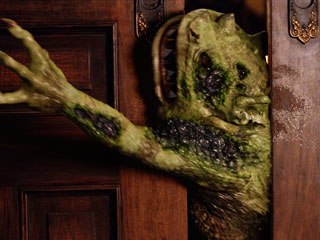
Another innovation called Riot Control further improved Tippett's pipeline. "In the wide shot of the goblins around the house, we came up with our own crowd system to handle that because there were 120 goblins in that scene. So, we developed our own tool that we call Riot Control. That was a tricky shot because in the beginning there was supposed to be several shots that ended up only being one. It was one of those situations where you look at it and think that maybe this is a case where we want to use a system like Massive. But there were too many characters to do it by hand and also too few to invest in what it takes to bring a system like Massive up to speed. So, that was one where we decided to go our own route because it fell in that middle ground."
The new system allowed them to make use of particle maps and vary the cycles in order to build the shot. "Those goblins, their actions are actually defined by particles, and then the animators have created cycles where the goblins can run in or they can move to a walk cycle or they can move to aggressive standing movements or whatever. So we had things that we could just build up and create this interesting shot. We could also combine all those different animation cycles with different looks because we didn't want all the goblins to look the same. So, we have a bunch of different painted textures and different sizes for the goblins so they could all appear as individuals, not too different but also not too similar."
Riot Control not only allowed animators to build a middle ground shot between a small group and a massive one, it also helped them to manage the way the goblins behaved and looked. "It also allowed us to choose the cycle and to choose what kind of goblin we wanted like a green goblin here with a weapon and a brown goblin there without a weapon," Darling notes. "That was the one shot where (Riot Control) was used. Everywhere else we had a crew of animators that were really talented. Todd talked about this where we had two animators working on it, and they split things up, and they did a really good job. The actual animation crew, I believe, was 30, which was the largest amount of animators that Tippett has ever had on just one show. But on any particular shot, just one animator could handle it, but the sheer number of goblins (attacking the house) required that the shot be split up."
There were some 15 shots where Tippett and ILM had to share characters. Darling details some of the challenges involved in their collaboration with ILM. "We had to make sure that everything looked correct so that we had our way to manage color and they had their way to manage color. But, when we exchanged the images, we put them back into the original mutual color space.
"There's this scene where their character picks ours up by his head. So what we did was we were able to cache out our animation so that we could give them what amounted to an empty shell of a character that didn't have any of our rigging or anything so we could block out our animation that way. So, it was totally not at all dependent on anybody's proprietary pipeline. In the end, one studio would do the final composite dependent on which one character was favored more than the other that would be the final person to finish it."
In all, Tippett Studio did a little more than 300 shots with a team of 100 artists. It took about 18 months to complete their work. They modeled in Maya and Mudbox then used a 3D paint package and used Photoshop, mostly with Maya and RenderMan. Then they used Shake to do all their compositing.
Now let's move across the Bay Bridge to San Francisco's Presidio where ILM is housed. There, award-winning Visual Effects Supervisor Tim Alexander, whose credits include the last two Harry Potter films, guided the development, animation and integration of the film's heavy, Mulgarath, the ogre, Thimbletack and his mean-tempered alter ego, the Boggart. Alexander's team also created a variety of fantastical supporting characters, such as Byron, the majestic Griffin, a rapacious Raven, the Snake, Sylphs and a host of magical and elaborately detailed Sprites. Alexander also oversaw the effects artistry involved in creating the seamless interaction between lead twin characters Jared and Simon Grace.
All in all, ILM created some 370 shots for a total screen time of 30 minutes. "We had 215 artists working for 15 months to create the shots, and out of the 357, about 230 were 3D shots," according to Alexander. "There were over 203 character animation shots, but then there were also all of the Sylph shots that weren't necessarily animated but simulated. On top of that, there were also all the digital matte paintings and so on."
Other work included creating digital environments for many scenes and all the doubling shots for Freddie Highmore, who played twin brothers, Jared and Simon Grace. All animation was done in Autodesk's Maya, which was then imported into ILM's in-house Zeno, where the team did lighting and simulation work. "All of our cloth sims were done there," Alexander adds, "and we also have our Fez system that lives both in Maya and Zeno, so an animator can choose which package he wants to use." All compositing was done in Apple Shake. "We do have an in-house package as well, but we're mainly a Shake house."
Along with Visual Effects Art Director Christian Alzmann, Animation Supervisor Tim Harrington was a key member of Alexander's team and provided insight into the driving inspiration that earmarked ILM's work on the production. "We've had some films that have a large variety of creatures, but the cool thing about the creatures in Spiderwick or the most challenging thing, I think, was just trying to make them look like they're grounded in reality and a part of nature," Harrington says. "One of the common themes we thought about when we were doing all the research for the project was that each creature had to be based on some kind of creature that we know in nature so they didn't come across as funny, goofy animated characters in a live-action film. We wanted them to be a part of this Spiderwick world that the filmmakers were creating."
The team spent a great deal of time studying animal behavior for each character. "For instance, for Thimbletack," Harrington notes, "we looked at lemurs and small mammals, and for Mulgarath, we researched gorillas and boars and big, ugly hairy creatures."
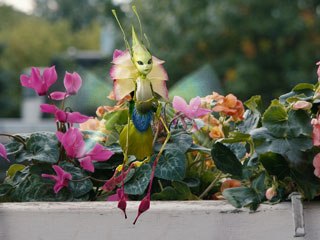
Another challenge that Harrington cites was the fact that there have been so many fantasy films recently, like the Potter and Narnia franchises for example, that these same type of creatures had appeared in other movies. "We wanted to bring a new spin to them. Traditionally fairies and sprites are just little humans with insect wings. So, with the flower sprites, for instance, we came up with this idea of creating a little fairy that's actually made out of flower petals to do something different. The challenge with that was, okay, that looks different, it looks cool, but how do we make this thing fly because it doesn't really have any wings? So, again we looked at nature, and we found some underwater creatures that kind of propelled themselves like jellyfish. Maybe you could have a similar movement like that to propel itself through the air, and then you use its big flower petals as kind of a glider and just glide through the air instead of flying."
Another area where the team thought they could push the boundaries of the R&D department was facial animation. "We've done facial animation before, and we had a pretty good system," says Harrington. "But we thought this would be a great opportunity to push the R&D department to come up with some new tools for creating facial animation. For instance, Thimbletack, we knew he was going to have to go through a wide range of expressions, and in some shots he would go from happy to angry to confused all within the span of two or three shots because he's kind of a manic character. So, the R&D department created this next-generation animation system called the Fez." It's basically replacing our old Cari facial animation system."

To go along with the Fez, ILM's R&D department came up with two new facial interfaces. "One of them is called Facedon," reports Harrington. "One of the problems that we always run into when we're creating creatures for these films is that you have a crew of 25 animators, so it's really hard to keep the performance consistent because each animator and each artist has their own span and their own style. Sometimes it's really challenging to keep the character on-model. When you watched the first season of The Simpsons, there's something about the drawings; they're not quite there. They're a little off. It's because they're off model."
The idea behind the Facedon interface was to bring back the concept of the model sheet that was used in traditional animation as a reference for all the animators. The sheet would contain various drawings that would illustrate how the character looked in different angles or different expressions. "The animators could reference that and keep everything consistent," Harrington explains. "So, the concept behind this Facedon module was to have something similar to a model sheet except make it more interactive. The idea is that you have a library of preset expressions for a character like Thimbletack created by the animation supervisor and approved by the client or director. So, you have happy, angry, enraged, sad, and the animators can use this tool to bring up all these facial expressions and quickly block in the facial animation for the shot. They can pop in one expression, or they can mix and match different facial expressions. So, they can use the eyes from one expression and the mouth from another expression to create a new one."
What Harrington likes most about Facedon is the consistency that it brings to the facial performance. "It gives the animators the same starting place and the same foundation to keep the character on model, but it doesn't lock them in a box.
"Face Select is another interface designed to go along with the Fez system. "Once you have your animation blocked in, you would use this next tool, Face Select, for fine tuning the performance," explains Harrington. "Before, we just had a bunch of sliders that had a bunch of different names. The animators had to learn what the names meant and what each control did to the face. So, with Face Select we came up with the concept of actually creating an interface for facial controls based on human anatomy. Imagine a Gray's Anatomy illustration of a human face with all the facial muscles. The interface has a little graphic of a human face that's got all the muscles. Say, you want to pull the mouth up, you would actually click on that muscle in the interface, which is Zigomatic Major, and it would bring up the control for that muscle so that you could pull the corner of the mouth up or down."
Harrington also points out that the Face Select interface is quite intuitive to use. "Traditionally, we used to spend a lot of time technically trying to debug shots and learn what the controls did, and the animators spent probably half of their time dealing with technical issues. Most animators are pretty familiar with human anatomy because they went to art school, so now they have an interface that makes sense. It was something that they could just jump right in. Within an hour, they would be up and running animating the face. Now they've got 80 to 90% of their time doing their creative work as opposed to spending half of their time dealing with technical issues."
Another ILM innovation, Rapid Prototyping, was utilized not only to build low-resolution CG models of the characters for study, but also to apply some basic movement, sometimes putting a staffer in a motion capture suit to begin assigning some early moves. As Alexander explains, "The director can actually see the character moving and can begin making decisions about physical proportions and movement early on."
The animators could then make use of the reference video shot during the recording sessions by the actors, in order to include as much of their characterizations in the creatures' personalities as possible. "That kind of thing is extremely helpful," Alexander adds. "We can add in twitches and other body language that we saw when he was making the recording, and we can put all that expression into the character. The Martin Short reference was extremely helpful for Thimbletack's lip synch, for example."

Harrington details the important intermediate role that Rapid Prototyping in creating a character rig. "With Rapid Prototyping, once the characters are designed, we scan the flat art, and then the art department would take these images and scan them into the computer, and they would really quickly mock up a 3D model. It didn't have a lot of detail. It was just enough to flesh out the proportions and the scale of the creature. From there, we use some proprietary software that we have called Block Party. We can run this model (the rapid prototype) through Block Party and within an hour, it creates a rig that the animators can use. If it's a humanoid, you can also map on the human anatomy. We have bones and muscles in the Block Party system that can be remapped onto these creatures based on their proportions. From there we can start mocking up some animation."
He cites Mulgarath, the ogre, as an example of how Rapid Prototyping can quickly fine-tune a character's design. "We did a lot of Rapid Prototyping animation with Mulgarath. One of the concerns when designing that creature was his legs were too short. When you design it in 2D, the image could look fine, but it's not until you get it in the computer and you get it moving around that you know whether it's going to be an issue or not. Doing this Rapid Prototyping, when we got some animation going, we could see how (Mulgarath) was moving. It became an interactive thing with the director where we could get him involved. What do you think? Should his arms be longer? Should his legs be longer? How do you want him to walk? To be more human? To be more gorilla? It's something that you can turn around really quickly and make those modifications and show him what you've done and get more feedback. The big win with that is that you're making all these design choices before you create the final model and before you get into shot production."
Harrington believes Rapid Prototyping is the key to preventing costly redesigns. "I've been on a few films where it looks great in 2D. Then you design it and model it and do a turntable, and nobody is really looking at how this thing walks. Nobody is doing any walk cycles. Nobody is studying if these proportions are going to have a negative effect on how it moves. So, you're actually in shot production when you realize his knees are too high, and it makes him look like he's walking on stilts. The good thing about Rapid Prototyping the model is that you can hit those big design decision head on right in the beginning before you get into shot production and waste any money having to redesign the creature."
Like the animators at Tippett Studio, Harrington says that, in the beginning, they often referred to DiTerlizzi's images. Then things changed. Then everything was up to how director Waters responded to their designs. "He was in the driver's seat," Harrington notes. "For instance, the original Mulgarath design in the book is a lot different. It's more, I don't want to say friendly, but it's not as scary as what we went with. When we got a hold of the design, we were like this is a great opportunity to scare the shit out of kids with this feature. We want this to be a ride for them. We don't want this monster to be just a Muppet that they're not really scared of. So, I think we went crazy and just cranked up the scariness of that guy. When we showed it to Mark, we thought maybe that's a little too scary, maybe that's a little too R-rated. We don't know if Mark's going to go for it. But he went for it. Nick Nolte's the voice, and it just fit. That creature's design and Nick Nolte's voice just came together."
Harrington enjoyed the archetypal aspect of Mulgarath's character. "Mulgarath was one of those creatures that was really fun to do. As far as figuring out his character, he was probably the easiest to figure out because his character was such a one note. He just wanted that book, and he just had to get that book. His motivation was clear. He just had to be a scary monster. He was one of the creatures that we tackled in the beginning. He came together really quickly, and everybody was really happy with him."
Thimbletack, on the other hand, was more of a challenge. "He was a little more manic," Harrington points out. "He was kind of an English butler type of character, and Eric Idle was going to be the voice, but they couldn't get him. So, Martin Short became the voice, and they did a few rewrites, and during the rewrites because he had been in the house for a number of years by himself protecting the book, his character became a little more manic, a little more crazy. So, the challenge with Thimbletack was that he had to go through this wide range of different emotions within one sequence sometimes. He got to explode into anger, and then being scared and then being sad, all within three or four shots. In both animation and acting that was probably the most challenging in that area."

Another major challenge was Thimbletack's transformation into the Boggart. "Transformations traditionally in computer graphics are always extremely difficult," states Harrington. "This was no exception, but we came up with a pretty cool solution as far as rigging. We modeled Thimbletack first. Then we used that same topology to reverse model it into the Boggart so that they had a one-to-one match as far as their topology goes, so you could blend between them. Then we actually created a rig that you could animate the scale of the bones on. If you needed to go from Thimbletack's skeleton to the Boggart's skeleton, you had a slider that controlled each limb, the body, the chest and the head. They were all separate controls so you could actually stagger different body parts to get a more organic, chaotic feel when he was exploding into the Boggart."
Harrington says that they actually decided to downplay the transformations. "A lot of times when people do these transformations in movies, it becomes this big hero movement where the music swells, and maybe the camera stops and starts circling around. We wanted to do the opposite. We didn't want to stage it so that it was this big effect that everybody had to marvel over. We wanted to downplay and make it part of Thimbletack's performance. So we made his performance dominate the shot. When he's freaking out and delivering a line, we wanted to get the performance right. Then on top of that, he just happens to be transforming. Blisters are popping out, and he's trying to keep them back. His arm explodes into the Boggart (arm), and finally he just explodes into the Boggart."
In addition, Harrington explains that the animators approached the transformations with two different philosophies. "When he goes from Thimbletack to the Boggart, we wanted it to be a painful, explosive quick thing because it's motivated by anger. Then when he transforms from the Boggart back to the Thimbletack to be more soothing and calming. It's motivated by being soothed by the honey, which is the only thing that can calm down a Boggart and turn him back into a brownie."
In the Thimbletack transformation rig, the animators could blend between Thimbletack and the Boggart in the shot, and actually be able animate a creature that is half-and-half and be able to pose him. "A lot of time when you do those types of shots, the scales change and the pivots change," Harrington points out, "and his hand might move away from the wrist. So, it gets really difficult to pose him when he's in the in between stage. With this rig his wrist stayed where it needed to. Everything was locked down. The pivots didn't change. Just the proportions changed."
For Alexander, the biggest challenges were creating the sequences with the Sylphs and the Griffin. "The Sylphs had a look that was very hard to define," he says. "We had shots with five of them in it, and shots with thousands, and trying to get a pack of a thousand dots to look like anything proved to be very tough."
Alzmann notes, "They look essentially like dandelion seeds that you might come across drifting on the wind, but with tiny faces on them."
To deal with this, the team used various scale models. "For close-ups, we had a full-rez model so we could see their face, and then each hair was modeled and put on the model and sim'ed," Alexander reports. "Then we'd go down from there all the way to the point where we were just projecting a 2D texture onto the particles, depending on what scale they were to camera. But even the middle rez Sylph had the ability to be either simulated or hand-animated. And on top of that, we simulated the hairs on their head as well."
The Griffin was modeled as a half-bird, half-lion creature. "So there's that underlying geometry," Alexander continues. "Then we have these two, very stubby wings, and then we placed individual feathers, all modeled, for his wings. So there are layers and layers of feathers that were modeled and then hand-placed, and those get simulated and they collide with each other, so that the feathers don't penetrate each other. Then the rest of the body feathers and the feathers on its head were procedurally generated by putting hair splines on the Griffin, and then adding feathers to the splines."
As for the actual flight sequence with the Griffin, Harrington explains how they solved that challenge. "We knew we were going to have to shoot the actors on a rig. So we spent a lot of time with the director prevising that sequence just to work out all the shots so we knew which shots were going to be live-action kids on a rig and which were going to be digital double kids. Once we had the previs all locked down, we took the animation from the previs Griffin and pumped that into the motion rig that was on the bluescreen set, which the kids sat on. So, the kids could actually react to the movement of the Griffin in the previs. For example, when the Griffin banks to the right, the rig would tilt to the right, and the kids could lean with it. The other tricky part about the Griffin sequence was that Freddie Highmore played both twins (Jared and Simon Grace). So, we had to treat two passes when we were shooting the kids on the rig. The first pass was Freddie playing Jared with Mallory. Then we had to do another pass with Freddie playing Simon. Once we had those elements, we brought those into the computer. Then we could pull in our real Griffin animation model and put him on top of that and start refining the animation so that it looked like they were actually riding on his back."

The Griffin ride provides both the fun and excitement of a roller coaster ride. Harrington explains: "Conceptually, the sequence is really cool. In one of the original versions of the film (script) there wasn't really a light moment for the kids where they're having fun. The cool thing about the Griffin sequence was that the beginning of it starts out really fun. They're enjoying themselves. They're riding up into the sky, and it's all beautiful. Then we came up with the idea of it being like a roller coaster ride. It's exciting and you're adrenaline is pumping as you're going up to the top of that thing. Then, once the roller coaster goes over the edge and starts screaming down the other side, that's really scary. That's the concept behind the Griffin ride. It's going to get more and more chaotic and scary and dangerous as the sequence progresses."
Sounds a lot like the overall journey of The Spiderwick Chronicles.
J. Paul Peszko is a freelance writer and screenwriter living in Los Angeles. He writes various features and reviews, as well as short fiction. He has a feature comedy in development and has just completed his second novel. When he isn't writing, he teaches communications courses.