VFX Supervisor David Ebner pulls some digital strings on The Kite Runner and Bruce Shutan discovers how.

Visual Effects Supervisor David Ebner had been eager to work with acclaimed director Marc Forster ever since he saw Finding Neverland, which he considers "movie magic." That day arrived when he signed on for The Kite Runner (which opened Dec. 14 from Paramount Vantage).
It also helped that Ebner found the 2003 bestselling novel upon which it was adapted to be "a gripping story" that begins with an innocent kite-flying contest in Afghanistan before years of brutal occupation by the Russians and Taliban dictatorship.
Universal themes of family ties, childhood friendship and forgiveness resonated so deeply with readers from around the world that the novel sold more than eight million copies in more than 34 countries. Author Khaled Hosseini, a physician born in Afghanistan who, like the lead character, managed to escape his war-torn country for America as a boy and didn't return for decades.
Building a Digital Set
Ebner, co-founder of CafeFX, oversaw 125 shots that blended footage from Western China and the San Francisco Bay Area with deft CG touches. "Where we shot [in China] there were no surrounding mountains and the architecture was very flat, while in Afghanistan everything is on hills," he says. "So we did a lot of digital matte painting work and set extensions. Anytime there was anything modern in a shot, we replaced it with things that were 30 or 40 years old."
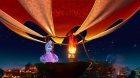
His team's biggest challenge was building about 40 square miles of digital set for aerial shots of numerous kites flying over Kabul. That meant paying close attention to detail on the geometry and texturing of the mountainous terrain, buildings, cars and street scenes.
A variety of 3D applications were deployed, as opposed to just using Maya, which came in handy for close ups but couldn't handle enormous resolutions, or LightWave, whose focus was on background elements. Special software from German-based db&w called infiniMap Pro that could hold large resolution texture maps was used to generate a hybrid of highly detailed 3D models featuring matte painting projections and instancing.

"It accesses only what you need out of the file when it's rendered, but it also works from the JPEG 2000 format so that when it blasts an image all over your render farm, it hardly has any overhead and very little memory overhead," he says, noting that it was primarily used for landscapes. "You can have lots of models with these textures on it."
Without infiniMap Pro, the vfx team would have had to do a lot more passes and patch things together in the composite. The tool enabled them to efficiently render the camera's entire field of view all in one pass at reasonable speeds. They'd render shadows and ambient inclusions, as well as different walls or building with red-green-blue coloration mattes that might be changed in the comp without the need to log several hours of frame rendering to make those changes.
A Skeptical Director
Given Forster's skeptical view of matte painting work based on mixed results from his previous films, it wasn't easy to win him over on the background-replacement issue. Ebner recalls how once the director had a chance to view the first matte painting, it raised his comfort level. But perhaps even more importantly, he thought the CG kites were believable not only in their look and feel but also the way they moved.
Ebner and his team worked quite a bit with DP Roberto Schaefer and did greenscreen shooting with the second unit that included separate elements of children flying kites and spectators that were composited in, though some principle plates were shot with the first unit. They also closely collaborated with the digital intermediate facility at Laser Pacific during post-production to color correct all the fully digital shots and see how they'd get shifted into the final color.
High Drama
The conditions in China included filthy streets, less-than-ideal hotel accommodations and exotic cuisine that triggered occasional outbreaks of diarrhea, but other than that, Ebner confirms, "it felt like an adventure."
Meanwhile, the film's release date was delayed to ensure the safe evacuation from Kabul of two child actors "in response to fears that they could be attacked for their enactment of a culturally inflammatory rape scene," according to an account in The New York Times. U.S. government officials later arranged a safe haven for the boys and their relatives in the face of what the report described as "simmering enmities between the politically dominant Pashtun and the long-oppressed Hazara."
High drama broke out on the set during a key sequence shot in an empty arena about two and a half hours from Kashgar, China in an oil-rich region known for political unrest. Just as preparations began on the first shot, which was prevised and digitally populated with footage of about 1,000 costumed extras that would be filled out in any wide shots, Chinese police who feared a rally was about to take place and didn't understand that a movie was being made shut down the shooting that particular day.
"We had to quickly improvise," Ebner recalls. Plan B involved three digital cameras with huge memory cards synchronized on a triggering device that would fire off three pictures in a in a huge courtyard at the wardrobe facility where extras were later bused. "We ended up lining them all up, one by one, to use them for our digital crowd and it took almost all the day."
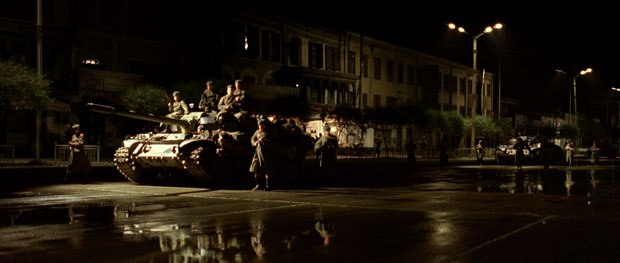
A little ingenuity on American soil went a long way to create a seamless look on some Chinese shots. A Russian tank was procured from someone in the San Francisco Bay Area for a shot that required about 10 tanks. The crew received permission from a naval air station in Alameda, California, where some Matrix sequences were done, to use an old runway whose concrete was busted up and shoot the sole tank at night from different configurations with the troops so that it didn't looked cloned.
Streetlights were installed and the shots were measured out at the same incremental distances as those done in China. In the absence of a brightly lit greenscreen, the tank footage was heavily Rotoed out. A tripod-mounted camera shot a lock off looking in one direction and panned over to shoot another lock off. Soldiers walking on the other side of the street were included in both plates that were stitched together as a 3D comp to build a digital pan over at any speed that would be needed when the tank was placed in the shot.
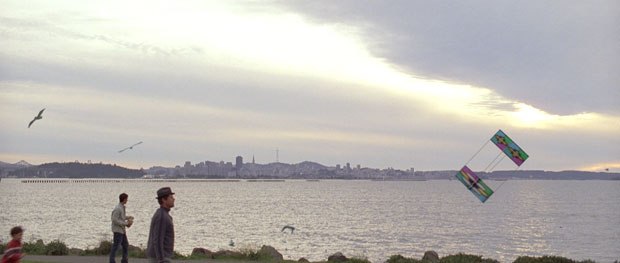
Digital seagulls and 3D kites were added to some noteworthy shots from Cesar Chavez Marina Park on the Berkeley, California, side of the bay where a remote-control helicopter with a digital still camera captured a bird's-eye view of the terrain from various angles to lay the groundwork for a digital recreation of the water and matte painted landscapes projected in a 3D environment with models and people.
The same approach was used in China where certain areas were canvassed with a 16 mega-pixel still camera to assemble a group of similar-style buildings. "The detail was outstanding," Ebner concludes. "We ended up getting tons of digital still pictures and used it as a blueprint for some models and textures, which helped us build the 40 square miles of digital Kabul."
Bruce Shutan, a Los Angeles-based freelance writer, has written for several entertainment publications and Websites, including Daily Variety, Weekly Variety, emmy, the 55th Annual Emmy Awards program, Below the Line News and Film Score Monthly.