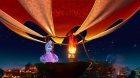
Andrew Osmond chronicles the making of U.K.-based BreakThru Films and Poland-based Se-Ma-For studios dark, stop-motion version of Peter and the Wolf.

Readers familiar with Peter and the Wolf, either through the original Sergei Prokofiev score or one of the numerous animated versions, will know, early on, a likeable character meets a distressing fate. In several cartoon versions, the plot point is softened or reversed (can we say Disneyfied?). Indeed, its even softened in the Prokofiev original.
Its not softened here.
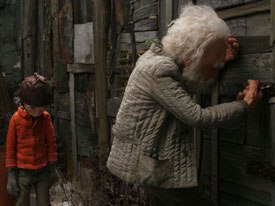
The new stop-motion version of the story, co-produced by BreakThru Films in London and the Se-Ma-For studio in Poland, takes the saga of a brave Russian boy and his fight with a fearsome beast seriously. Its not too dark, being aimed at families, but it can get emotionally intense, judging by the rough cut AWN saw. This Peter is striking, not cute, his childs face hinting at yearnings frustrated in his sometimes-bleak day-to-day life. The boy yearns to escape into the wood outside his home an enormous, wondrous set that may be unprecedented in the stop-motion medium. In the wood is freedom and adventure, and terrible danger in the snarling wolf, which challenges the boy to become a man.
The film was five years in the making, involving more than a hundred British and Polish animators, craftsmen, sculptors and artists. Its directed by Britains Suzie Templeton, whos made a considerable name for herself on the back of two exceptional stop-motion student shorts: Dog, a dark story of family bereavement, and Stanley, a black comedy about a henpecked husband whose love of gardening takes a scandalous turn. The finished Peter and the Wolf had its world premiere on Sept. 23, marking the 70th anniversary of the musics debut in Moscow. The live accompaniment, provided by the Philharmonic orchestra, was conducted by musical director Mark Stephenson who originated the project.
Following the live performance in London, and a similar event in Poland, the film will be screened on British television by Channel 4 this Christmas. As of writing, the American rights are held by Columbia Artist Management, which is looking into the possibility of a premiere next year.
AWN spoke to the films two producers, Alan Dewhurst and Hugh Welchman, who together formed BreakThru Films in 2002. Welchmans live-action shorts Crowstone and The Most Beautiful Man in the World won an array of international prizes. He also received a prestigious Shakespeare Scholarship from American Beauty director Sam Mendes. Dewhurst cut his teeth at Richard Williams animation studio (truly an inspiration) before co-founding Passion Pictures, one of the most prominent U.K. animation outfits. On Peter and the Wolf, Welchman was involved with finance and development, while Dewhurst was involved in the hands-on production. The pair took us through the films history.

Andrew Osmond: Tell us how the film originated.
Hugh Welchman: I was approached by the conductor Mark Stephenson, who asked if I was interested in doing a collaboration between film and music. We kicked around some ideas, and he told me the Peter and the Wolf anniversary was coming up, so how about that? I hadnt actually heard the music for about 20 years (I listened to it a lot as a kid) and I fell back in love with it. I watched the earlier animated versions and while I thought many had admirable qualities, they kind of missed the opportunity to do a proper film version.
AO: What do you think were the failings of the earlier versions?
HW: Their treatment of the story was too slight to fit the music. They were aimed at very young children, whereas we wanted something that would appeal to seven-to-11s, but also fascinate adults. The main people who have Peter close to their hearts are between 30 and 80 and we knew they would be the driving force for bringing children to see it.
Alan Dewhurst: Our starting point was that this is a very powerful story; a boy confronts a dangerous, lethal wolf. Some versions are very comic and avuncular, but we really didnt think thats what was in the story.
HW: We were anxious to keep live music as an element, because the whole point of Peter was to introduce children to orchestral music. So from the beginning it was conceived as something we could show on the big screen, to be accompanied by a live orchestra. One problem was the narration which Prokofiev wrote to go with the music was three minutes long, and the music itself is 30 minutes long. Nobody had really grappled with that difference in scope. (The Disney version of Peter in Make Mine Music is 20 minutes long, with different narration and the music re-orchestrated by Prokofiev himself.)
AD: When we stripped out Prokofievs narration (the film has no narration or dialogue), we had a tremendous musical drama, an extraordinary range of emotional tone and color. Its a very pure cinematic experience.
AO: Tell us the story of the film in this version. Peter seems to be quite an intense character
AD: He very much goes on a journey. Hes on the edge of puberty, so his yearning to go out into the world is just striking him. He lives with his loving but anxious grandfather, who wont let him go out into the forest as he longs to. Theyre kind of marginal figures, living on the edge of the forest. Theyre poor, their clothes are ragged. When Peter goes into town, the other kids are in more modern Western dress and two bully him. (We transfer the hunters from the original version into these bullies.)
So Peters life isnt particularly happy. But he has a deep relationship with animals, and hes inspired when he encounters a bird, an over-excitable, comic character with an undying enthusiasm. Its enthusiasm and confidence touches something in Peter and prompts him to defy his grandfather and go out. Theres a long passage where Peter, the bird and Peters pet duck play in the forest and we see Peter enjoying himself, perhaps as hes never done before. Then the wolf appears and does something terrible. Peter is prompted in a rage to go and get the wolf.

AO: How scary is the wolf?
HW: The music combines very light and humorous passages with moments of austere darkness. We wanted to ensure the wolf wasnt cuddly and would be terrifying at the right moments. Im hoping the wolf will be suitably scary in the tradition of fairy tales.
AO: Why did you choose Suzie Templeton as director?
HW: I saw her stop-motion graduation film Dog, which I thought was extraordinary. She had an incredible ability to manipulate the feelings of audiences and move them, and we needed that kind of magic around the storytelling.
AD: Suzies got a rare ability to reach a very wide audience while dealing with properly serious subject matter. She has characters and a form of narrative that people find easy to go with, though its sometimes quite difficult material. Shes got that way of carrying an audience with her. Even with Dog, her darkest film, everybody who saw it was captivated; they may not all have liked it, but its riveting.
Her work has a kind of poeticised naturalism, with a great emphasis on textures, characters recognisable from the real world, caricatured just a bit to take it into animation. The storytelling owes at least as much to live-action as to animation. Theres a lot of pure filmmaking, including lengthy and still takes so the characters are very present. Its as if theyre breathing in front of you, like human actors.

AO: How hard was it to develop the film?
HW: The main thing was to crack the story, to ensure we wrote it so it fitted exactly with Prokofievs music. For example, when the flutes there, youve got to write in whats happening with the bird, without changing the basic story.
AD: The script process took about 18 months. I got involved at the point when it was clear the script couldnt be progressed much further as a text, we needed to make it visual. We started by doing a bit of drawn storyboarding, but soon realised that wouldnt cut it. Because the films set to music, it has to be very fluid, very lyrical and we wanted to stress the dramatic ideas coming of age, stepping out into the world. We wanted big impressive sets and storyboarding them in drawings wouldnt work.
We decided to do it in computer and did a CG previz of the whole film. This stretched over a long time, with many revisions another year or so on the animatic. We didnt do much character design until relatively late, partly because we knew that would be very elaborate. But we had initial sketches, and some of the initial interest in the project came from a key image of Peter and the wolf, which Suzie painted herself. It was quite abstract, with Peter and the wolfs faces coming out of blackness, looking directly at the viewer. We were trying to capture both the fragility and the powerful potential in Peter, and the threat and the dark unknown of the wolf. Suzie linked the two characters, by painting them both with the same eyes.
That image was an extraordinarily successful one, and attracted many people early on. Until we started sculpting the characters, we didnt really beat that image.

AO: Why did you build such a huge forest set?
HW: We wanted to have a real sense of the forest. One of the things I like about Suzies style is that its hyper-real, it draws you in. We built a 70-foot forest set with 1,700 trees, because we wanted the awe and wonder when you go into a forest as a kid.
AD: We also wanted the breadth and fluidity in storytelling that you naturally have in live-action just by moving the camera around. Stopframe often appears rather theatrical, youre aware of the boundaries of the set. Thats why we chose Jane Morton (Peter and the Wolfs production designer, who worked with director Lynne Ramsay on the live-action films Ratcatcher and Morvern Caller) to design the set. Morton worked with her Polish counterpart, production designer Marek Skrobecki.
AO: Where was the setting based on?
HW: Modern Russia. We had an enormous number of photos and art references, and Suzy went to Russia for two weeks, visiting forests and small towns. She also spent two weeks filming and studying wolves at a sanctuary. At the same time, we researched fairytales and wolves place in them. We were looking at lots of 19th century wolf etchings.
AO: Tell us about the U.K.-Polish co-production.
HW: When we were looking for studios, we considered places in England, Wales, Russia, Norway, Hungary and the Czech Republic. The Se-Ma-For studio sent us a short film and the quality of animation and puppets blew us away. Se-Ma-For have made 1,400 films, most of them stopframe; it won an Oscar in 1983 for Tango. It was the state-run studio under the communist regime, and since that collapsed, this remarkable talent base has remained.
All Peter and the Wolf s pre-production work was done in the U.K., including the initial puppet and set designs. Then the team moved to live in Poland last September. The sets and the puppets were created at Se-Ma-For by a mixed U.K. and Polish team.
AD: The work done in Poland is just astonishing. I think that the audience will really respond to that; its so beautiful to look at.
Andrew Osmond is a freelance writer specializing in fantasy media and animation.