Bill Desowitz explores Wetas innovative work in building a CG Kong along with the dinos and other scary creatures on Skull Island. Includes QuickTime clips!
This is the first of two installments in VFXWorlds Creatures and Environments of King Kong.
If you have the QuickTime plug-in, you can view production clips by simply clicking the image.
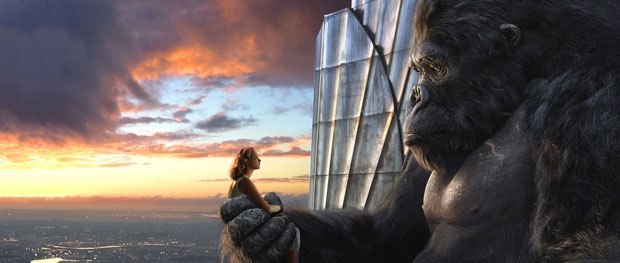
Peter Jacksons love affair with King Kong has lead to his creation of this years biggest blockbuster event. All images © 2005 Universal Studios.
When Peter Jackson finally fulfilled his boyhood fantasy of remaking King Kong (Universal Pictures, opening Dec. 14), there was never any question that Kong and the other creatures that inhabit Skull Island would be CGI. Kong, of course, was key. The scary thing about making the movie was the close-ups of Kong, Jackson admits. Would it work out OK?
Indeed, Jackson was crucially interested in the emotional connection between the 25-foot, 8,000-pound gorilla and actress Ann Darrow (Naomi Watts). The director wanted Kong to form an attachment and feel empathy for another living being for the first time. The greatest lesson Jackson learned from The Lord of the Rings trilogy was that the best fantastical stories are rooted in real world trappings, so he applied the same philosophy to King Kong, beginning with his new take on the legendary gorilla. Modeled after Snowflake, the albino gorilla from Spain, Kong evolved into a lonely, middle-aged, warrior. His brow is cracked, his jaw broken, he has a drooping eyelid and a snaggletooth and his powerful body is scar ridden.
Kong is stronger than I thought he would be, Jackson adds. Hes more realistic. He is a gorilla, not a monster you want Kong to be sympathetic [and brutish, which is part of the conflicting nature of the story]. Jackson was so pleased with Kong, in fact, that he made the unprecedented move of elevating Christian Rivers and Eric Leighton to animation directors.
Once again, as with Gollum, the director turned to actor Andy Serkis to provide the MoCap performance. Not only did the actor do extensive research but looked to Quasimodo from The Hunchback of Notre Dame for inspiration, because his role was much more demanding and technically complex.
We needed to make sure we delivered the expressions that Peter imagined Kong to make, asserts Richard Taylor, the head of Weta Workshop who specializes in special makeup, creatures and miniatures. We went through quite an interesting period utilizing frame-grabber software that you would use for stop-motion animation. And we proceeded to sculpt 18 expression studies for Kong. Each face was about 16 tall. We used the frame-grabber to check that the musculature was consistent with the bone structure underneath the skin, because its so easy to cheat beyond the facial points and turn it into a Looney Tune as you stretch the muscles. These were keyframe animation poses from a hoot to a scream to a snarl. Peter gave us a list of all the expressions he wanted to see the face in.
In terms of the body, the creature enters the digital world through scanning [courtesy of XYZ RGB]. We wanted to install all of Andys essence into the design as well. You want to make sure that the musculature and facial expressions are complementary of the direction that the creature is going in. So at no point do we consider the design process as a blueprint. Its an ever amorphic, ever evolving process. The performance capture is unique in that we arent capturing Andys facial movements but his emotional states. Each point is designed to capture an expression that hes pulling. You can then transfer these emotional states to the gorilla [which has the same expressions as a human].

To achieve this breakthrough, Wetas facial capture builds on the program called Facial Animation Coding System (FACS) developed by Paul Ekman at the University of California at San Francisco. The basic idea is that human muscles can only work in groups that form expressions, explains senior visual effects supervisor Joe Letteri. You can reverse engineer that by reading the patterns on someones face and figuring out what muscles activate it, pull everything into this pattern by starting with a neutral pose and going from there. Then you can infer what expressions are being made from those groups. But whereas with Gollum we sculpted all the group of expressions by hand, with Kong they were able to codify it by building an underlying muscle system to drive the facial performance instead of having to sculpt it all. And then by using the MoCap techniques on Andy, they were able to figure out what those facial expressions must have been.
What worked well for that was we were able to figure out a system that could be driven not only by motion capture but also by keyframe animation. So we could go back and forth between the two. But you always got Kong out of the deal. You could keep him on model easily, with room to vary. What was interesting was that we were able to learn what the eyes were doing from the motion capture. You couldnt track the eyes directly, but it was the same logic because once you figured out what the muscles in the face were doing, you could infer what the eyes were doing from the muscles around them. So we got that from our early tests with motion capture.
In reality, only about 25% of Kong was performed through facial motion capture, with 125 markers on Serkis face. The vast majority was keyframed because of the physical demands of the performance, with Kong running, jumping, climbing and battling dinosaurs. Even the motion capture work was run through the animators to make sure it was true to character because you dont want the machine making all the choices for you, Letteri adds.
Although the Weta Digital team relied again on Maya (along with RenderMan and Shake) for animating Kong and other creatures, the particular demands of creating five million hairs on the gorilla required new hair and fur simulation with processing power comparable to the U.S. militarys, according to Taylor (4,500 processors and 150 terabytes of disk space). Letteri emphasizes that this was necessary for gritty realistic close-ups as well as intense collisions with other characters.


To handle such complex characters and environments (totaling nearly 2,600 vfx shots compared to Return of the Kings 2,000), Weta concentrated, whenever possible, on generating data during render time. This freed up technical directors, in particular, to concentrate on lighting by manipulating low-res models. We relied more on rendering to some degree, Letteri continues. Its funny: you go in stages because early on you cant rely on low-res stuff. You have to know what it looks like and what youre getting, so you run it through high-res. Once you get comfortable with that, you can start pushing low-res models because you know what that will get you coming out the other end.
At the outset, Letteri shared supervisory duties with Ben Snow (Van Helsing, Star Wars: Episode II Attack of the Clones), who handled Skull Island and New York scenes. Then in August of this year, they recruited two additional supervisors: George Murphy (The Matrix Revolutions and Reloaded and Oscar winner for Forrest Gump) and Scott E. Anderson (Hollow Man and Oscar winner for Babe) to assist in managing the massive amount of shots to be delivered.
They deployed a divide and conquer strategy, with Anderson concentrating on the New York Rampage sequence and Murphy jumping into several Skull Island sequences. Delegating many of the sequences between Ben, Scott and myself freed Joe to focus on the overall consistency of the show and, as the keeper of Kong, to really hone in on key Kong moments. In working with Joe, I found that I had a great deal of autonomy on my sequences and in how I approached the work with the crews to pull these shots together.
One of the most challenging aspects of CG Kong was how sensitive the material shaders were to lighting and shadow. Too far one way or the other and Kong would look gray or bald or puffy. There were clearly lighting set-ups that featured Kong more dramatically than others, and a host of parameters that affected the look, texture and feel of Kong. Like every actor, he favored a certain kind of lighting and angle to the camera, but unique to CG, a whole team of Weta artists were constantly refining the look and behavior of Kongs fur and skin from shot to shot, based on what each of us supervisors sought to portray. Rendering Kong was a learned thing that took time to get right.

One of Murphys favorite sequences, Anns Sacrifice, in which the natives of Skull Island capture Darrow and offer her to Kong, offers the first glimpse of Kong. At this point in the story we dont know Kong and I felt that it was important to keep him feeling dangerous, Murphy continues. Peter didnt want us to get too good of a look at Kong yet he was saving that for later but we had shots that would reveal a large portion of the ape. I worked with the tds to keep the lighting mysterious, yet try to get a good feel for the physical presence of the beast. We used the settings smoky pretext to selectively reveal and hide Kong in the compositing and to give Kong physical interaction with the alter environment.
Meanwhile, one of the most challenging sequences was Kongs Capture on the island. Again, lighting Kong was key. We were trying to preserve this sense of pre-dawn that was the time frame for this scene, which meant pursuing a day-for-night look that entailed low shadow detail and slightly overexposed highlights. With Kong, it was always a tightrope act to find that balance between suggested shadows and no shadows. Once we had dialed in the optimal CG lighting, I opted to have the tds render Kongs key and fill lights in separate passes so that we could fine-tune them in the composite. In this way, we could selectively suppress or enhance portions of each lighting pass as needed, without resorting to new and costly fur renders. For the interaction of grappling hooks and the net with Kong, we experimented with special deformation of the 3D hair geometry, but found that this tended to affect too large a region. It proved most effective to do 2D displacements of Kongs fur in the composite based on the positions of the rope. Roto mattes were used to make the ropes and net look like it partially buried itself in the fur.
Lighting Kong to enhance his performance was important to Anderson, too. One of our first scenes was the Kong and Ann reunion after the Rampage. I really approached that scene as a classic 30s [moment], with low light and very selective eye lighting on Kong. Basically, I treated it as a romantic reunion. The approach was based on some small but important details that Peter and [cinematographer] Andrew Lesnie had given me about the aesthetic for the film modern in technology but strongly classic in look it really became the foundation for my approach on many levels. The other key motivation was simply Kong: his expressive range really drove much of my thinking overall, while showing his size and scale drove many other considerations.

As for the other CG creatures that inhabit Skull Island (which number more than a dozen out of a total of 50 made for the movie), think Ray Harryhausen and you have an idea of the look they were after. The dinosaurs, in particular, are a reptilian Harryhausen throwback: big scales on their backs and spiky bits, and the crocodile kind of skin texture thats cool looking but not scientifically accurate. Taylor says there was no reason to try and replicate the smooth looking creatures from the Jurassic Park movies.
The dinosaurs range from the gruesome t-rex family trio that combats Kong in the major set piece, to the stampeding brontosaurus to the ceratops (which were cut from the movie but who knows? may emerge on the DVD). Plus, theres a whole new species called the wetasaur thats a cross between a carnosaur and pit bull terrier. In addition, the hothouse of Skull Island has evolved a diverse assortment of raptors, flying lizards, rat monkeys, flesh eating bugs and giant spiders, many of which converge on the Venture crew during Jacksons suspenseful version of the infamous Spider Pit sequence.
The dinosaurs and other CG characters were more straightforward than Kong, Letteri admits. We used skin, muscles and skeletal systems, as we did on Rings. We added sub-surface scattering to the skin, another carry over from Rings [because of the environments], which you didnt need on Jurassic Park. We also did some high dynamic range imaging for some of the creatures like the raptors and brontos.
This is in direct contrast, of course, to the special attention paid to Kong. We had to grow Kong to make him work, Letteri confides. We built him almost as an adolescent and disabused him of a lot of bad notions. We stripped him down from being buffed up aged him and put in all the characteristics on his face.
Bill Desowitz is editor of VFXWorld.
| Attachment | Size |
|---|---|
| 2748-kingkongmocap1.mov | 529.73 KB |
| 2748-kingkongmocap2.mov | 318.04 KB |
| 2748-kingkongjungle.mov | 967.46 KB |

Bill Desowitz, former editor of VFXWorld, is currently the Crafts Editor of IndieWire.