
Henry Turner talks with King Arthur's visual effects wizards to conjure up the truth about the vfx behind the newest cinematic rendition of the legendary myth.


In the great John Ford classic The Man Who Shot Liberty Valance, it is said that when a historian has a choice between recording the truth or a legend, he should print the legend. But in the case where a legend has been done and redone to the point of utter familiarity, sometimes its good to go back to the source and discover what actual events inspired the mythmaking. Such is the idea behind Touchstones new King Arthur. In an interview several years ago, producer Jerry Bruckheimer said that hed wished hed made Gladiator; now, in King Arthur, he makes his wish a reality with a film that is comparable in many ways to the Ridley Scott epic. And yet, despite its basis in actual history, this King Arthur manages by the time of its finale to create a legend of its own the origin of the British nation under its first king and queen.
VFX Plus Intermediary Equals Reality
From an effects perspective, the most readily apparent challenge was to match the daringly realistic photography with equally realistic effects. Shot in a grainy style that gives an appropriately rugged look to the earthy, battle-scarred terrain, King Arthur is a classic instance of a film in which the often clean and linear designs of CG would stand out like a sore thumb. So an effort was made to combine the vfx work with the digital intermediary, all the time in service to director Antoine Fuquas vision. Hence the naturalistic photography is partially a CG creation. The entire movie has been graded using an intermediate process, says Matt Johnson, vfx supervisor of Cinesite, the sole vfx vendor on King Arthur. Cinematographer Slavomir Isziak envisaged color themes for each sequence; these have been enhanced using the digital grading process.
Anyone who has seen Fuquas Training Day knows that this King Arthur would be more of a nitty-gritty ride than a pageant of 50s era epic pomp. Antoine Fuqua was intimately involved with the visual style of the movie, Johnson says. His approval was sought when establishing the look of the CG environments. He had very specific views about rock texture, snow, color and atmospheric effects that were applied to the scene. It was this involvement that lends the film its visual unity, Johnson maintains. The visual effects on King Arthur were a wholly collaborative process with both the director and the editorial team involved throughout.

A More Real Epic Style
In order to step away from any prior envisioning of the Arthur story, both the production design and the visual effects departments studied extensive historical sources in order to impart as convincing a sense of reality as possible to the production. This attention to realism is as evident in the CG landscapes as it is in the costumes or any of the practical effects. Johnson says, In keeping with the realistic look of King Arthur, wherever possible, textures were based upon photographic source material then retouched by the matte painting team during integration into the scenes.
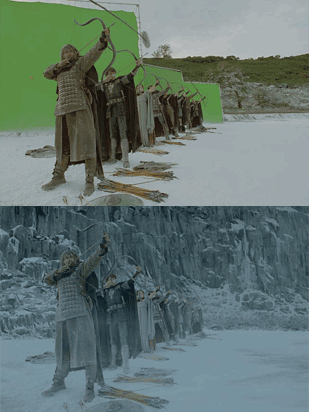
The dramatic atmosphere was added to by snowstorms that give the landscape a profoundly desolate mood. Procedural textures were used to create the internal structure of ice; this was used extensively throughout the frozen lake sequence. Actual snow at certain locations was often replaced to create a balanced feel. Jerry Bruckheimers particular request was for Cinesite to replace the practical snow texture on the ground with an icier, CG surface.

Walking on Thin Ice
King Arthur takes place in the height of the Dark Ages, about a thousand years prior to the usual time-period of the story. Artorious, (Clive Owen) a Roman commander stationed in the British Isles, leads a band of knights conscripted from Sarmatia, a country below Russia. On the desolate isle they fight mainly against the Woads, a guerilla-fighting forest people led by Merlin, their mystic elder. The Woads are those people written about by Julius Caesar among others savage tribes who paint themselves blue before going into combat, so as to terrify their enemies.
After fifteen years of service to the Empire, Arthur and his knights are ready to go back to Rome in retirement. But they are given one last mission from a visiting Roman Consul they are ordered to advance into the northern wastes of Britain to rescue a young Roman living there at a distant outpost. So, despite the threats of the omnipresent Woads and an invading Saxon army, Arthur and his knights venture forth. It is during his fights against the Saxons and in his growing romance with the Woad princess Guinevere (Keira Knightly) that Arthurs allegiance shifts from Rome to forging a British nation with his new allies, the Woads.
One of the highlights of the film is a battle pitting Arthur and his five principal knights against a vastly larger Saxon force. The fight takes place on a frozen lake, recalling the classic battle on the ice in Sergei Eisensteins Alexander Nevsky. Cinesite was especially attentive to detail in the creation of the ice battle. Previsualisation was used extensively for the sequence, Johnson says. Crude animatics were generated from the directors storyboards and given to editorial so they could approximate the timing of the sequence before it was filmed. Oddly enough, the scene was shot at a location that hadnt a single snowflake on the ground, but was rather a sprawling meadow! Hence the frozen lake sequence required 3D environments and texturing. This scene required the replacement of everything from the canyon walls to the floor the actors were standing on. We turned a green Irish field into a rocky ice-covered gorge.
One particular example where practical sets and CG backgrounds were integrated is a sequence that takes place as Arthur and his band of Sarmatian Knights arrive at the Roman Consuls Estate. A practical gateway was constructed on location, with a greenscreen behind the open door that leads into the villa. All the estate buildings, pathways and poplar trees were generated in the computer and composited into the scene.
A Virtual Climax
Johnson is as much a fan of past cinema as the films of the present. I am a big fan of the work of David Lean and other makers of classic Hollywood epics. Their work was always in the back of my mind while working on the panoramic visual effects shots. I guess the main difference between what we do now and what they did in the fifties and sixties is that we have a resource available to us of a digital cast of thousands. They needed to costume and feed every actor in their epic crowd scenes.
This new capacity to digitally create casts of thousands is shown to its best effect in the climactic battle of Arthur and the Woads against the entire Saxon Army. It is a testament to the quality of the effects and homogenizing effect of the digital intermediary that in the final battle there is not a single scene that looks artificial. Cinesite wrote its own proprietary crowd simulation/artificial intelligence system called REACT, Johnson points out. We found using our own proprietary software allowed better integration of the tools within the workflow of the facility.
Motion capture was used for animation cycles. For the CG Saxon army basic walk, run and fighting, clips were recorded and integrated into REACT.
Finishing Touches
Johnson rounds out describing his work by mentioning subtle effects that should not be overlooked simply because they blend seamlessly. A CG hawk was created for the film, but was animated traditionally by our 3D team. A variety of techniques were used for the weapons. Several shots of Excalibur use an extended CG blade, and other scenes use CG arrows, both flaming and unlit. At other times throughout the movie swords, axes, crossbow bolts etc. have been animated and combined with the background footage. In one scene a digital scar was tracked onto the principal actors face. This effect was achieved by tracking and 3D warping 2D artwork using Inferno.
Henry Turner is a writer and award-winning filmmaker, whose Lovecraft-inspired horror feature, Wilbur Whateley, won top awards at the Chicago International Film Festival. His writing on film has appeared in the Los Angeles Times, Lecran Fantastique, Variety and many other publications. A longtime film festival executive, he has programmed for the Slamdance Film Festival, and currently heads FilmTraffick L.A.