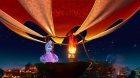
Alain Bielik uncovers how Inkheart brings The Wizard of Oz and other books to life with crafty CG.

Inkheart (now playing from Warner Bros.) is the latest film adaptation of a best-selling children fantasy novel. After Disney showed the way with The Chronicles of Narnia: The Lion, the Witch and the Wardrobe in 2005, other studios quickly followed with Bridge to Terabithia, The Seeker: Dark is Rising, The Golden Compass and The Spiderwick Chronicles. Inkheart tells the story of Mo Folchart (Brendan Fraser) and his 12-year-old daughter, Meggie (Eliza Hope Bennett). Both share a passion for books, and a miraculous gift for bringing characters from books to life by reading aloud. But this power is not harmless, as when a character is brought to life from a book, a person from the real world disappears into its pages.
Given the nature of the story, vfx played a key role in the production of the movie, a mission that was overseen by Visual Effects Supervisor Angus Bickerton and VFX Producer Crystal Dowd. "We started with about 260 shots," Bickerton recalls. "It went all the way up to 689, and then down to 594 shots in the final cut. We had approximately five months of post-production. Director Iain Softley is very aware of visual effects and was always keen to seek a real practical alternative, or if vfx were inevitable, that they be as real as possible. He has a keen critical eye and pushed for photographic realism. Although we finished with a lot of visual effects, the aim was always to create a believable world and not stray into a realm that was too fantastical. We didn't want the film to have an unreal visual effects veneer."
Six different vendors contributed to the project, along with an in-house production unit:
- Double Negative (259 shots): End Shadow sequence, Flying Monkeys, Body-to-ashes demise.
- Cinesite London (123 shots): All fire scenes, Dustfinger fire juggling and fire breathing, Rooftop sequence, Establishing shots of Capricorn's town (Capricorn is the story's villain).
- Peerless Camera Co. (55 shots): Twister sequence.
- Rainmaker UK -- later CIS London, which is now closed down -- (43 shots): Inkworld scenes, End scenes, Elinor's House.
- The Senate Visual Effects (9 shots): Minotaur enhancement.
- In-house department (105 shots): Fixes and matte shots.
- Mattes and Miniatures: miniatures of Capricorn's castle, Dorothy's farmhouse and collapsing building.

A Cloak of Smoke
Bickerton's primary concern was the creation of the Shadow, a huge billowing cloud monster. "I knew that this was the cutting-edge part of the effects list for the film, requiring custom simulation software and shaders. Double Negative, with the work that they did on World Trade Center, were my first choice for the Shadow. Iain's first point of reference for the creature was [Francisco de] Goya's painting of El Coloso, particularly the way the brooding Moor towers over the landscape of frightened people and animals. Paintings were always a source of inspiration for Iain."
Concept Artist Adam Brockbank developed Softley's Goya reference into a giant figure composed of volcanic, pyroclastic clouds. The shadow had to be a vital demon shrouded in veils of clouds of smoke. In addition, Softley wanted the demon to be visible only occasionally as he pushed the boundaries of his cloak of ash. Once the smoke look was established, Brockbank visualized the underlying demon figure. From this, Kate Hill sculpted an 18" clay maquette, which was scanned for Double Negative.
Bickerton recalls that the director never wanted to see this figure, but needed this underlying model from which to emit the smoke simulations. "To drive the animation, actor Marnix Van Den Broeke was employed to give movement reference, and we spent two days shooting a crude animatic with Marnix blocking out the Shadow's choreography. During principal photography, Marnix stomped around on a pair of apple picker leg extensions wielding a 6-foot-long stick acting as an eyeline and performance reference on the set. After shooting, we worked with the first assembly of the sequence and reshot Marnix on DV against bluescreen roughly matching camera positions as a small crew recorded him from three other angles for animation reference. Our in-house compositors Jack Hughes and Duncan Kinnaird then rough composited the DV footage into the Avid cut to help editing. Marnix's performance was then used as a guide by the DNeg animation team led by Thomas Ward."
The Double Negative team also included Visual Effects Supervisors Ryan Cook and Paul Riddle, VFX Producer Fay McConkey, CG Supervisor Gavin Graham, 2D Leads Victor Wade (environments) and Jonathan Bowen (Shadow).
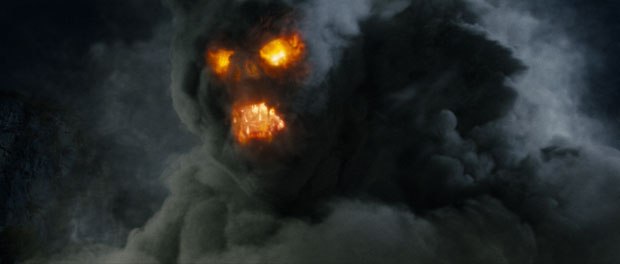
New proprietary software, dnSquirt, was written to help create the billowing, swirling smoke that makes up the character's form. "Until Inkheart, we were using Maya's fluid simulation engine, which is excellent for large plumes and natural-based effects," Cook explains. "But looking at the concept work, we knew that we needed to have more control over the process. Also, we wanted to introduce things like target-based fluids, to attract density. We hired Marcus Nordenstam to head up the effort, and brought in Robert Bridson, a professor of computer science at UBC in Canada, as a consultant.
"dnSquirt has now become our primary fluid dynamics simulation tool and has been used to do water simulations, and the fire snake on the upcoming Harry Potter movie [the Half-Blood Prince]," Cook continues. "One of the most helpful advancements in terms of the Shadow was that it uses levelsets or signed distance functions. It allowed us to use our CG model to animate, and to convert him into an actual volume that could be rendered. The same levelset could then be used to emit secondary smoke that was then simulated to give him a natural pyroclastic feel. Similarly, the movements of the character were translated into forces that were used in the simulation to push the smoke around as he moved. With DNB, our voxel renderer that was initially developed for Batman Begins, Jeff Clifford extended it to allow us to output everything as secondary outputs, so lights could be put into groups and output separately -- fill, keylight, firelight from his eyes and mouth and flood spotlights from the set. We also output the core creature and the world smoke separately to allow us more flexibility in compositing and to bring forward features for key performance moments."
The trickiest aspect of the sequence was maintaining the performance of the character and expression, which would dramatically change once the smoke was simulated. The early concept art used pyroclastic textures to form his face and jaw structure, which gave him a very defined character. Once this was animated as pyroclastic texture, however, it was often lost. "We ended up doing some extremely high-resolution simulations, and using these as textures over our actual creature that displaced the surfaces," Cook explains. "These in turn were converted to levelsets that were both used in the final render, and also used to emit smoke back into a world space simulation of the smoke. The animators used tricks like the level of fire in the eyes, and we would try to emit less smoke at key points of performance to maintain the expression of the creature. Tom Ward and his team did a brilliant job of animating the shadow, and building on the performance done by Marnix to give him proper scale and integrate him into the action."
Of Unicorns and Flying Monkeys
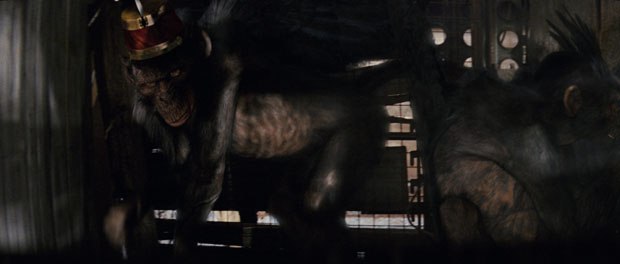
Though less imposing, other magical creatures appear throughout the movie, including a Unicorn, a Minotaur and Flying Monkeys. For the Unicorn, a CG horn was tracked and composited on a real horse by Double Negative. The Minotaur was a creature suit built by Neill Gorton's Millenium FX. In order to enhance its presence in the shots, The Senate rotoscoped the character and enlarged it by 30% before compositing it back into the shots again. Additional enhancements included steam and breath elements, and gloopy trails of saliva.
For the Flying Monkeys, however, a full CG approach had to be employed. Their design was triggered by the original illustrations in L. Frank Baum's Wizard of Oz novel, and then altered to indicate that they had been incorrectly read out of their books. This meant that they variously had mangy fur, inappropriate feathers or partial alopecia. Brockbank created concept illustrations from which Kate Hill sculpted a maquette that was cyberscanned by PCA for Double Negative.
The facility started tackling the characters while its brand new fur system, initially designed for 10,000 BC, was still in development. "The two movies were actually in production at the same time," Cook recalls. "We used the feather system for the tertiary feathers on the monkey's back and upper parts of the wings, but the flight feathers were actually individually modeled and rigged by our rigging department [Robert Helms, in particular] to allow more control over them. We needed to do feathers like raven feathers that have an oily iridescent feel. It was achieved via a custom RenderMan shader to simulate the iridescence, as well as a 2D treatment to enhance the effect by shifting the colors using a viewing direction secondary output from RenderMan."
Double Negative was also in charge of the demise of a key character who turns into ashes. The effect was mostly realized in Houdini by lead artist Louis Dunlevy. The idea was originally that the character would turn into the burning pages of a book, which required the team to develop a burning, onion-skinning effect as the paper turned into embers and peeled away. Double Negative created the effect via a complex transition between the real actor and a full digital double as the character crumbles away. Later on, partly because the director felt the effect was a bit too gruesome for a young audience, the effect became more of a marble statue. "We did lots of tearing and curling cloth, somebody tracking in Maya and Houdini using auto-rig tools, and the Morph tool in Houdini to clean it up afterwards," Cook adds. "We also developed a number of tools to shatter the geometry. Finally, we did an ink blotting transition effect -- as the words of the book were meant to start to appear across his skin -- using feedback compositing in Houdini to drive the transition between different looks." Double Negative composited all the shots using Shake.
Creating and Destroying Inkworld
Parallel to the creature effects, Bickerton supervised the digital environments effort to create Inkworld. "Although this world was deliberately only glimpsed, it was important that it be rich and fascinating. Building these little vignettes in the style of photographer Gregory Crewdson occupied Rainmaker UK [VFX Supervisor Adam Gascoyne] for almost the entire post-production period. Crewdson shoots beautifully exposed and stage-managed vignettes on huge 10x8 negatives. These images have a rich color and texture, and capture a strong sense of ennui or an enigmatic moment. They are rich in carefully plotted detail. We tried to achieve the same look for Inkworld."
In order to capture the appropriate scenery, principal photography partly took place in Italy, in a region that had inspired author Cornelia Funke when imagining the villain's hideaway and Inkworld. The vfx team shot an aggregate 360 degree background plate on VistaVision, combining vantage points from six different locations around a mountain town, and also captured a number of establishing background plates. Capricorn's castle was built in miniature by Leigh Took's Mattes and Miniatures at Bray Studios. At 1/10 scale, it stood 12 feet tall by 18 feet wide and was shot outside the studios with open skyline, in both natural daylight and at night. Sections were pre-built to collapse.

Those environments served as background in one of the movie's most complex sequence, when Mo reads The Wizard of Oz aloud, and brings the famed twister out of the book's pages. "After the Shadow sequence, the Twister sequence was my next big concern," Bickerton says. "The team at Peerless Camera was impressive with its early enthusiasm," Bickerton remembers. "Visual Effects Supervisor Paul Docherty jumped into solving those issues. To create the wind effects on location, Paul Corbould's physical effects team used wind machines, and rigged various practical damages. Peerless added flying debris and atmosphere in post. For the shots of the roof tiles smashing into the cylindrical hanging tower, Peerless built a CG structure, using location photographs and some set LIDAR for reference. The FABBRO building collapse was created using a miniature, but the Jeep lift-off and crash to the ground was realized by shooting plates in the town and then, in the car park at Shepperton Studios.
"Paul Corbould's team used a crane to lift and drop the vehicle against a huge bluescreen. Peerless then composited it into the real town with additional sweetening debris. They also created a CG Jeep for two shots of the vehicle airborne, and animated the black jackets as they were swept away. [Technical Supervisor] Patrick Ledda and [Head of CG] Ditch Doy led the mini-team at Peerless that created the twister itself, using Houdini's tools."
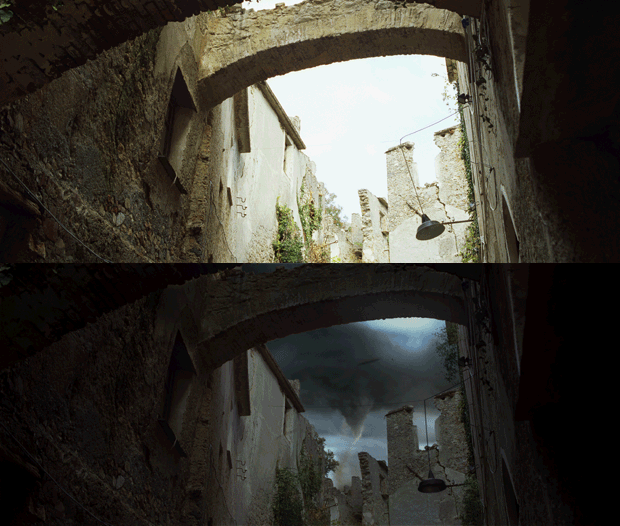
The team at Peerless also included VFX Producers Marianne Speight and Diane Kingston and Digital Effects Coordinators Nick Bedford and Ed Hall. 3D rendering was done using mental ray, while the shots were composited using Shake and Inferno.
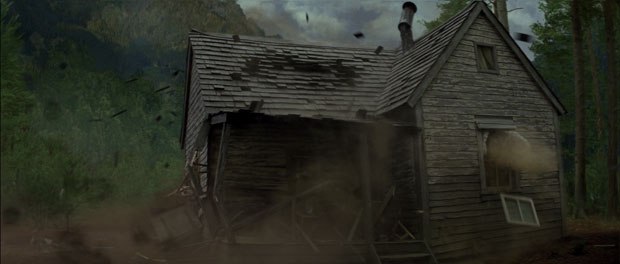
Peerless Camera also handled the shot in which Dorothy's Kansas house (of The Wizard of Oz fame) crash-lands right in the middle of a road. The house was built by mattes and miniatures at 1/3 scale. A foreground section of road and earth was then built with hidden foam underlay and kicker plates to throw up debris on impact. Scale porch furniture -- chairs, brooms, pans -- dressed the house and simple bladders compressed on impact to blow out curtains and windows. In post, Peerless composited the house into a location plate captured in England. The environment was then replaced with matte painting derived from VistaVision plates and digital stills to place the road in the Italian location.
A few digital matte paintings were also created by Cinesite, but the facility mainly focused on fire effects. That included fire juggling scenes and the climactic sequence in which two characters set about destroying Capricorn's castle by setting it on fire. The actors were filmed miming the effect of fire-blowing to given cues upon which portions of the set were ignited. In order to provide realistic interactions and to facilitate tracking, they wore ignited fire-retardant gloves with special LED tracking markers on.
"Cinesite did an excellent job of painstaking work, matching flame elements to Paul Bettany's mimed fire performance," Bickerton observes. "We spent two days shooting a variety of different fire elements on black stage with real fire jugglers and Paul Courbould's team. Then, Effects Editor Kevin Ahern and I spent the best part of a week selecting flame sections -- sometimes up to eight or nine pieces for a short cut, flopping, flipping or reversing or multiple combinations -- to match Paul Bettany's movements. VFX Supervisor Zave Jackson and his team then had the unenviable task of blending all those element together to look like a single flowing action." Additional glows, smoke and heat haze effects were also added, as well as set extensions.
Old Fashioned Film
For Bickerton, the whole production turned out to be extremely enjoyable. "I always felt that we were making a slightly older fashioned film -- one in which the magic was in the story and not in the effects. To that end, we strove to serve the film rather than be the effects 'on top'. Even at the finale, when we had our most overt and fantastic effects in the shape of the Shadow and the Flying Monkeys, we pushed for a realistic motion and recognizable physical traits. I think the story resonates more when you are not lifted out of it by huge animated effects. I know that there is a devout coterie of fans of the book. We wanted to capture the essence of the book. I hope that we did."
Alain Bielik is the founder and editor of renowned effects magazine S.F.X, published in France since 1991. He also contributes to various French publications, both print and online, and occasionally to Cinefex. In 2004, he organized a major special effects exhibition at the Musée International de la Miniature in Lyon, France.