
After the recent release of Blueberry, French effects artists deliver yet another visually arresting movie. Alain Bielik uncovers the magic behind Enki Bilals Immortel, a fascinating blend of live-action and CGI.

If America loves its comic books, Europe cherishes its graphic novels. From Tintin to Asterix to Blake and Mortimer, these large sized, hard cover albums have been to European fans what comics are to Americans with one major difference: in France, Belgium and other countries, graphic novels are considered a true art form. In fact, influential writers and artists such as Jean "Moebius" Giraud, Edgar P. Jacobs, René Goscinny or Hergé enjoy a fame that goes far beyond the realm of their discipline. Among those is Enki Bilal, a Serbian-born artist whose work in graphic novels and film is considered to be one of the most innovative.
When producer Charles Gassot approached him in 2001 with the idea of adapting La Foire aux Immortels, his most famous graphic novel, for the big screen, Bilal doubted it could be done. His graphic style is indeed unique, rich in bizarre characters and hardly suited for a traditional feature film. However, when Gassot mentioned computer animation, Bilal was hooked: he knew that CGI would allow him to faithfully translate his vision into filmed images.
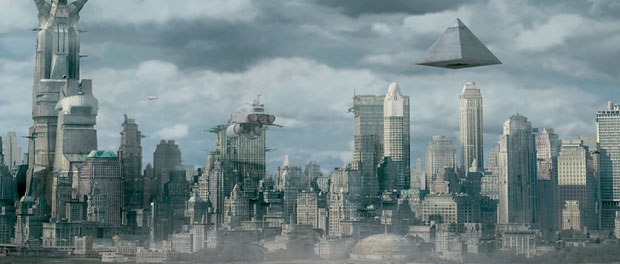
Set in the year 2095, Immortel tells the tale of an ancient Egyptian god, Horus, who has been sentenced to death by his peers. His last wish is to see once again planet Earth, a world he helped to create. He arrives in Manhattan in a giant pyramid-shaped vessel that floats majestically above the city. But Horus has a hidden agenda. He must find a very unique girl who has the power unbeknownst to her to make him immortal. He has seven days to do so
84 Minutes of Visual Effects
Bilal and Gassot introduced their project to Pascal Herold, co-founder and chairman of Duran Animation Studio, a subsidiary of Duran/Duboi, a major player in visual effects in France (Alien: Resurrection, Asterix and Obelix). Duran had a complete pipeline set up for computer animation: Maya for modeling and animation, LightWave for rendering and proprietary Dutruc for compositing and 2D work. Herold confirmed that the project could be done and that it could be done on budget.
Yet, nothing of this scale had ever been attempted in Europe, even more so in France. "Immortel is, without wanting to sound pretentious, the biggest special effects movie ever made in Europe," proudly boasts visual effects supervisor Jacquemin Piel of the 84-minute feature. "There are 390 shots of full CG animation, 500 shots combining live action and CG animation, plus 280 composite shots." The sheer quantity of visual effects shots was daunting in itself, but the nature of the project made it far more complicated than a "regular" effects movie requiring the same amount of shots. It had to be a Bilal movie. It had to reproduce in moving images these fantastic worlds that the director had been creating on paper for years. "It was a real artistic challenge for us," says Piel. "On a strictly technical level, the main difficulties were combining real actors with CG characters and creating completely computer-generated sequences."
Designing the Future à la Bilal
Production started in the summer of 2001 with a long period of design and storyboarding. Bilal made it clear that the CGI had to be "Bilal-real" and not photoreal. It was his world that was to be created on film, not the real world. Duran's art department started to gather reference material on architecture, decoration and vehicles. "The design of the film is quite contemporary," observes Piel. "Enki wanted the look of this universe to be based on the past. He felt that it would be more realistic than an out-of-this-world sci-fi environment. For example, he had this idea that Manhattan would look pretty much the same as today, except for some new buildings and for the fact that the whole street level had been raised by 50 stories! In 2095, people walk into buildings at what used to be the 50th floor in our time. In the end, the city in Immortel has the same street plan as Manhattan, but it's ultimately a Bilal city."

Working from the reference material, illustrators created detailed drawings that reproduced real New York buildings. This artwork was then converted into CG models that were only half textured. "Once we had a model of each building, we printed it out and passed it on to Enki," explains Piel. "This process gave him the opportunity to paint directly on the printouts, adding futuristic or unusual elements to the buildings. When we got them back, the structures were no longer recognizable."
Meanwhile, another team led by Stephane Levallois focused on the design of the creatures. The movie was to feature three categories of characters: the Gods, human-like creatures with an animal head; the mutants, aliens or humans with varying degrees of malformation due to genetic experiments; and the "normal" humans. The former two were eventually generated by computer animation. Some of the mutants could have been portrayed by actors wearing prosthetic make-up, but Bilal thought that CG characters would better blend in with the graphic style of the movie.
Once the concepts were approved, Duran turned them into detailed model sheets scale drawings that presented each character, building and vehicle, from every angle. The data was then turned over to Duran's modeling department where Jerome Desvignes supervised the creation of the characters, while Christine Gatto and Frederic Palacio coordinated the effort on the environments.

Paving the Way for Previs
Jacquemin Piel and his crew then started to develop a 3D storyboard with new software that was specifically written for this project. "Immortel was the first movie ever to be completely previsualized in 3D," Piel contends. "Back in 2001, it had never been done on a whole film. This previs allowed us to prepare principal photography in a very precise way. Camera moves were programmed, lenses were selected, angles were chosen, and sets were designed and directly output into construction blueprints. By the time we got on the set, everything had been thoroughly rehearsed and prepared on the computer. The only element for which we allowed a certain amount of freedom was the movement of the actors on the set. Otherwise, the previs was strictly respected. As a result, I'm proud to say that we completed principal photography only one hour behind schedule. You have to understand that we had a very tight budget, an even tighter shooting schedule and no motion control or field recorder. Thanks to the previs, we were able to complete live-action photography on time and on budget."
The previs was also a precious tool for Bilal, who wanted to cut the whole movie before one frame was shot. In fact, the film cut was constantly updated during the course of the production. "Each shot was cut in maybe 100 times," notes Piel. "As soon as we had an update of a shot, we delivered it to Enki and he cut it in to replace the older version. From one shot to the next, we could have a simple previs, actors on a greenscreen, actors with a CG background that would be textured but not yet animated, characters animated but not yet textured, final comps, etc."
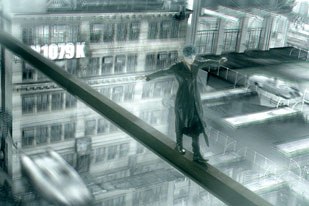
When it came time to shoot the live action portions of the movie, only four sets were actually built: the bedroom of the main character, the bathroom, a bar and a section of a subway station. The rest of the movie was shot on a stage entirely covered with green material. In some instances, the filmmakers elected to build a floor section on which the actors could play the scene, the rest of the set being added digitally. "It turned out that these real portions of set were no help," comments Piel. "Looking back, it would have been much easier to do it all on greenscreen. It would have saved us the hassle of matching the virtual set to the real set. The textures in the digital environments derived from still photographs or were created from scratch in Photoshop or Paint."
Motion Capturing the Gods
In term of environments, some sequences turned out to be real challenges with long shots revealing the whole cityscape. Individual CG buildings were exported from the architectural database and integrated on a shot-per-shot basis into a virtual street plan of the actual Manhattan. Both high resolution and low-resolution versions were available for this. Depending on how far the structure would be from camera, one version or the other would be selected. Matte paintings helped complete the virtual environments.
For character animation, Piel opted to combine two techniques. Motion capture was used for body language; while keyframe animation was preferred for facial expressions, lip sync and clothes simulation. "We could have done it all manually, but motion capture did help us a lot in the animation," says Piel. "As for Horus, we often shot the live-action plates with an actor, dressed up in green, playing the part of the God. He wore a headpiece that represented the falcon head of the character. It allowed the other actors to focus their eyes at the right height, Horus being very tall. The actor was then painted out of the shot and replaced with the CG Horus. We didn't use this technique all the time. In several instances, we opted to shoot the other actors alone. For example, there is one scene in which a human named Nikopol delivers a series of strong but harmless blows into Horus' belly. To achieve this effect, the actor playing the part of Nikopol actually hit a heavy punching bag. We then lined up Horus with the bag to create the illusion that he was being punched."

When rendering the CG characters, photorealism was not the ultimate goal. The characters had to look like they belonged to this stylized world. Ultra realistic characters à la Gollum would have been out of place in Immortel. "We didn't have the time, nor the budget to do a Gollum anyway," admits Piel. "For example, we couldn't afford to use sub-surface scattering. When people praise Gollum's photorealism, they forget to take into account that a whole team worked on this one character for several years. The same is true for The Matrix Revolutions. I learned recently that, for the famed "superpunch" shot, they actually had one supervisor and a team of 14 CG artists working on it for no less than 14 months! Don't [get me] wrong: we were absolutely impressed by the work that was done on those movies, but one has to put it in perspective. The whole budget for Immortel was about $20 million and we still managed to create more than 1,400 digital effects shots although the final cut only features 1,160 of them. There is certainly no `How did they do that?' scene in the movie, but I feel that in terms of design, creativity and ambiance, our work surpasses most of what is being done in big-budget blockbusters. The most important for us was not to `wow' the viewers, but to bring to the wide screen the poetry and the evocative power of Enki's graphic world. And I think that we succeeded."
Alain Bielik is the founder and special effects editor of renowned effects magazine S.F.X, published in France since 1991. He also contributes to various French publications and occasionally to Cinefex.