FOX debuts Fringe tonight, so Tara Bennett goes behind-the-scenes with creator J.J. Abrams and Zoic VFX Supervisor Andrew Orloff.
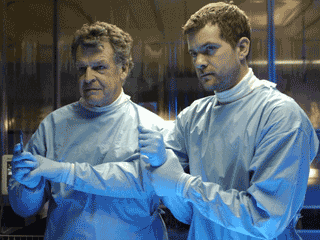
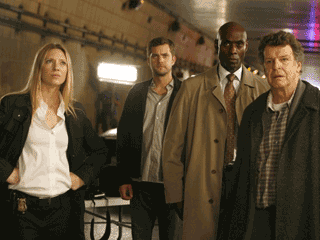
When creative wunderkind J.J. Abrams (Alias, Lost) brings a new pilot to television, audiences now expect big-screen quality in their living rooms. Luckily, Abrams doesn't disappoint, as he's always breaking new ground, especially when it comes to the integration of visual effects in his TV projects (despite lesser budgets and tighter production turnaround). Abrams' latest series, Fringe, premiering tonight on FOX, 8/7c, created with Alex Kurtzman and Roberto Orci, concerns an FBI agent (Anna Torv) investigating bizarre scientific "patterns" with a mad-scientist (John Noble) and his more stable but equally brilliant son (Joshua Jackson) in tow.
Already called a more outrageous X-Files for the new millennium, Abrams said in a conference call with VFXWorld last week that, "with Fringe, we very consciously did what is in many ways a preposterous, out there, far-fetched, story point in order to say to the audience this is what you are going to be getting on the show. Some [episodes] will deal with science very much as it exists, but, for the most part, the fun for me in TV shows and films is to push the envelope further than you might otherwise."
And it shows in Fringe's two-hour premiere (which cost upwards of $10 million), which could easily hang with its big boy cousins in the theaters considering the pilots impressive cinematography, production design and detailed, gory visual effects. Zoic Studios handled the bulk of the labor on the pilot and is now in charge of the vfx on the continuing episodes. Andrew Orloff is the visual effects supervisor for episodic at Zoic and considers Fringe one of his favorite projects this TV season.
Asked to come on board in 2007, Orloff explains, "We came to the show through Kevin Blank (Lost, Cloverfield), who was the visual effects supervisor on the production side. He came to us and we hadn't worked together before, but we quickly got a relationship together. We spoke mostly about what we called our 'invisi-John' shots, which was the character (Homeland Security Agent John Scott) who gets poisoned and slowly turns into a translucent/jellyfish version of himself. There was a lot of technical discussion right away about whether that should be prosthetics or CG. We did a lot of R&D in conjunction with the prosthetic company, who did X-Men and X2. They did some 3D tattoos, where they take the 3D model and print out some decals that they can put on the human body. It looks like you could see through the skin onto the muscle tissue. It worked well as a base and then we tracked a virtual person over it. We had a skin model scan of the actor that we tracked frame by frame on top of him doing his breathing and performance. Then we had a medically accurate human anatomy model by Zygote. It was the same model used by the prosthetic company to print out their tattoos. It's a super detailed data set of the human anatomy with all the different systems and organs and skeleton. We conformed that model to fit inside the actor's scan. We rendered out each element piece by piece so our lead compositor, Johnny Banta, was able to put it together. We have the heart beating and blood coursing through the veins. It was very labor intensive but we started out very early doing Photoshop comps based on reference photos from the makeup tests so we could send those to Kevin and J.J. to get a lot of the look development figured out."
Since the effect was integral to selling the concept of the show to viewers, Orloff says they all spent a lot of time getting it right. "It was a lot of back and forth about how much translucency," he explains. "As the disease took over his body he got more and more transparent so you could almost see through him to the other side. They flew me out to the set to supervise that sequence with Kevin. It was important to give it a real sense of volume and it was successful in that way. A big key to the success was that I took a lot of really detailed photo surveys. We have our own 360 camera rig and I took multiple exposures of 360 pano of every environment that the 'invisi-Johns' took place in, so what I had what a huge, high-dynamic range sphere that we were able to us as a reflection for all the lighting. The key to get the organs right were the highlights and moisture. We used the detailed photo survey as a basis for the reflections and lighting rigs. All the CG was rendered in LightWave and the compositing was done in After Effects. All in all, it was a great thing to work on because J.J.'s intention was to do something you haven't seen before. And it was a great creative process with us, Bad Robot, the director Alex Graves and Kevin."

Orloff says the success of that sequence added more Fringe work to their schedule. "Everybody liked it so the shot count grew," he offers. "We started out with a lot -- maybe 20 shots. Then it went down to 10 and then they saw it and brought it back to the original. Then we did a couple of other big sequences like the exterior plane stuff."
In the opening teaser of the pilot, a flight from Germany is shown in a lightning storm. Orloff details, "We have a long pedigree of working on shows like Serenity and BSG [Battlestar Galactica], so we used that talent base. We also had some innovative use of combining 3D renders from LightWave and 2D workspace in AfterEffects to get the volumetric clouds. It's an interesting combination of 3D and 2D using lighting. Everything was broken into passes so individual details and highlights can be dialed in element by element.
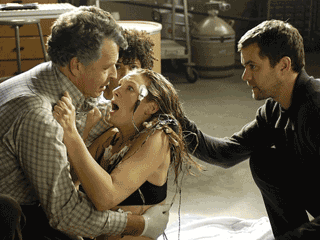
"The other big sequence was the 'jaw drop,'" Orloff continues. "In the teaser there is panic on this airliner where everybody's skin starts to disintegrate and most of that was done with makeup. They went to a big shot of the co-pilot in the cockpit and there's goop all over his face. It looked pretty scary but J.J. took one look at that shot and said, 'It doesn't look scary enough. You know what would be scary? If the guy's face disintegrates and his jaw fell off onto the floor.' So it was never really planned as a visual effects shot. We looked at the plate going, 'Um… OK,'" Orloff laughs.
He continues, "We used Maya and mental ray. First thing we had to do was get a scan of the actor's face. We had to match angle and camera and the soft deformations on his mouth. It all had to be tracked in 3D. We painted the textures of his jaw back on and did a 3D mouth interior. We then did detailed modeling and dynamics to make the jaw stretch and fall off. Also, once the jaw was gone you could see behind the mouth as to where the neck was so there was a lot of intricate tracking and rotoscoping. That shot had a high degree of difficulty. Kevin spent a lot of time at Zoic working with me and the artists on it which was really great. We would sit in dailies twice a week and then everyday. We also really got a good system with J.J., who is very computer savvy with Maya, so he was able to see the animatic stages and the timing without going into the texture and rendering of it."
Zoic is now the vendor on the episodic production of Fringe, with Orloff staying as the point supervisor on the series working with the new Production Supervisor Jay Worth. He says the transition was a natural evolution as "the pilot turned into episode one, there were a ton of changes from the other sequences we didn't do on the pilot. There was a lot of work, like the dream sequence, from other vendors that we re-opened up. There was a robotic arm we re-rendered and retouched. We also were able to bring some virtual set expertise into it with a Toronto for Iraq shot.
"We developed new techniques that we are continuing to use in the show, which is basically using 2D tracking data to refine our 3D performance tracking," Orloff continues. "The show has a lot of things that are organic and happen to people so it ends up being on people's face and bodies. The pilot sequence helped us get really good workflows for using quick turnaround track of 2D integrating with 3D material. Fringe is interesting because it's really a different effect every week, which is really challenging to do well in episodic. You aren't seeing the same effect over and over. It's a real water cooler style show and the visual effects are playing a big story component and making it real for the viewers. The function of the visual effects in the show is to take the viewer on a journey of discovery with the characters. It's tied into story and the action and the drama of the show. It's a good thing for us and it's what Zoic is known for -- its effects design. You have to stay innovative and how to do these things fast but it's very gratifying to work on so much different stuff. As with all the shows we do, from CSI to Eli Stone, we have a lot of tricks to bear. With Fringe, all of them are used. There not one thing we aren't doing."
Tara Bennett is an East Coast-based writer whose articles have appeared in publications such as SCI FI Magazine, SFX and Lost Magazine. She is the author of the books 300: The Art of the Film and 24: The Official Companion Guide: Seasons 1-6.