
Joe Strike takes the pitch, looking at the production of IDT Ent.s first theatrical animated feature, Everyones Hero.
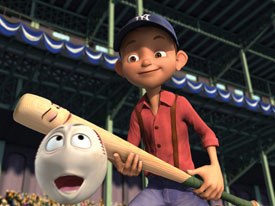
Everyones Hero brings together two heroic stories: Babe Ruth and Christopher Reeve. All images © 2006 IDT Ent. Inc. All rights reserved.
Once upon time in New York City during the Great Depression, a poor tailor made a baseball uniform for his son and took him to Yankee Stadium for his birthday. When the boy made an amazing catch in the stands, the Yankees invited him to take part in the game. The next day at school, no one believed the boys story until the Yankees arrived with presents for everyone.
Once upon a time in Hollywood during the 1970s, a young actor became an overnight star by portraying Earths greatest superhero. When a tragic accident left him paralyzed, he displayed such grace and courage that everyone who met him realized he was a true superhero. For the rest of his days, the actor lived his life to the fullest, facing challenge after challenge with an indomitable spirit that was an inspiration to the entire world.
The first story, about a child named Yankee Irving is make-believe; the second, about an actor named Christopher Reeve is true. The two stories became one when Reeve signed on to direct an animated feature that would come to be known as Everyones Hero.
Yankee Irvings adventure began as a fathers bedtime story to his children. The father in this case was Howard Jonas, the founder of telecommunications giant IDT and its animation-focused subsidiary IDT Ent.. When it came time for IDTE (recently acquired from IDT by Liberty Media Corp.) to produce its first feature, Yankee Irvings story was, if not The Natural, a natural.

This project began as a bedtime story by IDT founder Howard Jonas father. Co-writer Robert Kurtz 100-page treatment hooked first-time animation director Christopher Reeve right away.
Howard told me the story, and I was intrigued, says Robert Kurtz, the films co-scripter. I loved the little boy being the hero, the father and son story and the time period. I told him, let me think about it. Kurtz, an experienced TV writer/producer with a background in family-focused series like The Cosby Show, Grace Under Fire, Boy Meets World and the WB animated series Baby Blues, had recently joined IDTEs creative development department. This was my first animated film, but I knew enough to know the boy needed a journey, he needed a problem. If you have a father-son story I wanted something to go wrong with the bond between them that leads to the journey.
My uncle Al Brodax [yes, that Al Brodax] once wrote short story about a little boy who goes to England to bring the queen a fish. I always loved that story when I was a kid. I liked the idea of a little boy traveling across America to bring a special gift to his hero. In my script the father was a tailor working on Lou Gehrigs uniform who would lose his job unless his son got the uniform to Gehrig in time.
In terms of a finished screenplay, Yankee Irvings story had barely reached first base. Lou Gehrig and his uniform fell by the wayside, replaced by Babe Ruth and a one-of-a-kind bat that shares credit with the Babe for his slugging success. In the finished film, Yankee has to retrieve the stolen bat and return it to Babe Ruth in Chicago in time for the Yankees to win the 1932 World Series.
My first treatment was over 100 pages long, Kurtz continues. Howard read it, and being Howard found a way to get it to Christopher Reeve. He loved Chris and thought of him as the last great American hero.
Chris read it and loved it. Its a story about a kid who wont quit, who keeps swinging.
Its tempting to assume that Reeves directing credit is more a sentimental gesture than an actual measure of his work on the film; other than a few TV movies, Reeve had little directing experience and none in animation. However, everyone contacted for this article agreed that Reeves participation in the film was genuine and his title in the credits honestly earned.
Chris knew he hadnt worked on an animated film before, so he was open to suggestions and advice, recalls Ron Tippe, one of the movies producers. He had no problem making decisions. A director is a director animation is just a process, it doesnt take away from the fact youre making a movie. The fact that it was animated was secondary to Chris. The movie was about how do I tell a great story with great characters, and make sure the comedy organic to the story and its characters?
According to Tippe (who produced 2D and CGI animation for Space Jam), Reeve directed via the films storyboards, making sure each panel captured the scripts emotion and story progression, as well as providing input on character design and art direction. He wasnt alive to follow through, but he helped us set the tone for the picture.

After Reeves death, the project briefly lost momentum until IDT brought on Daniel St. Pierre and Colin Brady as directors and producer Igor Khait to complete the film. IDT wanted its release to coincide with the 2006 World Series.
The producer describes his first meeting with Reeve as, one of those absolutely unbelievable moments. I went to his house the day after I was hired. I was waiting inside the front door for him with the sunlight coming in from the second floor window. About 100 feet away I hear somebody say, You must be [here Tippe pauses for a whispered breath] Ron. He was blowing in his tube, which is how he manipulates his chair, and out of the sunlight comes Christopher Reeve. It was one of those times in your life when you knew you were about to embark on something that was going to be fantastic.
Kurtz spent close to eight months developing the films story with Reeve, traveling to the actors Bedford, New York home. When asked what beyond the mans handicap accounted for the tremendous impact Reeve had on everyone involved in the project, he pauses for a moment, then answers.
There was no handicap. With Chris, it was the gracefulness of his life, the ease of his personality, his sense of fun. He was the opposite of a difficult Hollywood star. Think of the best times you ever had hanging out with buddy from high school or college. Thats what it was like. The handicap disappeared, the wheelchair was gone. Hed have juice or a glass of water and Id bring it over to him. Hed take a sip and say, Thanks Rob, and that was it.
After Reeves death in late 2004, the project briefly lost momentum. Janet Healy, producer of DreamWorks Shark Tale had recently joined IDT as its president of animation. Healy brought aboard two experienced animation pros to continue work on the film, Daniel St. Pierre (who also served as production designer) and Colin Brady. St. Pierres credits include overseeing the deep canvas look on Disneys Tarzan, while Bradys roots are in the 3D world, with a co-directing credit on Toy Story 2 to his name.
Healy also brought in Igor Khait (whose own animation résumé dates back to Steven Spielbergs animated Family Dog series, and who contributes a brief blues guitar number to the soundtrack) to make sure the film was completed in time for its fast-approaching fall 2006 release. It took us a couple of months to retool and refine the movie that Chris had started making, Khait explains. Animation movies always evolve; youre always discovering new stories as you go along. We started to deconstruct and rebuild, while trying to stay true to the storys original theme persevere. We had to make sure we didnt stray from that and tell the story in limited time we had left until the films release.
Everyones Hero was scheduled for a fall 2006 premiere, just in time for the baseball playoffs and World Series. (Its not a Christmas movie, Khait notes.) For the next year and a half Khait lived in Toronto, riding herd on the films day-to-day production at IDT Ent.s DKP Studios. (In order to meet the release date, some scenes were lit, rendered and textured at Reel FX in Dallas, Texas.) The film was animated in Maya 6.5, with some proprietary plug-ins to create hair and skin textures. Cloth simulation was done with commercially available Syflex software, tweaked by the effects department to the movies needs; lighting and rendering were handled by off the shelf Mental Ray software.
Fusion software was used to composite the many layers of animation, including a complex train sequence. Those shots were challenging, Khait recalls. The train was transitioning through different environments. We had to be careful to make clear the progression from inside the station out to ever more rural areas, and balance out the changing light in different environments. We also used moving light sources to create an illusion of speed. It was really a combination of 2D and 3D in those shots it involved a lot of painting that had to be planned very carefully.

Bradys background is in cartoons while St. Pierre comes from the world of art direction and production design. Their differences became the strength of the film, notes Brady.
While Khait took care of logistics and scheduling, Tippe was on hand as well, overseeing the films creative aspects. In the films publicity materials, Brady notes that St. Pierres background is in art direction and production design, while his own work tends towards the cartoony, and compares their working relationship to Lennon and McCartneys: Our differences were really the strengths of the film. Tippe offers his own perspective on the dynamic between the two directors. Its important to get people to lay out their points of view, to and then get them to compromise. Otherwise why have two directors? My job is to get the best out of them. I worked hard to get them to articulate what they both really wanted, and when they disagreed, come to happy medium they both could live with. Nobodys going to be 100% happy unless theyve been working together for five years.
In many ways, Everyones Hero is a throwback to an earlier age of animated features, and not just because of its 1930s setting and G rating. Theres a refreshing absence of cynicism, over-the-kids-heads throwaway lines, pop-culture quotes or smarmy, clueless parents in the film. The bond between Yankee Irving and his folks is warm and palpable, and while the boy goes on an amazing and perilous journey that no 10 year-old is ever likely to attempt, hes always presented as brave and resourceful child, not a miniature, wise-cracking adult. The wisecracks belong to Whoopi Goldberg, who voices Babe Ruths bat Darlin and Rob Reiner, aka a sarcastic New York baseball named Screwie.
Screwies the kind of character I love, says Kurtz. I was really thinking of Danny DeVito or Billy Crystal, but Rob was absolutely perfect. He did this wonderful, cigar-chomping seen-it-all voice. Tippe shares Kurtzs enthusiasm for Reiner, even though the actor replaced Tippes scratch track. Rob was phenomenal, he was so collaborative. You go in with the script and record the lines, but an actor whos engaged says Can I try something else? In the film Screwie bounces down a flight of steps. The original script was just a series of ow-ooh-ahs, but Rob turned that into My head! My butt! My head! My butt!

The filmmakers found Rob Reiner very collaborative when creating the voice of Screwie. He added to the character.
According to Kurtz, Reeve always wanted Mandy Patinkin to play Yankees father Stanley. An hour after getting the script, Mandy called back to say he had to play the part. Chris never suggested it, but when I asked if [Reeves wife] Dana would like to play the mom, he said, I was really hoping you would say that. Chris was the kind of guy wouldnt necessarily assume that, given who he was, he could just call that as the films director.
William H. Macy, who seems to specialize in playing hard-luck losers in live-action, voices a cartoon version as the bat-swiping Chicago pitcher Lefty Maginnis. (In one of Heros best-animated sequences Maginnis, riding atop a train in pursuit of Yankee Irving goes through a series of wild contortions in order to dodge the overhead signal lights whizzing past him. That scene was Jans baby, says Tippe, crediting Jan Carlee, the films head of layout and one of its directors of photography.)
The biggest surprise in the voice cast however, is only referred to as Surprise Guest on the movies website. Much as Robin Williams portrayed Aladdins genie while keeping his name out of the credits, one of Reeves classmates from their Julliard drama school days portrays Napoleon Cross, the villainous owner of the Chicago Cubs. The pudgy characters pompous boasting and gleeful bobble head doll-abuse (Stop hitting yourself, he tells two Babe Ruth dolls while banging them together) provide some of the films funniest moments. After letting the actors name slip, Kurtz adds that, Chris wanted [his colleague] to do some sort of fun cameo, to enjoy this project with him because they were the best of friends.
Hero avoids giving its 1930s, depression-era setting the sepia-toned nostalgia treatment. Instead, the impoverished time period is evoked via a reference to the absence of available jobs and Yankees friendship with three good-natured, freight train-hopping hoboes (one of whom is voiced by Tippe himself). When Yankee hitches a ride with an all-black baseball team, the movie doesnt grind to a halt for a history lesson about the segregated national pastime of the day; instead, a stadium banner reading Negro League in the background is all thats necessary to tell the story.

The two things that differentiate Hero from other animated movies says producer Ron Tippe, are that the story, and not the comedy, takes priority and that IDT let the filmmakers do their job without interference.
In a fascinating sequence for any architecture buff, Yankee sneaks aboard a train leaving from New York Citys long-demolished Pennsylvania Station. The films meticulous CGI reconstruction of the station is as close as anyone in 21st century will ever get to seeing the place with their own eyes. Tippe credits St. Pierre and the films art team for going back to photographs and architectural drawings they did a huge amount of historical research for the film. When Yankee walks into the train station its beautifully lit and you get a sense of how vast and ornate it was.
As Tippe sees it, What makes us different from the other [animated] movies is that people usually go for comedy first we didnt. We went for story first and foremost. Once we got the structure down, then we went back in and asked ourselves, whats funny about this situation? The tension between Darlin and Screwie for example can it be funny? What makes it funny?
Chris had a lot to do with that attitude, and we just carried it on after he passed away. Dont forget Dana was one of the executive producers, along with Chris. I updated her on a weekly basis and we spoke regularly.
Theres another difference between Everyones Hero and its animated competition, one that Tippe is passionate about. We made this film in two years, for less money than 99% of the movies out there. Every company should do this say, Were giving you two years to make a movie and X dollars then let them make the movie and dont interfere. To their credit, the executives at IDT for the most part let us make our movie and didnt second-guess us. This is not a movie made by committee, this is a movie made by filmmakers and I think it shows.
Thats a critical paradigm shift in my opinion, that these people fully trust the creators. Were not going to spend $100 million and do this for four or five years. Thats one of the things that interested me in this project. We were going to be creatively challenged by having to work with less. Our crew was 25% smaller than on a comparable project. Thats very freeing. You realize your only option is to make good decisions. You realize you cant spend five months or 10 months or two years designing one character and Ive seen it done like that.
Everyones Hero, dedicated to both Chris and Dana Reeve (who died of lung cancer in March 2006) opens on Sept. 15. Dana was very involved up until the very end, recalls Khait. As a member of the cast and as one of the exec producers, she was always present. She was very supportive; she knew we wanted to, and she made sure we did, make Chris movie.
Joe Strike is a regular contributor to AWN. His animation articles also appear in the NY Daily News and the New York Press.

Joe Strike has written about animation for numerous publications. He is the author of Furry Nation: The True Story of America's Most Misunderstood Subculture.