For the first-time, ILM tackles mid-day CG water on the move for Evan Almighty and Thomas J. McLean finds out how they met the challenge.

It's an act of God that propels the story in Universal's Evan Almighty, the sequel to 2003's Bruce Almighty, but it was a far-less-mysterious force called Industrial Light & Magic that created and controls the forces of nature in this updated version of Noah's Ark.
Director Tom Shadyac returns behind the camera, with Steve Carell reprising his role as newscaster turned Congressman Evan Baxter and Morgan Freeman recast as God. In this Almighty continuation, Baxter's desire to be closer to his family prompts God to inspire him to build an ark.
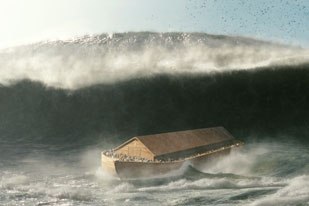
ILM and Rhythm & Hues split the lion's share of the vfx work. While R&H handled the animal work, ILM tackled the climactic sequence of the flood sweeping through Evan's suburban development and carrying the ark through Washington, D.C., to the steps of the Capitol.
ILM associate vfx supervisor Lindy De Quattro says the water work was the most challenging part of the film. "We've done water before, mostly in night sort of disaster-type situations, so it is glimpses of things happening in the water, a shot here and a shot there," she elaborates. "This is the first time where we had to do a whole series of shots that were happening mid-day, where you were going to get a really long look at the water and what it was doing."
Water on the Move
The water also had to behave as though it was being controlled, requiring new tools that allowed ILM to choreograph its movements. "We had to develop what we call a shape-targeting system to do that, which essentially means we could sculpt certain shapes and then describe how tightly the water needed to hit that shape at a certain frame," De Quattro suggests.
ILM added those tools to the PhysBam engine it developed in conjunction with scientists at Stanford University and used on last year's Oscar-nominated movie, Poseidon. Shape targeting combined PhysBam's simulation ability with the need to control the water as though it were a character, she explains. "It needs to move like water and act like water but it also needs to act like a character. That was the first time we really needed to control water to the extent that we had to."
The extent of the water's "acting" changed throughout production, getting toned down from some very active early animatics and controlled in ways that obeyed the needs of the story instead of the laws of nature. "Tom was very sort of nature conscious and he didn't want to damage the trees or make it look like the trees were getting harmed so we had to be very careful with what exactly the water took out," adds De Quattro.

Automating the Right Look
Getting the right look of the water had its challenges as well. De Quattro maintains that one of ILM's goals was to automate the process of simulating water and its tricky transitions from solid shape to the blobby particles of splash to mist as much as possible.
"It needs to be seamless, but they're treated in the computer using very different techniques and they're each rendered as separate elements so getting that transition has always been something that's required a lot of sort of manipulation in the compositing," continues De Quattro.
"We did get to a point where we could run the computer simulation and it would create particles which would be both above and below the water surface -- particles below the water surface would render basically as bubbles that would give kind of an aerated look to the water, and particles above the surface would be rendered as kind of the blobby bits that came off the water," she says. "We would run a secondary particle simulation to get the finer spray off of that and then again another simulation to get the mist off the spray."
The ark posed a number of unexpected problems too. Lighting was a major issue, as most of the shots of people on the ark were shot on a greenscreen stage and had to match an outdoor setting full of water that reflected light around the environment. There also was a partial ark about a quarter the size of the full size built on location in Virginia for shooting scenes of animals and people boarding that required set extensions.
A Tricky Boat
The ark's simple design made it difficult to give it the proper mass and weight. "That was one of the tricky thing about the CG ark was selling that sense of scale because in most of the shots you're really far away, it's a little tiny ark on the water. And because the design is really simple, there's not that many cues for the scale of it. So big weighty, heavy and large was another thing that took a lot of work and a lot of consideration," De Quattro offers.
Keeping the camera angle low and moving the ark slowly and deliberately gave the ark size and mass. "Wherever we can, just to sort of cheat additional detail, we had a certain amount of detail painted into the boards when it was far away and we'd tone it down when it was closer to camera. Anything we could do to just give it detail and scale," she says.
The type of wood used for the ark also created problems. "The wood that they used would turn very yellow when it was in sunlight and looked very red when it was in shadow," she adds. "So you could have these situations where you're on one side of the ark and it looks yellow, and you flip over to the other side and it looks red and you suddenly feel like you're looking at a different ark in a different movie. It was quite a bit of work just to get the continuity of the ark to work throughout the sequence."
Screenings and Workflow
On top of all this, Evan Almighty is a comedy. Shadyac was a big proponent of frequent screenings of the film as a key tool for figuring out what makes audiences laugh. That required ILM to alter its usual work procedure of taking shots to completion one at a time. Instead, they created temps for every shot in the film and worked on each shot concurrently, improving the quality between screenings, De Quattro admits.
Each screening, of course, brought changes to the edit and changes to the vfx shots, requiring sometimes-significant changes on the fly.
The film climaxes with the flood carrying the ark into Washington, D.C., and coming to a halt on the steps of the Capitol. De Quattro says the images of the capital city had to be created with CG due to heavy restrictions on shooting at the Capitol and the National Mall. The crew made extensive use of reference photography and digital matte paintings. The digital mattes are what De Quattro calls 2 1/2D work, as the process projects the image onto rough geometry to give it more depth than a static 2D image would on its own.
ILM had a relatively small crew on the film. De Quattro estimates 30 core crewmembers, with support staff and R&D bringing the number to around 50 or 60. The crew produced around 200 shots on a yearlong schedule that began in April 2006 and ran through May.
"(A year) used to be standard, but compared to what's happening in the industry, it felt long. But I can't imagine getting this show done to the level we were able to do in anything less than that because there was so much to develop; it would have been tough to do it any shorter," concludes De Quattro.
Thomas J. McLean is a freelance journalist whose articles have appeared in Variety, Below the Line, Animation Magazine and Publishers Weekly. He writes a comicbook blog for Variety.com called Bags and Boards, and is the author of Mutant Cinema: The X-Men Trilogy from Comics to Screen, forthcoming from Sequart.com Books.

Tom McLean has been writing for years about animation from a secret base in Los Angeles.