
Tara DiLullo uncovers the secrets of the vfx wizards working on SCI FI Channel new original series, Eureka.
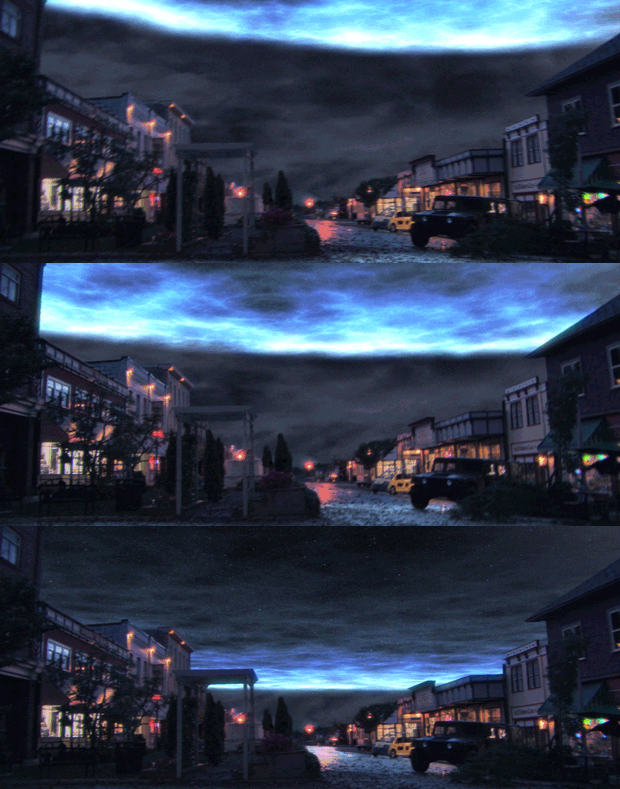
Theres something funny going on in the sleepy little Pacific Northwest town of Eureka. For starters, according to any map or book, the town doesnt even exist. In fact, according to the new SCI FI Channel original series, Eureka is a top-secret, government-funded enclave created by President Harry S. Truman to foster and protect some of the finest scientific minds ever. Over the decades, the protected town has become the birthplace of some of the greatest scientific inventions of the last century, along with some colossal failures too. Turn the corner or enter any humble abode and you could find a tachyon accelerator, a mind-wiping ray or some other fantastic invention too ahead of its time for the human race. In the series, misplaced U.S. Marshal Jack Carter ends up discovering the mysteries of the town and then is drafted to keep its secrets under wraps from the outside world.
When the exec producers needed a visual effects team to bring the gismos and gadgets of Eureka to life, they looked to Los Angeles and Vancouver-based Zoic Studios to fit the bill. Matt Gore, the visual effects supervisor along with Simon Lacey on Eureka, explains how the show first came onto their radar. We came to it originally sometime in February about a year and a half ago. We knew one of the producers, who was on an earlier project with us and we also had someone over at the studio, Todd Sharp, who we worked with before on Battlestar Galactica. We got the script and I personally read it and was breaking it down. I really liked what the exec producers were trying to do. Its a fun show and its ambitious. I like the idea of something that is kind of Northern Exposure meets The X-Files. Plus, the characters are fun. At the time, I was producing visual effects for Battlestar in-house over at Zoic. I walked into our head of production and pretty much said, I want to do this show. I liked the script and thought it would be a cool project.
The ambitious nature of the scripts and the scientific inventions core to many of the episodes meant Gore and his team immediately had headaches to overcome in the pilot. The pilot is a little bit different than the series. In the pilot, the original visual effects supervisor was Bob Abrams. He is currently working on Blade: The Series with us. But it was a tough one because there were a lot of things we had to do to stretch the budget as far as we could stretch it, he explains. I think the original budget had about 65 budgeted shots and the final had 200. For the most part, we were successful. There are some things I think we could have done a little bit better, but on the whole, we tried to give it as much as we could. To give the exec producers credit, they were really great working with us so it enabled us to expand the scope and it just grew. The whole end sequence, a lot of that stuff where the [tachyon accelerator] machine is turned on and its glowing and there is a glowing ball inside. I think there was one shot originally budgeted for that and we looked at it and said, Heres what we would like to do, so we can try to add some more production value to the sequence. The execs liked where we were going and that process went well and we were able to stretch whatever we could.
When it went to series, I moved up to Vancouver and we brought on another supervisor on the show, Simon Lacey, Gore continues. He has been pretty much doing all the set duties. Between the two of us, we have been trying to cover as much as possible. The way we would try to handle is was that he would take care of everything on set and I would pretty much cover all the meetings. He probably made it to 70% of all the meetings and we wanted to make sure by the end of it that he would at least be at the production meeting or at one of the final visits so he and the directors could get in synch. Usually he would go out on the location surveys and I would cover it on set if he couldnt be there that day. The show got more and more ambitious as the season went on so the two of us were stressed a bit, he laughs.
Continuing on that theme, Gore laughs, The schedule is crazy! The pilot was a longer process and the day-to-day on a TV series is just insane. At one point during the season, including the pilot, which was getting revisions, we had 13 shows going at once. It was crazy trying to keep it all together. The day-to-day is that you are always prepping; you are always shooting and posting at a certain point. Its normal for TV production, just schedule-wise with cable you want three to four weeks to deliver your effects and a lot of times its shorter than that, which makes it interesting.
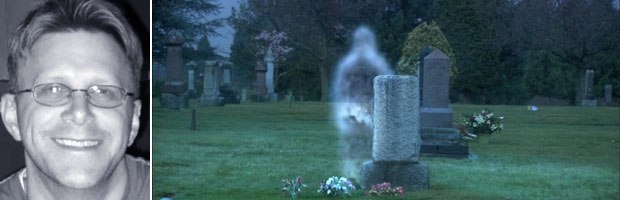
The episodic nature of the show also means that creatively there is a lot for the Zoic team to explore. The reason I really like the show is that every week there is something different, Gore offers. It takes me back to when I was working on The Outer Limits and every show was its own little movie. In the first [Eureka] episode, this kid sees what we are calling the Dark Man appear before him and he plays throughout the episode. So we were trying to match a drawing that the kid had done to what the Dark Man really looks like. The first episode also had a cryogenics lab with frozen bodies and robotic arms. When we got the plates, we wanted to try to add to the scope of the shot and not just be constrained by the plate. The room was a little smaller than we wanted the lab to be so we filled out the sides and made that shot a lot more than it initially was. Then in other episodes, we are dealing with CG flies that are more techie than normal. In another episode, there will be a tornado. Right now we are working on something called the artifact, which is a recurring effect through the series. They keep the artifact in a room and we are starting to lock down the look of what this artifact is. Its supposed to be something organic and inorganic at the same time and stuff like that is always a challenge.
As any supervisor knows, surprises are the name of the visual effects game and Gore says they have had their share in season one. There is always something that comes up and its like a jigsaw puzzle and you have to figure out how to make all those little pieces fit. Right now we are working on a crop circle shot. The shot is from overhead and we are finding it interesting that no footage actually exists from overhead of any fields. Weve gone on the Internet and everything is of a certain angle, but there is nothing from directly overhead. After searching all over the place for that one shot of a crop circle or just a crop, we hired a guy that went out on a blimp and he shot some stills of some fields to be used as a canvas to put our production footage into and we are going the CG route for adding the wheat. We were a little surprised, just because you would think it would exist, the shot we want to make, so its been interesting!
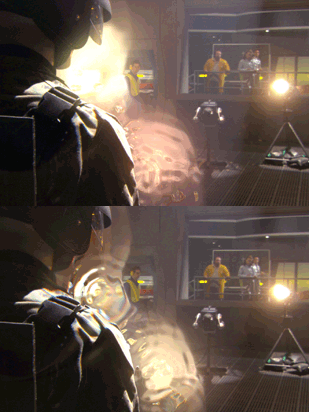
From my end, its always challenging to come up with something different, Gore continues. They want things to be Eurekafied. Like a guy leans into a car to analyze and disinfect it and there was a light out. They came back and said they wanted to enhance it so we are taking something that is nothing and making that piece of equipment cooler. And its all about the little things that make a shot cool. Like if someone shoots a gun, I dont want it just to be a flash in there, I want interaction on the gun. We have a shot where somebody fires a pulse cannon on someone and we had people add a little smoke or some embers to make it feel like its part of the piece of equipment. It adds a little bit more work to some of this stuff, but a lot of times in TV its a factor of just trying to move the sausages out of the factory. I like to work with artists who care an awful lot. One of the people working on the cryo lab [episode], he and I were here until four in the morning for three or four nights in a row looking at the shot. It was taking 45 minutes to render a frame, but we both love trying to do this stuff and bringing what we can to the show. And the exec producers have been great and I love working with them, so its trying to please people whom you respect and whom you agree with a lot of their notes.

On the technical end, Gore says the number of shots woven into the show have been aggressive for a TV series in general. The first episode had 50 to 60 shots and the second had 20-30 shots, so it fluctuates based on the needs of the episode. To date, not that much of it has been greenscreen, but a lot of it has been dealing with the live production footage. To bring the effects to life, Gore says they have two teams working on the show both in the L.A. and Vancouver Zoic offices. We have a team in L.A. that has done a lot of Galactica work and they are doing some missile silo work. The team in L.A. can be as many as eight or nine people and the team in Vancouver is another five or six at least just on one episode. We try to expand or contract based on what the needs of the show are. We are using Maya and LightWave for some of the 3D. We are using Shake and Combustion and some After Effects to composite.
Gore says the Zoic team is turning around the final episodes of Eureka for the season now. Production wrapped up two weeks ago and we will be delivering shots until mid-September. The series opened with excellent ratings, which bodes well for another season. Gore is hearing good things in his circles too. Im pretty happy about the feedback. A friend of mine who is not in the business watched Eureka and he said he really liked it. He will always send us critiques for whether shots are working and based on his reaction, things seem to be working. Someone else today walked in and said they liked it. And my dad likes it!
Tara DiLullo is an east coast-based writer whose articles have appeared in publications such as SCI FI Magazine, Dreamwatch and ScreenTalk, as well as the websites atnzone.com and ritzfilmbill.com.