Tara Bennett talks to Hybride, Frantic Films and CafeFX about helping evolve Dragonball to the big screen.

A worldwide phenomenon is getting translated to the big screen this weekend and believe it or not, the property isn't based on a superhero, a boy wizard or a teen vampire. Dragonball Evolution is actually based on the Dragonball Japanese manga that debuted as a weekly serial back in 1984. It told the story of a young boy named Goku that traveled the world in search of seven mystical objects called Dragonballs that in turn grant wishes. Since its debut, the Dragonball manga series has sold more than 150 million copies around the world, spawning anime films, anime TV series and videogames.
Of course, it was only a matter of time before the mythology made it to Hollywood and a live-action format. In Dragonball Evolution, the story doesn't stray too far from the source material: young martial arts expert Goku (Justin Chatwin) is tasked by his dying grandfather to seek out Master Roshi (Chow Yun-Fat) and round up the protectors of the Dragonballs in order to protect the orbs from the evil plans of Lord Piccolo (James Marsters). What ensues are many gravity-defying fights, extreme martial arts melee and plenty of vfx wonders.
Together director James Wong and Overall Visual Effects Supervisor Ariel Velasco-Shaw rounded up a small army of vfx vendors and artists to create the world envisioned on the manga page and anime for a whole new audience. VFXWorld talked to three of the vendors: Hybride, Frantic Films VFX and CafeFX to discover the behind-the-scenes secrets of this mystical world.
Hybride of Quebec was brought on early in the pre-production phase to help establish the visual parameters of the film. Pierre Raymond, Hybride founder and CEO, explains their initial connection to the project after being hired by Fox's VFX Producer Janet Hamilton and VFX Supervisor Ariel Velasco-Shaw.
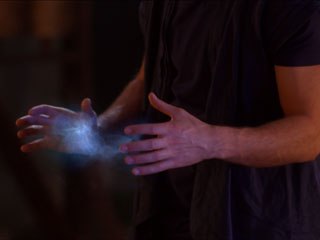
"Being involved in the very early stage of the production was great for Hybride because it gave us the chance to work on R&D in order to develop the look of the different energy blasts such as Ki, Shadow Crane and Ma Fu Ba," Raymond offers. "We also worked on look development for the Dragon Temple, as well as for the Flying Hummer and Lord Piccolo's dirigible. Having our staff on-stage working closely with Ariel Velasco-Shaw alongside director James Wong, was very helpful in achieving our goal."
Raymond says 20 Hybride artists, not including supervisors or their administrative team, worked on the 48 visual effects for the film. "Most of our work consisted of developing different looks for different parts of the movie, which we then shared with third-party post-houses. We were mainly involved on shots where tracking interaction is required. Generating animation interacting with the actors' performances is very frequent in most of the movies that we work on, but this kind of interaction was more difficult to achieve. The energy force took different steps and evolves shot by shot to represent the learning process of our young master. Both the look and the animation were customized and many versions were produced in order to attain the final result. So the amount of shots is quite irrelevant for this movie, as it required a decent amount of investments in R&D."

Asked what sequence pushed his team the most creatively, Raymond replies, "The Dragon Temple sequence was definitively a good challenge for us. We had to make the Temple very similar to the surrounding rock formation all the while creating a look that would make it seem as if it had been hidden underground for thousands of years. The high point was making it come out from the ground and the result is simply astonishing, thanks to our R&D team, which managed to develop tools to help us reproduce a very natural look and feel to the moving and falling rocks, dust and debris.
"We are also very pleased with the look our artists created for the different energy blasts," he continues. "The main difficulty we had to overcome was to show how Goku didn't have any control over this at the beginning, and then slowly make it into something that became more powerful, and under control. So while the Dragon Temple was a very big challenge for us, I think the subtlety and the evolution of Goku's energy blasts, as well as the demonstration of Master Roshi's power are both something Hybride can be very proud of. There is a very powerful scene where Master Roshi uses his full power to bring back a near to death Goku. So having started with something very weak and out of control and transforming it to point where we feel the energy created by Goku is fully under control is definitely something we are pleased to have achieved."

For Frantic Films VFX, Dragonball Evolution ended up being a much more expanded job than initially expected. Mike Shand, co-vfx supervisor at Frantic Films, explains that he and his team completed around 300 shots with around 90 artists in four countries Dragonball Evolution.
"Frantic was brought on board very early due to our liquid dynamics technology," Shand details. "The Lava Lake was our first major chunk of work and it was supervised by Chad Wiebe. The sequence featured liquid dynamics, elaborate set extensions, matte paintings, particle work and fully-CG Fullum assassins. I think it was the success of that effort that led Ariel Shaw to awarding us more of the show, including the final battle sequence, which was supervised by me."
Shand says in that climactic battle Goku performs a move known as the final Kamehameha, which was ultimately something their team needed to create through visual effects. "It was the most challenging aspect of the entire sequence," he reveals. "We knew there was a huge fan expectation for this effect. We also knew that our presentation of the move needed to accent the anime yet work in a live-action sequence. We looked at the anime versions as abstractions of something that would be more complicated and sophisticated in the real world. Some people wanted it to be over the top, others wanted it to be a more literal representation of the move. So we tested many different looks. We also had to consider the larger story and how Goku's power will increase in possible sequels. There was a ceiling we needed to establish in order for this move to fit into the larger character arc… We had only three very short months with Christmas in between, so needless to say it was a wild ride."
For CafeFX, their work on Dragonball Evolution came out of their previous collaborations with Velasco-Shaw. Danny Braet, vfx supervisor for CafeFX, explains, "On this one our Art Director Alp Altiner did a lot of concept work for Dragonball before the movie even started. He did a lot of sketches for different shots, working closely with the director. He also did some animatics before he came over full time with [CafeFX]. Because some of the shots involved required some of his art it made sense for the work to stay here."
Braet details that Alp's design work expanded throughout the whole production and became the basis for the visual effects work created by other vendors like Hydraulx (of Santa Monica) and Hybride. But CafeFX's work on the film remained rather small. "We were brought in at the end just because what needed to be done required a little bit more on the art end. They had ideas for things and because Ariel liked working with Alp, I got introduced to Ariel, as well as our CG Supervisor Will Nicholson. We never had planned to be on this show but that's how we came aboard.
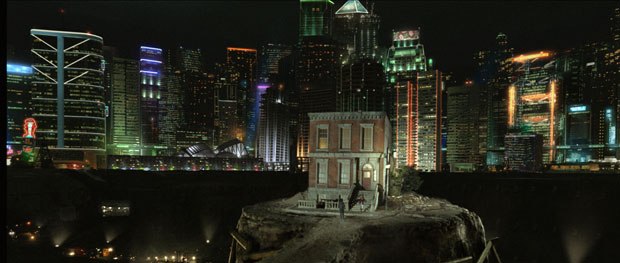
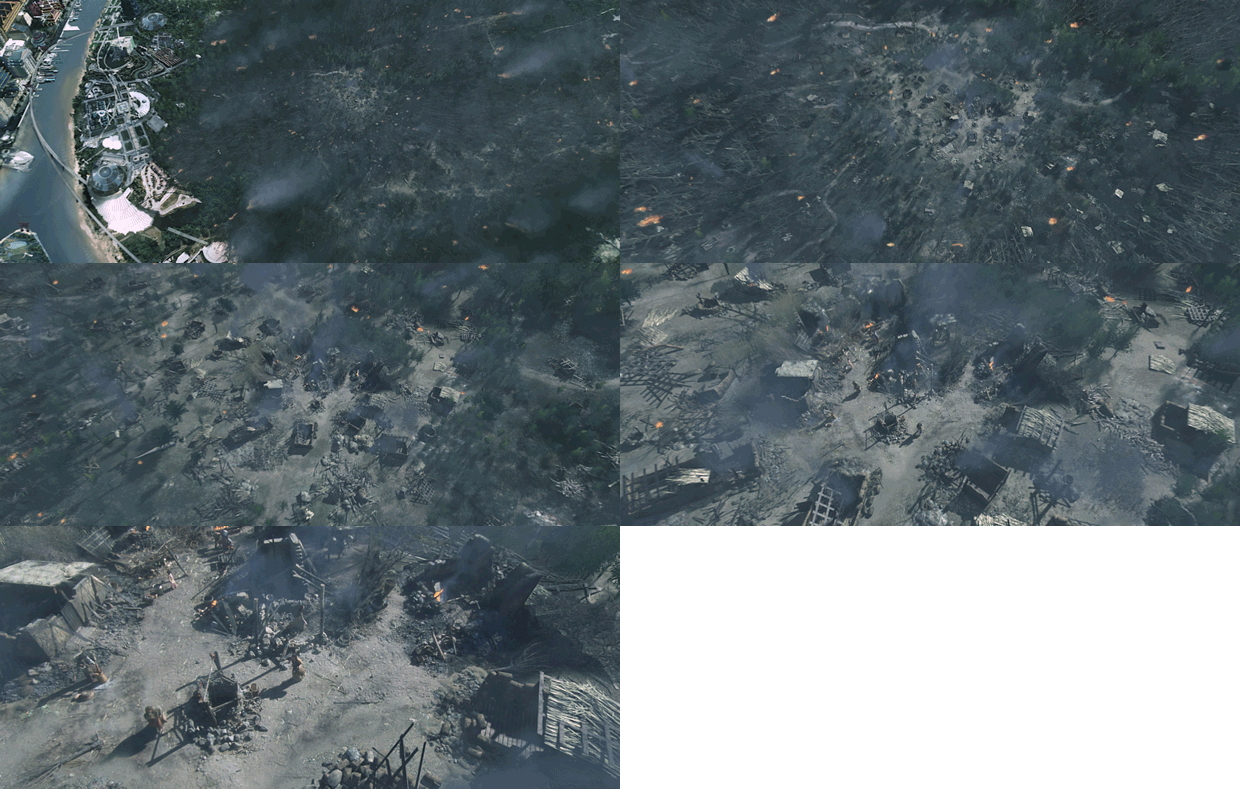
"The three main things that we were brought in for was the visualization of Goku's house, which is an abandoned old house in a quarry in the middle of city. They wanted us to visualize that because his living quarters are important. Secondly, at the beginning of the movie, the storyline shows that one of the character's villages gets wiped off the face of the map. On the set, they couldn't go wide enough and it was localized. So we took that and made a full 14 seconds in front of that where we pull out all the way and go into the clouds and hook up from one of Hydraulx's shot. When you are up in the air that way, there was no description yet about what was around that village or where the village was, which needed to be conceptualized. That scene wasn't playing so well in the edit so Ariel, Alp and [I] came up with some ideas and we experimented with it. We made something that is not in the movie but was used elsewhere in the movie because they liked the concept. We made an energy burst explosion from a wide view. We decided that we were showing too much at the start [of the film] so we wanted to tone it down. But, in fact, it was used later from a different angle. And that's what we do -- traditionally we are brought in as a vendor and set out to do what needs to be done at the start and then we did more. For us, this was fun for us because it was more of a collaboration figuring out how to show this without altering the focus. There was a lot of back and forth and it came out great which is what we are known for at CafeFX.
"The last piece they wanted us to show a temple where the monks are living," Braet continues. "However, what wasn't established in the movie is where the temple is and what connection does it have. We created a shot that would show the arena for the fighters and then come back to the temple that is overseeing the whole city. We made this contrast of a pretty wide shot of the city and the arena, which is modern, and then slowly we go very close into the old temple which was very cultural. We didn't have enough time to make it so we had to come up with a lot of different ways to make it visually stimulating. We ended up using a lot of matte paint work."
Due to CafeFX's late addition to the post process, Nicholson says they "definitely had to crunch to get it all done. We put some good hours on the show. We had a very small crew starting with only three people and by the end it was just [Danny and me]. Our artists tailed off as we progressed dwindling down to one 3D and one compositor finishing the show. We had to pull out all the stops. The last shot that we did was a massive exterior shot where you could see an entire valley and the city. It was gigantic where we go up a mountain to a symbol at the top. We had a lot of modeling and a lot of tricks to make the city look huge, without having to create a huge city, which is where a lot of the matte paintings came in. We created a lot of building procedurally rather than try to model them perfectly and then did a lot of projection of matte paintings onto the geometry to limit the texturing.

"With the lighting we did a lot with the textures that we were baking into the projections which limited our render times a little bit. But as we got up the hill it was a completely CG environment where everything was CG in 3D so there was a lot of procedural texturing. When we got to the temple we went back to projected textures supplemented with actual CG lighting."
Going back to the opening shot that flew from the clouds, Braet explains that hookup point for their shot with Hydraulx's shot happened in the ethereal clouds, which made the matching rather seamless. "The only difficulty was a device called a grenade which glows and explodes in the air. The timing was set by them and ours was a little bit different so we had to play around with the timings. But I have to say we have done a few projects where we have to share with Hydraulx and these guys are great. They are very open and a good symbiosis."
Tara Bennett is an East Coast-based writer whose articles have appeared in publications such as SCI FI Magazine, SFX and Lost Magazine. She is the author of the books 300: The Art of the Film and 24: The Official Companion Guide: Seasons 1-6.