
Tara DiLullo follows up last years report on Battlestar Galactica with a look at the uniquely creative and chaotic method to the madness surrounding the much-anticipated second season.

Last years Sci Fi Channel hit Battlestar Galactica begins season two this month. Behind the scenes, its barely controlled chaos. All images © 2005 NBC Universal Inc. All rights reserved.
A lot has happened since Battlestar Galactica premiered as a series on the Sci Fi Channel last year. Its become a ratings hit and helped solidify Friday night as the genres appointment TV night, along with winning placement on a host of TV critics lists as one of the best shows of 2005. Meanwhile, the winter premiere of season two began airing this month, with the climactic Resurrection Ship, Part 2, bowing on Friday.
Behind the scenes, its been business as usual, which means barely controlled chaos for one of the most unusually crafted television series in production today. Visual effects supervisor Gary Hutzel and his team of vfx artists and collaborators from Vancouvers Atmosphere and L.A.s Zoic Studios are still creating the impossible in record time, helping to achieve exec producers Ron Moore and David Eicks exacting mandate for a science fiction show that surpasses the boundaries and quality of other TV shows. What does that mean? No prisoners taken on this show, Hutzel laughs. We joke in the office that the producers are like kids and we are all in this wooden, rickety cart being pushed down a hill at high speed and we are just dying for one of the wheels to fly off and it never quite does. They make it to bottom and push us back up again, but at some time we all know the wheels are coming off, but its a thrill ride until then.
With the producers having established a very organic and some might say, dizzyingly unstructured production cycle during the first year, Hutzel says the second season is following the same model with even more challenges. Season one was a short season of 13 episodes. Going into season two, we are going to do 20 episodes in very nearly the same amount of time with an extra month or two thrown in. Its really 50% more shows in nearly the same amount of time. The specific visual effect hurdles come from the way Battlestar is post-produced. We started out season one by approaching it in a traditional fashion, having the usual visual effects and finals meetings. What we found was that after the first few episodes, we discarded that because of the sophistication of the show. In order to address all the ideas being expressed with the visual effects, the meetings would go on for three or four hours! Even that was fine, except the shows had a tendency to not lock. There are no traditional vfx locks on any of our shows, so the elements of post-production, which you are used to, the lock dates, the meeting dates, none of those things apply. There is literally no schedule. We just know when they air!
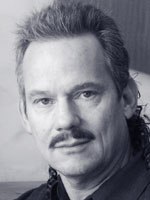
Vfx supervisor Gary Hutzel and his team of vfx artists and collaborators from Vancouvers Atmosphere and L.A.s Zoic Studios create the impossible in record time.
It starts with the fact that David Eick has always insisted the directors get a cut of the show. On any TV show, the director has a cut, but its really just a cursory nod because the directors on a one-hour show have four days to cut and they often dont have time to get through it. On a sophisticated show like ours, its absolutely inadequate. But what David said early on was that the directors get their cut and we may not like a lot of what they do, but its worth going through it all for just one fresh idea. It means, quite often, the directors dont have their cuts for weeks, so that immediately blows the schedule out of the water. Normally, if the director isnt available when he is scheduled, then he forgoes his cut. Not on our show. If hes unavailable, we wait for him to come back to do the cut. He does his cut and at that point the producers tag team the show. They go through and take up to two or three weeks to completely change the show to their liking. Then at that time, they pass it to the next producer and he has his pass on the show. Then they get together and argue about what they liked and didnt like and generally do a third or fourth producers pass and only then do we get a show in a form we can work on Its a show that is done spontaneously and [thats] what gives the show its form.
In theory, its a refreshingly open and creative way of producing a series outside of the standard, cookie-cutter production cycle. In practice, especially for the visual effects team, it can be hell. It defies all of the ideals of how you get a TV show done, Hutzel agrees. Its very much more like a feature where people get a say because its politically their option to have a say, and they take as much time that they need to get it done. On a feature, if the screening date shifts three months, its pretty standard procedure. On our show, there is no shifting. It was easier last season because the delay in airdates was so incredible. In this new season, the task has become as demanding as we can possibly get. We are delivering the whole second half of the season on a one-week per schedule. It would have been different if they hadnt gone into episode 11 [Resurrection Ship] and decided to turn it into a two-parter, but, the truth is, that isnt unusual for our show...
All of that open-ended production just means Hutzels team has to step up and rise to the challenges of each episode with speed and creativity. Clearly, it falls on the vfx department that is on the end of that chain to deliver in record time on every show, Hutzel admits, but the whole point of Battlestar is to avoid any kind of streamlining of the process. By the choice of the producers, they want the show to be full of bumps in the road. They want it to be shaken up every time we go to produce another episode. They want to have curve balls everywhere. Its not by happenstance, but by design. Consequently, for the visual effects, there is no pattern. For instance, today [Dec. 29], we just went through what will be the season opener, which will air Jan. 6. This is the first time that David has seen the finals for the show and. of course, there is a list of revisions. Now, its not about the visual effects at all. We have no option. They continue cutting the show until the 11th hour and we have no locked cut on the show at all. We just started on the effects when we ran out of time and we adjust to the cut on the fly, he chuckles.
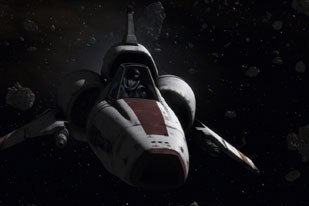
Unlike other TV shows, the directors cut is for real on Battlestar. If a director is unavailable, production waits for him, which throws off the vfx schedule. The results give the show its form, but it wreaks havoc with the vfx team.
And that doesnt mean Hutzel cuts any corners to get the job done either. He insists there are no stock shots and the idea is to push it so there is never the same thing twice. Occasionally, at the 11th hour, they will grab a shot from another show when they cant afford to do another one for an action shot. Star Trek is a great example, in that it was all structured. Every show had five stock shots in it. Its the absolute opposite of what we are doing.
Yet, with that kind of oppressive turnaround, can they truly be satisfied with the work they are able to produce, when time is always of the essence, but never in spare? Hutzel says: Yes. We are maintaining the quality of the show and we are delivering the kind of entertainment I want to do. Im very pleased with Atmosphere and Zoic. We are also doing a certain number of shots in house. One of the things I developed this season was that I built our own render farm. We have our own capability and we have two fulltime artists working with us in Vancouver, which allows us to respond to these last minute demands. Its been very helpful and made a big difference. And if it sounds as if we are taking work away from the facilities, thats not really the case. We are picking up additional shots that we would not have been able to do and taking some shots to a different level when we can. It takes the onus off the facilities because their capabilities would be strained, because we are delivering everything in two to three weeks. Normally, a show would have 10 to 12 weeks. We also do some R&D in the office too.
Hutzel says his initial system choices are also helping the process this season too. We use LightWave [3D] and composite either in Digital Fusion or Combustion. I designed the show originally on LightWave and as far as compositing, the tools have kept up with the times. I pat myself on the back for using LightWave. In our local render farm, we are running full 64-bit. We are the only facility doing that and since we are the beta-testers, we were crazy to jump in on that. We have a great IT guy and we kept things up to date. We anticipate that render times will drop to nearly a third of what they were last year. It means that we can turn in a lot more sophisticated stuff and tools much faster. LightWave has been rebuilding their software from the ground up and it turned up as we needed speed increases, so LightWave has grown with the show.
With the rest of the season still spread out in front of him, one has to wonder if burnout is imminent. Hutzel laughs and says, Burnout is all relative. Ive been burnt out and its like running marathons you get tired and get your second wind and keep going. A lot of people see the kitchen is hot and they dont want to go in there, we just jump into the fire and keep going and I have a team of people willing to follow me. Ive collected a bunch of terrific artists that say if this is how you want to lead us, this is the way well go. I dont have anybody digging in his heels and anyone saying it cant be done. I have a team of great people who stay on top of it and recognize what we are doing and that its demanding but unique and worth spending time on.
Tara DiLullo is an East Coast-based writer whose articles have appeared in publications such as SCI-FI Magazine, Dreamwatch and ScreenTalk, as well as the websites atnzone.com and ritzfilmbill.com.