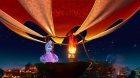
For Baz Luhrmann's dreamy Australia, Rising Sun Pictures, Animal Logic and Framstore combine for some crafty vfx, as Thomas J. McLean discovers.

Baz Luhrmann's Australia sweeps across the wild brush of the outback with all the romance and scope of a classic Hollywood epic.
But telling the tale of romance in and with the outback required the expertise of 10 visual effects houses to bring to life the droving cattle, a raging stampede and a World War II battlefield -- all under tight deadlines.
Starring Hugh Jackman as the Drover and Nicole Kidman as English aristocrat Sarah Ashley, the Twentieth Century Fox film stayed in-country to create its droving cattle and the port city of Darwin.
Luhrmann tapped Rising Sun Pictures, based in Sydney and Adelaide, to create more than 150 shots for the film, including animating the cattle for the drove sequences using the facility's in-house crowd system, Posse.
CG Supervisor Carsten Kolve says that when Rising Sun started on the project 18 months ago, it evaluated all the crowd system options and stuck with Posse.
"We basically decided the amount of work that it takes to integrate it into our pipeline might as well be spent investing into our own infrastructure and bringing that up to speed and then not having to deal with issues like high license costs," he explains.
Posse also was already tied into Venom, Rising Sun's in-house 3D infrastructure. Venom's ability to let visual effects artists create geometry as late as the render phase provided the kind of flexibility the project required, Kolve adds.
"We're dealing with just skeletons most of the time directly in Maya and then, when it comes to render time, we would actually bind the skeleton with the geometry applied the shader and render the complete individual cow or many of them on demand, which made the whole rendering process very efficient," he says.
Posse works with a concept called "crowd containers." On Australia, for example, a library of crowd "building blocks" was assembled that includes rigs, shaders and deformers that would then be assembled and used to fill a 3D space.
"It gave us faster turnaround in producing those shots and much more important it made it possible to uses reuse those building blocks in different shots over and over again or even in the same shot," Kolve says.
Work began with one main animator producing most of the cattle animations. For reference, Rising Sun shot some of the real cattle used on location in a studio with a bluescreen setup. Kolve says they shot the cattle trotting, stopping, cantering and milling about from a number of different angles to create the base reference for the animation.
Control over all the elements was maintained through to the lighting stage. Kolve says the lighters would receive a complete assembly from the crowd TD that consisted solely of a huge cache of animated skeletons that gave the lighters complete control over variations in color, texture and placement.
It also gave lighters the ability to change any element necessary, up to adding, altering, deleting or moving specific cattle from a shot. "We wouldn't have to go all the way back to the simulation stage. The lighters could just pull out a particular cow," says VFX Supervisor Kat Szuminska.
Cows' appearances were easily adjusted. Out on the desert, they were made to look skinnier and when times were good they were fattened up, according to Szuminska.

That was quite useful on Australia, which pushed the limits of its schedule. Szuminska cites as an example a shot in which Kidman's character looks across the river at the just-crossed herd. "They said: 'We actually don't want the cows on the other side of the bank anymore. Can we bring them on to this side?'" she says. Moving the cattle was less difficult than finding a way to make work their fur, which had been designed only for mid- and background shots.
But solving that problem, the scene ended up evoking compliments from Luhrmann. "He said, 'I don't even remember having cows over there,' which is about the highest compliment he can give," Szuminska admits.
Rising Sun's digital cattle mixed frequently with real cattle, filling in scenes or extending them to the horizon, Kolve suggests. It also was a challenge to match the speed and placement of digital cattle with real cattle.
"It was a massive job from the 2D side just to rotoscope out the shape of the real cattle so that we could put the CG cattle behind it," says Kolve. "And then it would be a big task for the crowd team to integrate them speed wise and general animation wise."
Beyond the cattle, Rising Sun worked on nighttime camp sequences, expanding the sets to establish a sense of geography while also being flexible enough to accommodate changes Luhrmann would ask for on aesthetic grounds.

One of the centerpieces of the film involved a stampede of the cattle on the edge of a cliff overlooking a gorge. The sequence was created by London-based Framestore, which was the only non-Australian facility to work on the film.
Mike Mulholland, CG supervisor at Framestore, says they got the sequence late in production -- only four months ago. The client had provided a rough previs of the sequence and Framestore's first task was to nail down the details of the sequence.
"The director, Baz, is keen to always be tweaking and changing things, so it was ever-evolving," says Mulholland.
The cattle sequence was created with Massive and was the most extensive Massive sequence Framestore has done to date, requiring changes to their pipeline to accommodate the work. Tools were written to preview Massive data in Maya and to preview and edit the crowd simulation.
Mulholland says Framestore inherited a cattle model and extensively reworked it and cleaned it up to meet the requirements of the stampede sequence. "We also spent a lot of time doing iterations on the cow," he continues. "The cow they gave us was a hefty, fat cow and in our sequence the cows are a lot thinner because they've been driven across the desert."
Dust was added to the sequence using both 2D and 3D elements, the latter generated in Houdini using a proprietary particle rendering system called Wisper. The Massive simulations were exported to Houdini so the dust could be generated from the cattle's footfalls, Mulholland explains.
Framestore also did extensive environment work, ensuring that footage shot on location at different times of day or in the studio against greenscreen matched up in the final sequence, Mulholland says. The scenery of the cliff and gorge was created with matte paintings and projections.
This also was the first project on which Framestore used all 64-bit rendering, a technique they had used on some sequences of The Chronicles of Narnia: Prince Caspian. "It gave us more memory for our renders," he says. "This allowed us to raytrace the cows, which was important to get shadow detail."
In all, Framestore had a crew that peaked at 50 people working on the project, including a group in Iceland, and produced 117 shots for the film.
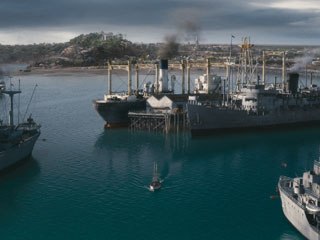
The port town of Darwin is another focal point of the film, beginning as the commercial hub to which the cattle must be delivered and later as the scene of an attack by the Japanese.
Created by Animal Logic, the Darwin sequences required a broad spectrum of techniques, says Emmanuel Blasset, 3D supervisor at the Sydney-based facility.
To handle the workload, Blasset says they put in place a system the facility first used on 300, in which a "creative hub" of artists very quickly blocks out shots, interacting with the client to nail down the shot as quickly as possible.
"That's the most important part on these kinds of projects," he says. "If there is any kind of creative uncertainty, because the nature of the shot has changed, we always would go back to this creative hub, which would allow us to solve it as quickly as possible."
The challenge of Darwin was to create a full CG environment, including terrain, period buildings, vegetation and a wharf full of ships of all shapes and sizes. "It was very important to get the scale and the immensities that Baz Luhrmann was after, so we needed the wharf treated almost as a character," Blasset notes. "From a framing point of view, it was very important to help the storytelling by helping the way the eye is drawn through the shot. And large shapes within the frame really help toward that end, and Baz used the ships and the wharf to that extent."
Blasset says Animal Logic pushed some of its technical capabilities in such areas as atmospherics, applying a number of SIGGRAPH papers to ensure the atmospherics of the sky were correct.
The facility also used a light stage that allowed it to capture materials under any lighting condition they wanted. "It would capture those materials and extract shading models," he continues.

Pipeline wise, Blasset says Animal Logic works in parallel as much as possible, with elements being built while they're being blocked out and changes being constantly updated to all departments as work progresses. "It's about minimizing the delays between each department, minimizing communication and really maximizing the amount of creative cycles we can have," he says.
For creating Darwin, a tool called City Builder was developed to implement a more procedural, eye-level approach to creating the city. "You can draw streets and define areas where you say, well this area is more industrial, this area is more commercial and this one is more a resident area," he says. "You define parameters: density, size of blocks, any of the different props you would include in those areas. And we can manipulate the streets and manipulate the overlapping zones and it will do a first pass of the layout for the artist."
While Animal Logic has been on the project 18 months, since before principal photography began, most of the work was done in the last five or six months using a crew of about 80 people to create 185 shots.
"Compressing the schedule on a visual effects company is only a problem if you don't cater the way you work to handle that," he concludes. "Six months doesn't sound like a lot but it was a huge amount of time for a typical visual effects project."
Thomas J. McLean is a freelance journalist whose articles have appeared in Variety, Below the Line, Animation Magazine and Publishers Weekly. He writes a comic book blog for Variety.com called Bags and Boards, and is the author of Mutant Cinema: The X-Men Trilogy from Comics to Screen, forthcoming from Sequart.com Books.

Tom McLean has been writing for years about animation from a secret base in Los Angeles.