
Alan Bielik explores how Buf and MPC conquered Babylon and Alexandria armed with plenty of CGI.

It took Oliver Stone 15 years to direct his dream movie about the life and death of Alexander The Great. The project almost was greenlit in 1996 with Val Kilmer in the title role, but at that time, the sword and sandal genre was all but extinct. Plus, the enormous cost of these movies was more than intimidating, even to the boldest producers. However, in 2000, Gladiator proved that it had become possible to produce a large-scale epic movie at a reasonable cost. Thanks to digital technology, the cast of thousands that scared the studios away became a cast of 400 extras surrounded by thousands of synthetic characters. Virtual environments allowed the filmmaker to freely move his camera in what used to be locked-off shots executed via matte-paintings or hanging miniatures. The MTV school of filmmaking had entered the world of sword and sandal movies and turned them into hot properties again. Troy followed, then Alexander, and next summer, Ridley Scott will deliver Kingdom of Heaven, an updated version of his infamous Crusades project.
For the bulk of the visual effects, Stone turned to Buf Compagnie, a Paris-based studio that had produced brilliant effects for a commercial that he directed in 2001. Under the joint supervision of Sébastien Drouin and Stéphane Ceretti, Buf ultimately created more than 200 shots for Alexander, while another 50 shots were assigned to Londons The Moving Picture Co. (MPC), where Rudi Holzapfel oversaw the effort. John Scheele was hired as overall visual effects supervisor.

The Mother of all Battles
Although Buf had worked on several high-profile American movies (Fight Club, Panic Room, The Matrix Reloaded), it had never before embarked on such an ambitions project. The prestige of the subject and the aura of the director only added to the excitement of the artists. There were two major challenges ahead of them. The first one was the creation of both Babylon and Alexandria, two legendary ancient cities. The second one was the battle of Gaugamela in which Alexander defeated the 250,000-strong Persian army with only 50,000 soldiers. Undoubtedly the most complex scene of the movie, the battle required three different categories of effects. For tight shots of the fights, Buf added CG arrows and blood spurts, a seemingly simple task that was rendered very tricky by the fact that the action had been photographed among layers upon layers of dust. This thick atmosphere was a cause of concern for Buf as it often concealed the background or the ground itself, making tracking an enormous challenge.
Dust was an even bigger problem in the second category of shots, which featured larger groups of soldiers. Since the plates had been shot with 1,000 extras only, it was Bufs mission to multiply the soldiers on screen. In order to avoid putting any limitation on Stones creativity, no bluescreen had been used on the set. As a result, rotoscoping became a major issue, especially with the ever-present dust making it difficult to trace the outline of foreground elements. It actually required the development of a new tool that saved Buf the hassle of painting these manually. Digital soldiers were then added in the background and painstakingly blended in the dusty environment. For this scene and the rest of the movie, Buf exclusively used proprietary software in every aspect of the visual effects.

These battle shots were quite tricky on their own, but Buf knew that the real challenge laid in the third category of shots: A (CG) eagles point of view of the battle with the two massive armies in frame. No less than 300,000 digital soldiers had to be created for these shots which may be a record in the field! Key to the success of the simulation was the gathering of precise data for every element that was used on location. To this purpose, Buf set up a neutral light environment in a large tent directly on location. One by one, every element was photographed from different angles: actors wearing every possible costume, in different make-up conditions, horses with and without their rider, camels, chariots, weapons, banners and every prop and set element. Back in Paris, this database was then used as a reference to create a lifelike CG replica of each and every element. It kept growing during the course of production as Bufs representatives on location never stopped updating it with new elements.
A Cast of 300,000
Bufs team also set up an improvised motion capture studio equipped with four video cameras. Actors and animals were asked to repeat what they had done on the set, allowing the company to capture hundreds of different actions, including variations of the same movement: walking, running, standing, shooting, horse falls, fight choreography of up to three performers at a time, etc. This data was later used as a template that was rotoscoped by CG animators. The result was a comprehensive library of movements and actions in which CG artists were able to select what they needed to animate the digital characters. In those long shots, animations were applied to large groups of people, but the artists always fine-tuned the shots by keyframing the action of specific soldiers to add unexpected moves and break the smoothness of the simulation. With 300,000 characters to be animated, Buf turned to 3D instancing to multiply troops on screen without adding unnecessary render time. Renders were actually done in one pass in order to simplify the workflow of the whole project. In several shots, the environment itself was digitally created, as there was no real location that corresponded to the landscape that Stone had in mind. Buf modeled the geometry in CG and used images of the location footage as texture maps.
Just like Troy, Babylon is one of those mythical cities that nobody knows what it really looked like, but that everybody knows what it should look like Since the city was destroyed 2,000 years ago, very little is known about its layout or architecture. The rare reliable evidence consists of samples of Babylonian art on display at several museums, and the actual ruins of the city. Not much to build a whole city from. Stone made clear that he wanted Babylon to look as authentic as possible with some artistic license. Thus, it was decided that everything should be larger than what the research had suggested. The Tower of Babel, whose real height was probably about 300 feet, was enlarged to a spectacular 1,000 feet tall! Also, at the time of Alexander, the Tower was already a ruin, but this translated into a structure that Stone was not sure the audience could identify. The director eventually asked for a badly damaged, but still easily recognizable Tower of Babel. In the end, the city was entirely modeled in the computer, allowing Stone to put his camera virtually anywhere.
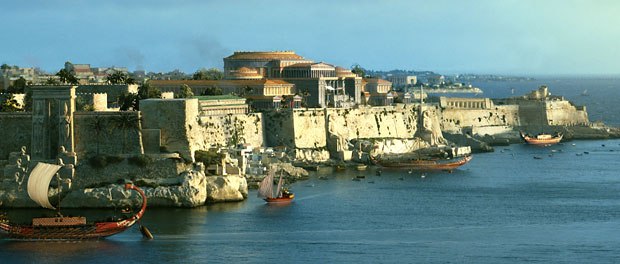
In comparison, the creation of Alexandria was somewhat simpler. Stone shot VistaVision plates of a fort overlooking the sea in Malta and Buf added a digital Alexandria behind the walls, with virtual ships sailing in the harbor. Originally, the movie featured many more shots of the city, but most of them were deleted for pacing reasons.

The Battle of the Elephants
Meanwhile, in London, MPC was busy creating a series of complex shots for a major battle sequence: the fight between Alexanders troops and the Persian army assisted by armored elephants. Since the production was able to gather only 30 trained elephants, MPC was asked to digitally duplicate them in order to double their number on screen. What we did was extract elephants from different takes of the same shot and add them in our master plate, explains Holzapfel. For the shot in which one elephant has its head nearly severed, we replaced the animals head by a CG replica and animated the trunk to be cut off.
A different technique was used to create Alexanders cavalry. Fifty horsemen had been shot on location, but the script required 400 riders interacting with enemy troops. MPC set up a motion capture studio for the horses and their rider performing many different actions in full costume in a 60-foot long tent. The motion capture database that had been developed at MPC for Troy was updated with new moves and specific actions. We created a complete database of costume elements, weapons, patterns, cloth colors and animation cycles, and our ALICE crowd simulation software picked them up randomly to build - and animate - soldiers and riders. We ended up adding hundreds of synthetic characters to live-action plates alongside the real extras. A large part of MPCs work also involved enhancing the brutality of the battle: adding CG blades to swords that didnt have any, for security reasons; animating hundreds of CG arrows; simulating blades and spears piercing bodies; and adding countless blood spurts that had been shot live on bluescreen.
In the end, both Buf and MPC had to deal with one of the trickiest aspect of the project: the fact that cinematographer Rodrigo Prieto had subjected the original negative to a bleach-bypass process, a technique that shifts the colors to a very distinctive palette. It meant that the synthetic elements created for the movie had to look photoreal, but also needed to blend perfectly in this very unusual ambiance, which required a lot of trial and error. MPC even had the distinctive honor of being one of the first digital effects companies ever to add CG character animation into live-action plates shot on infrared film stock (for Alexanders near-death experience)! Now, thats something we never saw in those classic sword and sandal movies
Alain Bielik is the founder and special effects editor of renowned effects magazine S.F.X, published in France since 1991. He also contributes to various French publications and occasionally to Cinefex. Hes currently organizing a major special effects exhibition that will take place early next year in Lyon, France.