
With more and more TV series delving into the world of forensics, Mary Ann Skweres ventures into the seamy world of crime scene investigation and how visual effects are being used to help solve the case.

Perhaps the most popular genre in scripted television today is the investigative, forensics-type show, as evidenced by the consistent top 10 ranking of CSI: Crime Scene Investigation and its offspring CSI: Miami and the addition this season of the spin-off CSI: New York. Other shows such as the critically acclaimed Without a Trace and this seasons new offering, Medical Investigation,expand on the genre. Although all the shows are similar in that they use investigative techniques and forensic-type evidence to draw conclusions, they each have different ways of presenting that on screen. Steve Michaels, Brickyard vfx producer for CSI: New York, reveals that his team wants to create a distinctive look for the new series that builds on and complements the success of the other shows.
All the shows use visual effects to help them not only achieve their signature styles, but to create a sense of reality. That sense of reality might be showing the audience a view of the body that they would not normally have the opportunity to see, or convincing them of a location where the story takes place without the expense and complications of a location shoot. But where CSIs zoom into the body visualization is an obvious in-your-face effect, the use of visual effects in Without a Trace that create a sense of place are much more organic and subtle. VFXWorld investigates the similarity and differences of several of these established shows as well as two of the new season offerings.
Medical Investigation
Medical Investigation premiered Sept. 10 on NBC. Jaison StritchofStargate Digitalsupervises the creation of the shows visuals effects and explains the difference between CSI and Medical Investigation: Were not zooming down into cells, into molecules. We dont get into that kind of graphic detail. Were distinct and uniquely different than CSI. All the visuals are organic. Theyre natural. Its all about the story, the people. Besides the creative challenge of making the series stand out visually and stylistically, Stritch and his vfx team face three specific challenges presented by the premise of the series itself.
The most involved vfx challenge is the signature visualization by main character, Dr. Stephen Connor (Neal McDonough). These sequences show what Connor is seeing in his imagination and support the logic that is the basis for Connors medical conclusions turning points in the story. These visualizations constitute the majority of the vfx for each episode up to 30 shots. The effect has a ghostly, streaky look achieved through multi-pass layering of the scene with action shot in different speeds 150 fps to 6 fps exposures. To create a separation and draw the audience in, the visualizations have a distinctly different look and different lighting from the live-action footage. Under most circumstances, Connor strikes a nighttime look and visualizes the scene at another time. The visualizations actually comprise a daytime overexposed look, juxtaposed with higher contrast and a specific color design. Dynamic greenscreen and motion control photography using organic tracking points such as textures in a wall design that the computer can track are some of the techniques employed to create the visualization sequences.

The audience needs to believe that each episode takes place in a different city. Visual effects are used to sell the location digitally the opening of each episode establishes the locale. The shots might seem like stock footage, but are really a 3D construct achieved by the second unit visual effects team shooting with a 50 million pixel digital camera and bracketed exposures to extend the dynamic range so the construct actually matches the film used for production. For the episode, Progeny, the crew shot a fly-over 150 feet above the location. Stritch explains, We had to create a factory in all CG, where we fly, like in a helicopter, over some smokestacks and into our next set. To create this Ill get up over 150 feet and cover it with digital stills. Ill shoot up to 150-200 images and well stack them together. Were able to zoom into the footage up to 100,000 times. I call these opening shots the MI powers of 10, because were going exponentially into this footage. When the audience sees it, it looks like a normal piece of stock footage.
Each episode also uses imbedded transitions to move the story from one scene to the next. Examples of transitions used in the show include pulling out of a reflection into a scene or tilting up to the ceiling on one set and then panning off it into a new set. Every now and then other effects are needed depending on the story parameters.
Stritch credits the creative and technological vision of exec producer Marc Buckland and co-exec producer Jim Hart for the direction of the vfx. Buckland desired natural, organic reality-based visuals. One of the criteria that the team follows in designing vfx shots is that the virtual camera moves need to emulate what an on-set camera would do. The result: vfx constructs that dont look like visuals effects. Another plus for Stritch is the producers embrace of technology, which encourages the use of cutting edge tools such as greenscreens and motion control. Associate producer Kim Hamberg liaisons between editorial and the vfx team, supplying durations, stay points and lists of notes to apply.
On set daily, Stritch supervises the creation of an average of 20-25 vfx shots per episode. According to Stritch, The cast and crew are so supportive that Im able to pull it off with an effects team of four.
On Thursday, dubbed Technical Thursday because it seems to be the day that is generally scheduled to shoot visual effects scenes, his coordinator, Alex Thiesen, vfx producer Scott Ramsey and an assistant join him on set. According to Stritch, the production crew is very effects savvy, which makes his job easier. To shoot the large number of shots within the time-constraints of television, everybody has to hit their beat and does. The director of photography allows him to choose the stock for the effects heavy scenes. Movement is designed into the shots. To allow the actors unrestricted movement, the crew runs behind the action, moving greenscreens and lights as the action dictates.
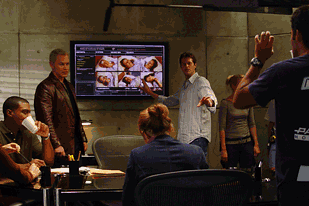
Stritch uses the cutting-edge techniques of global illumination, radiosity, bracketed exposures, extended dynamic range and digital stills approaching 50 million pixels in res, photogrammetry and 3D projected environments to create photorealistic effects that seamlessly integrate into live-action footage. Shot on film, the series is transferred to HD Res 1920 by 1080 pixels for delivery to air and for work in post, including the visual effects. The vfx team uses proprietary laser technology developed by Stargate Digital, Boujou, After Effects, Maya, Softimage DS and XSI.
Valeri Pfahning is lead compositor for the series. There are five to 10 artists on the show every day compositing, and an additional three for creating 3D constructs. Most are very experienced and familiar with the software.
The CSI Franchise
Zoic Studioscreates the visual effects for CSI: Crime Scene Investigation and CSI: Miami. Brickyard VFX in Santa Monica creates the effects for CSI: New York, some of the work coming out of the Boston branch of the company. According to Andrew Orloff, vfx supervisor for CSI: Crime Scene Investigation, the creative challenge facing all of the shows in the franchise is to keep everything fresh. Each show has a different look within the language established for the original show.
The different shows in the three series distinguish themselves by the use of different color palettes and storytelling styles. The color palette for the original, CSI: Crime Scene Investigation, uses neon colors and fluorescent green in keeping with its Las Vegas location. Stylistically it is very technical, getting right into the body. CSI: Miami uses a bright, orange color scheme. The series is more action orientated with story lines that include a hurricane, a firestorm and lots of water. CSI: New York has a more photorealistic, grittier tone and a desaturated look. Drawing on the claustrophobic feel of the city, the show focuses on minute details. The crew has used an endoscopic lens to get extremely close, close enough for an eye to fill a 16:9 frame.
Each show has three to four major exposition shots within the body the series signature effect. Orloff thinks one of the coolest things about working on the CSI shows is the combined application of traditional practical film effects using props and prosthetics with computer technology-based effects such as motion control and CGI. This combination of techniques has also been embraced by CSI: New York. VFX producer Michaels comments, We try to shoot practically and then enhance digitally where necessary. All of the shows use a variety of other effects, including production enhancements, sky replacements, snap zooms from wide shot into close-up, microscope p.o.v.s and even rats against a greenscreen. Each episode averages around 35 vfx shots.
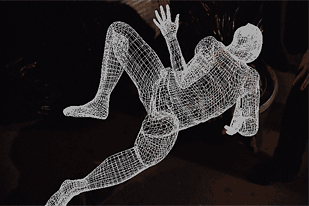
The process is set at production meetings with the episode director, department heads and second unit director. Accurate research is critical. To that research, the teams add the artistic component. Science and technology advisors Liz Divine, Rich Catalani and Larry Mitchell guide the vfx crews to assure accuracy in the forensic reconstructions. Both Zoic and Brickyard VFX use animatics or previs as part of their process. This CG storyboard helps both the director and the vfx team to visualize the sequence. It also helps in timing shots. It is an invaluable tool for the vfx teams, allowing them to get the shots right in the tight turn around time for visual effects in television usually one week after plates are received.
The CSI series are filmed and then converted to HD Res 1920 by 1080 pixels for post, visual effects work and eventual broadcast. High-speed digital cameras are used when explosions are required, because of the financially prohibitive cost of shooting massive amounts of film 8,000 feet in half a day for four takes. Zoic uses a combination of software Maya and LightWave to create effects while shots are composited in HD flame and combustion. Brickyard VFX has some proprietary software but also uses Discreet flame, inferno and various sparks software add-ons.

The crew for CSI: Crime Scene Investigation includes Orloff (vfx supervisor), Steve Meyer (digital supervisor/lead compositor), Dayna Cernansky (digital compositor), Lochlon Johnston (lead CG artist) and Kevin Quattro (CG artist). The crew for CSI: Miami includes Larry Detwiler (vfx supervisor), Michael Leone (lead CG artist/digital supervisor) Eric McAvoy (lead compositor) and Mike Davis (digital compositor). Vfx producer Rik Shorten and vfx coordinator Sabrina Arnold handle both shows for Zoic Studios.
The crew for CSI: New York includes Steve Michaels (producer, Brickyard VFX), Kathy Siegel (vfx supervisor, Brickyard VFX), Mandy Sorenson (lead compositor), Geoff McAuliffe, Patrick Poulatian (vfx designers) and George Fitz (vfx/compositing).
Without a Trace
Vfx supervisor Paul Linden supervises the creation of an average of 20-30 shots per episode, up to as many as 50. Although the series is set in New York, it is shot in Los Angeles, so vfx are used to reinforce the NYC location and include palm tree removal or the addition of a cityscape through windows. Other effects include gun flares, crowd replacement and New York backgrounds. Most of the effects involve compositing. Linden works with the dailies outputs, using a neutralized palette to what is shot.
The most obvious effects in the show are the flashbacks that show the audience what may have happened during the course of the characters disappearances. Linden would like to take credit for the effect, but admits that the effect is achieved in editorial on the Avid by combining a cross fade with a blur at the end and then fading to white.
Working out of an office in Hollywood, Linden hires artists and compositors as needed from a pool of talent that he has worked with before. His crew can be as small as three or as large as a dozen. Most of the artists work from home and shuttle firewire devices into the office as needed to complete shots. Post supervisor/producer Nancy Van Doornewaard is a valuable collaborator to the process.
Linden is involved in pre-production and on set during vfx days to make sure the process goes smoothly and correctly. As with all television post there is a time crunch. The vfx cant be worked on until the episode or at least the sequence is locked. Then the team has seven to eight days to deliver the completed effects. Wide handles allow for last minute changes. Yet despite the time pressures, Linden enjoys the run and gun environment. He relies on his experience to work instinctively.
The biggest technical challenge Linden faces is learning new software so that he can to push it to the limit to achieve the desired effect. Boujou is a favorite program. The show is shot on film and converted to a D5 master for work on the visual effects, then output to broadcast HD.
Mary Ann Skweres is a filmmaker and freelance writer. She has worked extensively in feature film and documentary post-production with credits as a picture editor and visual effects assistant. She is a member of the Motion Picture Editors Guild.