
Joe Strike visits the fourth annual Red Stick International Animation Festival in Baton Rouge and likes what he sees.

Red Stick International Animation Festival offered presentations on all aspects of TV and feature development and production. Writer Eric Shaw revealed secrets of writing for SpongeBob SquarePants. © Nickelodeon.
The Mississippi River city known as Baton Rouge, Louisiana has been around for 300 years or so, dating back to a French explorer's sighting of a red cypress pole marking the boundary between two Native American tribes.
Shape and color play a different role in 21st-century Baton Rouge, in the form of the city's Red Stick International Animation Festival. It's an event that's been growing in size every year since its 2005 debut; this April saw the city's Shaw Center for the Arts play host to its fourth go-round.
Red Stick is the joint brainchild of Stacey Simmons, head of the Baton Rouge Area Digital Industries Consortium, and Stephen David Beck, director of Louisiana State University's Creative Arts and Technology Lab. "My office started after the first festival," Simmons explains. "Its job is to develop opportunities in digital media, whether it's animation, special effects or video games. We wanted an economic development engine -- we have a lot of film production here and the state is very economical for tax credits, but we haven't really pursued animation and visual effects. We're going after that now in a big way."
For his part, Beck extols Baton Rouge's "great weather, great food and great people" -- and LSU as a generator of new digital talent. "The university is stepping up to the plate with new programs and faculty. We're hiring six new people in digital media over the next two years. Having that faculty, and students who study with them, gives you a knowledgeable workforce for local companies to draw on."
Red Stick started up with some help from England's Animex festival. According to Simmons, "No other U.S. festival covers the animation community and the animation business. Animex was doing that. When we went to Middlesbrough, we found we had a lot in common in terms of demographics, population and general economic standards. They'd been doing some incredible stuff. We asked if we could partner with them and they said, absolutely. It's been great." Animex's director Chris Williams reciprocates Simmons' feelings: "Events like this are about people first and foremost. The people here in Baton Rouge share the same views as us on how an animation festival can be so much more to a community than most events of this type."
Red Stick's multiple programming tracks make it impossible for any one person to take in everything the festival has to offer. One could learn about shows in development and production, participate in scripting, pitching and character design workshops, or go behind-the-scenes of special effects work and computer animation. The reclusive could spend the festival watching shorts and feature screenings at several venues: the Shaw Center's Manship Theater, the Louisiana Art and Science Museum just down the hill, or across the street in the castle-like Old Louisiana State Capitol Building.

Comet Entertainment's Raquel Benitez.
Inside that ornate structure, at the top of its curving central staircase, a series of cut-out wooden stick figures were arrayed across the tile floor. The tiny figures were waiting to be filmed by the festival's annual Animation Workshop group, led by Gary Schwartz from Detroit's College for Creative Studies. "We're showing the footage here first," Schwartz explained, "then we take it back to Detroit and make a soundtrack. When it's done, it'll be shown at the Beijing Olympics this summer, and next year it will be the festival's TV spot." (Last year's effort is on YouTube.)
Animation scripter Eric Shaw revealed secrets of writing for SpongeBob SquarePants in a full-day writing workshop. Casually mentioning that Nickelodeon's undersea star generates $1 billion a year for Viacom, he described working with story editors, spending hours getting one line perfect, and the difference between working solo and participating in a group "table write." "There might be 20 writers in a room collaborating, but you get your script fee when your name is on the script."
Show pitching was a major component of the festival, with several sessions devoted to the ins and outs of developing and selling animated series. Rugrats scripter and Disney development exec Barbara Slade hosted "Introduction to International Television Development Track," as she and Trade Media U.K.'s Isabelle Carriere, Corus' Jocelyn Hamilton and Comet Entertainment's Raquel Benitez compared notes on what their companies look for when acquiring shows. "A character-driven show will work anywhere," said Hamilton, but cautioned that "what we find funny isn't necessarily universal."
Slade told the audience, "There's a fine and confusing line between taking things to a certain level by yourself, because it's your vision and instinct, to not having a million people breathing down your neck telling you what to do. The stronger a project is when you bring it in, the less people are going to mess with it. But at the same time, animation is a group business. You'll be working in collaboration with a lot of people -- at some point you do have to let go of it."
Benitez told the story of a series pitch that wasn't going anywhere until the folks being pitched noticed a drawing of two Santa Clauses -- one in his traditional garb and the other in a business suit -- confronting each other. "The premise was Santa retires and hires a company to replace him. It was just a piece of paper but they said 'we're on, what do you need, what's the budget?'
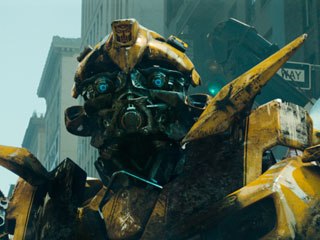
ILM's Tom Martinek gave an overview of "Bayhem" -- otherwise known as working with Michael Bay -- on Transformers. © DreamWorks LLC/Paramount.
"The idea was so clear that now, a year and half later, you can watch the movie. They didn't have to make a bible, or tell stories. Sometimes all it takes is a piece of paper and you've got it." That drawing turned into the animated feature Santa vs. Claus from Benitez's own Comet Entertainment that premiered as the festival's Saturday night closing event.
Later that day Slade headed up a pitching workshop where would-be producers practiced their spiels. "I'm tearing this apart -- not as your enemy, but as your friend," she told one. "You have a few precious minutes to get me to see what your series will look like on TV. It's the most obvious yet most difficult task. I've seen so many projects gone down the wrong road and the problem is always the same. I call it 'bible babble;' it doesn't tell me who your hero is, what's their world, what are their adventures."
The training culminated in Friday's "Pitch!" competition. Over the festival's first two days, the creators of each of the 25 projects accepted for the competition were given two "executive meetings" with industry professionals who selected eight to pitch in the final, onstage round. The finalists included would-be Adult Swim-type efforts, superhero shows (including one featuring an actor who strolled onstage as the spandex-clad "Daddy Man"), comedies and educational efforts, but the Red Stick trophy went to Natasha's Parrish's Junior Dynamos.
Parrish's effort, a comedy/adventure aimed at the 6-11 crowd, stars teen superhero "Bubblin' Betty," who comes to the big city in hopes of joining a superhero team, but instead winds up babysitting the heroes' super-powered offspring -- a well thought out (and excellently pitched) premise chock-full of characters rife with story possibilities for cross- and intra-generational conflicts. Parrish, a New York-based toy and graphic designer, said her inspiration came from watching "a lot of shows with kid superheroes who knew everything; I thought maybe they need some supervision -- they need to learn how to be heroes."

Jason Walker revealed the secrets of compositing live-action eyes with the stop-motion puppet star of the Oscar-nominated Madame Tutli-Putli. © 2007 NFB.
Technically focused events dominated the other end of the programming spectrum, including sessions on scripting Maya character rigs, designing content for hemispheric (i.e., planetarium dome) projection, or creating 3D Studio Max explosion simulations. ILM's Tom Martinek gave an overview of working with Michael Bay on Transformers. "We shot on back lots in Los Angeles and New Mexico... you know you're in a Michael Bay production when you see signs that say 'filming ahead -- gunfire, managed explosions & smoke.'" Martinek described working with the mega-budget director as "Bayhem" and the challenge of dealing with Bay's preference for using on-set pyrotechnics: "Using real camera shots makes compositing harder, but Michael thinks it's worth it because the actors react more realistically and that leads to a deeper cinematic experience."
Jason Walker revealed the secrets of compositing actual live-action eyes with the stop-motion puppet star of the haunting, Oscar-nominated short Madame Tutli-Putli. He created onscreen "wonder bars" that traced lighting changes throughout each shot and resorted to devices like balsa wood sticks to keep the actress's head framed properly and an aluminum strip across her forehead to match the shadow of the puppet's hat across its face. Although shot simultaneously, each of the actress's eyes was individually composited onto the puppet to compensate for the wider distance between them on the puppet than on the actress. According to Walker, the producers of Pirates of the Caribbean: At World's End consulted with him regarding their tentacle-faced Davy Jones. (While the live-action eyes in Tutli-Putli were matched to the previously filmed puppet, the Pirates actor was filmed first and his animated elements added afterwards.)
Rhythm and Hues' Hans Rijpkema traced advances in creating CGI animals, from Coca Cola's polar bear commercials, to the many companion "daemons" of last year's Golden Compass. He spoke of advances in depicting fur, from the polar bears ("they had no real fur -- just a fuzzy edge") to the "first real fur" worn by the star of Mouse Hunt, to the "77 hair types and 5,200,00 strands of hair" sported by the leonine Aslan in Prince Caspian.

Rhythm and Hues' Hans Rijpkema presented the history of CGI animals, including companion "daemons" from The Golden Compass. © 2007 New Line Cinema.
Rijpkema pointed out that "Hollywood has been using [painted] set extensions since Gone With the Wind," by way of introducing Rhythm and Hues clips featuring environments digitally composited from live-action and animated elements. For scenes taking place on a Middle Eastern apartment building balcony in The Kingdom, "we paved over the ocean and put a city on top" consisting of CGI buildings in the foreground backed up by a matte painting of the wider cityscape. For Tokyo Drift, "we filmed Wilshire Boulevard at 4:00 am, then added neon signs to turn it into Tokyo" and used R&H staff as the models in billboards decorating the ersatz cityscape. "I like effects," he summed up, "when you don't know there are effects in the shot."
Not many biology professors are consultants to major animated features, but California State University's Stuart Sumida is an exception. The animal anatomy expert has worked on over 30 films, beginning with Beauty and the Beast in 1990, and most recently guided Brad Bird's 11th-hour reworking of Ratatouille by helping the animators make the rodents more closely resemble their real-life counterparts. "They didn't want a bipedal orthograde mouse," Sumida explained. "Stuart Little had already done that. They wanted something between complete reality and a man in a rat suit."
Accompanied by dozens of slides and animation tests from the Pixar film's production, Sumida explained the minutiae of rat locomotion ("that was an asymmetrical true bound"), ear location, and the different swimming techniques of mice and rats. "I thought [the studios] would have less need for me with CG production, but my work for them actually increased," he noted. Beyond the pleasures of working with "incredibly creative people," Sumida pointed out the benefit his animation consulting has had on his teaching methods: "I don't spend two weeks teaching terminology to my students. When I can show them Scar or Simba instead of a dead cat, they're learning from day one."
"Animation Collaboration for a Cause" is a regular feature of the Red Stick Festival, created in partnership with Clifford Cohen's AnimAction organization. This year's effort, organized by Farah Kamal of the international educational group iEARN, teamed students from Uzbekistan and Pakistan with local Baton Rouge kids to create short cartoons on hurricane preparedness. According to Cohen, AnimAction exists to help kids address "global topics of concern" and past efforts have aired as interstitial spots on outlets like Kids WB! and Cartoon Network.

Cal State biology professor Stuart Sumida talked about consulting for major animated features, including Ratatouille. © Disney Enterprises Inc. and Pixar Animation Studios.
Bob the Builder character designer Curtis Jobling described how his casual sketches on the way to a publisher's meeting became the macabre children's picture book and the Flash-animated TV series Frankenstein's Cat. Jobling partnered with Corpse Bride puppet makers Mackinnon and Saunders, with the idea of turning the book into a stop-motion short, but "we looked at the character and decided he had more legs -- but not literally -- than for a short."
Key to expanding the simple concept into an ongoing series was adding an assortment of characters to play off the mad scientist and his pet, a point illustrated with a chart of an entire village of back-up players. Lottie, the lead character, was "aged up" to look more like a contemporary ten-year-old and the overall show given a "graphic novel, French comics" look. The session ended with a look at the show's first Flash animation test, followed by its stylish, Nightmare Before Christmas-style opening sequence.
The funniest project screened at Red Stick must have been Hildy Hildy, a TV series in the works from longtime Disney animators Dan Lund and Tony West. (Their 2004 documentary Dream on Silly Dreamer traced the shutdown of Disney's 2D animation studio.) Based on an improv character created by Los Angeles actress Patricia Scanlon, Hildy is a hilariously over-caffeinated, self-dramatizing, would-be haiku poetry star whose plans always seem to go awry. "Patti's been performing the character for 15 years," Lund explained in his presentation. In spite of attracting the likes of Lily Tomlin, John C. Reilly and Jack Black to a hole-in-the-wall downtown L.A. theater, Hildy's yet to break out of the underground, an injustice the series will undoubtedly remedy. "We pitched it to a popular cable network and they totally got it. They realized we were going for heart, not sarcasm."
A classical 2D special effects animator, Lund learned Flash to create the animated version of Hildy, an angular, dressed-in-black figure with a red slash of a mouth wider than her face. Lund described her as "stuck at 13 years old inside. Everything is either hope or despair -- a new pair of jeans can save or ruin your life." After his presentation, Lund talked more about developing the project: "This is what I was doing nights to keep me sane while I spent 80 hours a week on The Simpsons Movie, because that production was horrible.

Disney animators Dan Lund and Tony West screened their TV series Hildy Hildy, which Lund worked on during his down time on The Simpson Movie. © 2007 Twentieth Century Fox Film.
"You'd sit around for quite a while waiting for things you'd done to be thrown out while they rewrote the script. So I'd set a keyframe and do some work, then set another and it just added up somehow. I did get kind of obsessed with it, because I'd set my alarm for 4:00 am, then lay in bed setting key frames for her mouth and fall asleep doing it. But I had to get her out there -- I was just obsessed."
Lund (who is back at Disney doing effects work on The Princess and the Frog) and West (who now runs his own Orlando animation shop) were highly visible at Red Stick and on Saturday morning made themselves available to review the portfolios of aspiring animators. "We saw thousands of them at Disney," West told them, "the good, the bad and the ugly. We reviewed 2,000 portfolios for one open position. Five of us reviewed them together -- we had 10 to 15 seconds to make a determination based on a half-dozen pages." Lund and West gave the aspirants presentation tips ("put your portfolio in book form -- make it easy to flip through and pass around the building") and viewed their CD-ROMs. ("Put a pregnant pause in there," Lund advised a CGI student about his character motion test. "Sometimes what you don't do before a move sells the animation.")
The highlight of the Festival was "A Life in Pictures (and Sketches)," Friday morning's presentation by Disney's Andreas Deja, recipient of Red Stick's first Career Achievement Award. The celebrated animator brought along an amazing assortment of his original art, from the roughest of concept sketches to final animation drawings, which he projected for a rapt audience. A brief montage of his character work unreeled -- Jafar, Gaston, The Little Mermaid's Triton, Bambi's father [from the direct-to-video Bambi II], Scar and others -- work he summed up as "30 years in 2½ minutes." He gave the audience an inside look at the pressure cooker of Disney animation in the mid-1990s ("'Welcome to Aladdin -- you're behind schedule'") and detailed the combined process of refining the characters' personalities and physical appearances to bring them to life. ("Jafar has hands like a spider. You wouldn't want them to touch you -- ewcch!… There's a bit of Jafar hangover in Scar's eyes. You always carry over something from your last character into your next, especially if he's a villain.")

The highlight of the Festival was a presentation by Disney's Andreas Deja, the recipient of Red Stick's first Career Achievement Award.
Deja described how he obsessively reviewed original animation drawings from the Disney classics in the studio's archives. "I took out all the key drawings, separated them from the in-betweens. I'd analyze their styles -- Lounsberry, Frank [Thomas] and Ollie [Johnston], they all draw differently.
"There isn't one Disney style -- it doesn't exist. Frank is all loose and Milt [Kahl] is all precise… In the end you have to make it your own -- put yourself into your work. You can learn techniques, arcs, pacing… but if the emotion isn't there, you haven't gotten anything -- you're a technical animator."
Deja spoke movingly about his friendship with Johnston, the last of Disney's fabled "Nine Old Men," who had passed away just days earlier. "He was one of the most sensitive, soulful animators. He was very giving, and said things that made you think… 'don't animate drawings -- animate feelings…' He didn't think about drawings or design -- he thought about what's going on inside the character, and he crawled inside Bambi, Thumper, Penny [in The Rescuers], Baloo and Mowgli.
"I visited him once a week for the last few years. When I told him Disney was going to start pencil animation again, there was a big smile on his face."
In spite of appearances by top industry creative and technical people, festival heads Beck and Simmons still have to work hard to build a stronger and wider bridge to the heart of the entertainment world. "Our first year was the hardest," reflects Simmons. "It's been getting easier every year since then, but it's still hard to get the companies to bring their films here. I think [they don't understand that] we want to create an event that's not just for the Baton Rouge community. We want to have a showcase for animation and special effects for the entire film community. I don't think the marketeers and production companies get that yet, that this could be a spectacular venue for that kind of promotion."
That yet-to-be-leaped hurdle may be why independently produced features like Santa vs. Claus and the long-in-production Delgo, rather than WALL•E or Kung-Fu Panda, screened at Red Stick. "It's only our fourth year," Beck sums up, "but we're starting to get recognized by studios and people in the industry. When people come here and have a great time, they tell their friends and bosses, and word starts to spread."
Joe Strike is a regular contributor to AWN. His animation articles also appear in the NY Daily News and the New York Press.

Joe Strike has written about animation for numerous publications. He is the author of Furry Nation: The True Story of America's Most Misunderstood Subculture.