Tara DiLullo explores how Animal Logic and Digital Pictures handled CG weaponry, complex color palettes, on-set choreographed fighting and wire removal in Zhang Yimous acclaimed House of Flying Daggers.


In his acclaimed 20-year career, director Zhang Yimou has evolved into one of the most significant and prolific voices of contemporary Chinese cinema with his lush, historical themed period films, such as Judou, Raise the Red Lantern and Shanghai Triad. While his films have achieved praise outside of his native country, primarily in art house circles, the release of his martial-arts epic, Hero, last year launched the director into a new realm of cinematic storytelling, as well as mainstream Western recognition. Hero was already an international phenomenon for more than a year when it finally reached U.S. theaters in August 2004, stunning critics and audiences with its rich, lyrical take on the classic martial arts epic a genre the majority of American audiences finally became familiar with when Crouching Tiger, Hidden Dragon landed back in 2000. Zhangs new film, House of Flying Daggers, again revisits the Chinese martial arts epic for a story that challenges tradition by meshing period history, romance and cutting edge vfx into a dynamic film that pushes visual boundaries.
With the House of Flying Daggers script calling for a more ambitious visual effects agenda than Hero, Zhang collaborated again with his vfx house, Animal Logic, along with adding the services of fellow Sydney-based house, Digital Pictures, to get all of the visual elements created for the film. Andy Brown and Kirsty Millar, both of Animal Logic, worked as the co-visual effects supervisors on the film, overseeing 115 shots, with a total crew of around 40 artists and technicians working in a very compressed schedule, taking only six months from shoot to final visual effects delivery. At the same time, Jane Maguire, the post-production supervisor on the film at Digital Pictures, worked with the Sydney and Melbourne groups on grading, wire removal and a high-end bamboo forest effects shots.
As with all his films, Zhang set about creating a very visually specific look for House that Kirsty Millar explains was key in helping create the foundation for the early effects designing. Zhang Yimou uses symbolic visual devices, such as a color palette and seasonal changes, as his key storytelling techniques, she details. His films tend to contain nuances that are not evident from the script, so they must be demonstrated visually. It follows from this, that he utilizes visual effects in much the same manner to tell his story.
That story revolves around Mei (Ziyi Zhang), a blind dancer that is suspected of being connected to a revolutionary faction known as The Flying Daggers. The local police enact a plan to trick Mei into leading them to the group, but in their journey, one of the deputies falls for the young woman and they embark on a doomed love affair against the perilous backdrop of an impending confrontation with the authorities. The focus on the Flying Dagger faction meant that the usage of weaponry was going to be a core element in many of the visual effects featured in the many epic fight scenes staged throughout the film.
Upon reading the script, Andy Brown initially storyboarded some sequences to demonstrate the legendary traditional Chinese martial art of flying daggers, Millar details. We wanted to show Zhang some ideas about shots with fluid camera moves and the use of speed ramps to enable the camera to get close-ups of the CG weapon. The idea was to create a strong visual signature to highlight the power of the dagger-darts each time they appeared. This could be achieved by allowing the camera to travel fluidly in and around the weapon, in one continuous shot from the moment that it parts from the assailant until it finds its victim. The weapons were ultimately done in Maya and rendered in RenderMan. Having worked closely with Zhang already, their rapport in developing the right visual look was a truly collaborative process. Zhangs directing style on set is both precise and collaborative and his filmmaking process can seem quite fluid, she says. He will think up a plot twist and ask the vfx supervisors for ideas on how to visually convey a narrative nuance. Zhang is extremely focused and succinct in his direction, yet he is open to suggestion as to how visuals can be used to broaden the narrative, through vfx or otherwise.
A hallmark of the film is that it takes place in many natural environments shot on location, which meant the effects house often had to go to the production on numerous occasions. You have to be prepared for anything on set, much more so than usual, Millar says. Animal Logic had shown on Hero that we could respond to this challenge, creating solutions immediately, using the on set resources available at that particular moment to produce high quality visuals. For instance, many of the action stunts are spontaneously choreographed on location. Consequently, the visual effects must also be created in the moment. Andy and I would use our laptops to roughly pre-visualize visual effects concepts while on set in order to communicate them to the director and multi-lingual crew. We knew that time with the director would be scarce after the shoot wrapped, so we wanted to get the animatics well and truly underway whilst on set, so we did bash comps from the video split to mock up shots. This was fundamental to progressing the vfx editing, as we used these bash comps to lock down hero takes with the director.
The directors preference for stunning natural locations can also mean that shooting is often remote in terms of communication and accessibility, Millar continues. Internet access on location in the Ukraine was slow and some distance from our accommodation, so wed phone selects info through to the crew back in Sydney, whod then start working on some more refined animatics using the onelight rushes. The 3D crew, headed up by Luke Hetherington and Scott Hunter, also began modeling and texturing the CG weapons. Internet communication was much faster in the Chinese locations, so we found that a great way to get a creative brief of a shot across to the crew back home was to do a quick 2D animation and FTP that. So these bash comps that we did while on set served a multitude of purposes lock down of take by director, brief the Animal Logic crew back home in Sydney so they could commence work and any technical problem solving, and also serve as a first pass animatic for the director and editorial. Also, Zhang was determined to have the film ready for a May 2004 Cannes release, with visual effects shooting commencing early in September 2003 in the Ukraine. This compressed post-production schedule amplified any problems posed by an unpredictable shooting schedule in remote locations, so the director had to be sure that his vision would be translated quickly and seamlessly. Working with a crew who spoke only Chinese and Russian also made for some hectic moments on set. Although the crew were extremely accommodating to the crazy antics of the vfx team rushing around and taking measurements, the language barrier sometimes made for some exciting times. Wed often be shooting reference passes whilst the Ukrainian crew would be busy moving lights for the next set up, so wed have to quickly find a Chinese person who spoke English to tell another Chinese crew member who spoke Russian to ask the gaffer to please wait until vfx were finished shooting their plates, she chuckles.
Nature, as usual, wasnt always cooperative making for even more challenges for the team such as with a complicated snow sequence. Millar details, The hero and villain of the film, Jin and Leo, have been battling it out with swords in the fields through autumn, then the first signs of snow begin and the season changes to winter as they continue to fight on. This scene was shot in the Ukraine during November, when the weather turned suddenly and unexpectedly. Over a foot of snow was dumped in one night. Wed already shot a wide plate of the two actors fighting with the Carpathian Mountains in the background. After the snowfall, we re-lined up the shot and did another take. Andy shot some extra elements later in the Beijing Studios. Senior compositor Krista Jordan used the artificial snow shot against black and a matte painting by Evan Shipard to transition the two passes and create one shot where the actors are just continuously fighting as the season changes dramatically around them. The unexpected snowfall was one of those curve balls you sometimes get thrown on location, but it turned into a beautiful shot on screen, she smiles.

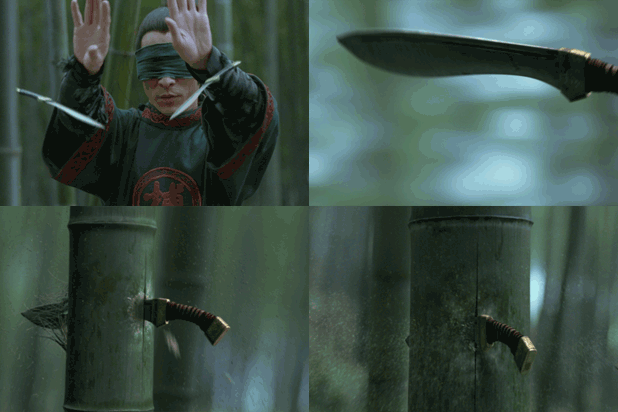
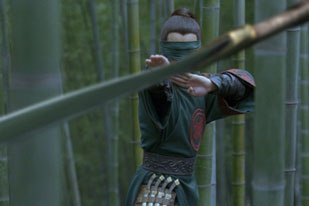
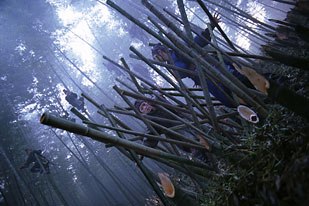
House also features the now requisite bamboo forest action sequence, but Zhang was very specific in wanting to create his own spin on the sequence by having the battle happen simultaneously on the ground and up high in the trees. That challenge fell to Digital Pictures and Jane Maguire explains DP Ilouras longform vfx animation team produced the series of shots for the dagger/ bamboo forest sequence. The daggers had to do quite specific things within the shot. In one shot, the daggers fly through the air in a choreographed motion around the actors hands, but the characters hands dont actually touch them. The same daggers travel on a long trajectory and land in the trunk of a bamboo tree. Both the dagger and the bamboo tree had to be simulated in CG to achieve such a detailed shot. The impact of the daggers involved some extreme close-up detail such as the impact point, the vibration of the trunk and the shards of woody material that fly out of the tree upon impact.
Aside from the more epic shots, House also features a host of the less sexy but necessary effects work inherent to a wire-heavy film, such a subtracting those wires and other seamless effects in every frame. We did a lot of work on the bean dance sequence and the fight scenes, Millar from Animal Logic says. The bean for the bean sequence were done in 3ds max and rendered with Vray. We did some other seamless effects, such as some blood reduction to keep the censors happy. There were also some location fix ups, such as the wide vista where Jin and Little Sis each ride down into the bamboo forest. There was a fair bit of forest extension required, which I shot some extra plates for with 2nd unit.
Over at Digital Pictures, Maguire adds, In Sydney, the vfx team completed 70 wire removal shots. Scans were supplied from Atlab at both 4k and 2k resolution. Some of the shots required removing up to 17 wires, making it a complex task. We also completed about 40 minutes of digital grading using the daVinci 2k. Neg Dirt and Data conforming when required was completed using both daVinci Nucleas incorporating Revival and Discreet smoke. Lastly, we graded the Green Bamboo Forest Fight, the Green Bamboo and the autumn sequences. These three sequences were probably the most intricate as far as grading was required, as it was imperative that the DPS team was able to separate the background color tones (green and yellow) as far as we could without effecting the facial and body skin tones. Multiple power windows were tracked into place and used throughout the grade to achieve this look. At all times both the cinematographer, Xiao Ding and the digital pictures colorist were able to visually see the sequences in context and had full control of the color grade at realtime. The original scans were supplied from Atlab via the CeNTIE fibre network in full 2k log color space providing all the film information available for grading, giving the colorist maximum latitude when using multiple layers of color correction.
Despite their accelerated schedules, the balancing of the effects work load allowed Animal Logic and Digital Pictures to get House completed on time and it was screened at Cannes, where it has since garnered acclaim and buzz equaling that of its predecessor, Hero. House of Flying Daggers opens in limited release on Dec. 3.
Tara DiLullo is an East Coast-based writer whose articles have appeared in publications such as Sci Fi Magazine, Dreamwatch and ScreenTalk, as well as the Websites atnzone.com and ritzfilmbill.com.