
From studios to independents to schools, Chris Robinson details the animation scene in Ottawa, from its humble, scientific beginnings to its current bubbling state.
The hottest animation area in Canada is not Toronto, Montreal or Vancouver, but Ottawa. Over the past 5-6 years, a flurry of activity has taken place including the appearance of original and service production studios (notably, Funbag Animation and Dynomight Cartoons), a developing independent scene, two major animation festivals (the Ottawa International Animation Festival and SAFO), schools (Algonquin College), a gaming studio, an already well-known hi-tech industry (Corel, Nortel etc.), and perhaps the biggest news (from a media standpoint) was the recent return of Ottawa native, John Kricfalusi, who is producing his series, The Ripping Friends in the Eastern suburbs of town.
Ottawa, you ask? Where? What? How?
Where?
Ottawa is located in Eastern Ontario between Montreal (2 hour drive) and Toronto (4 hour drive).
What?
The capital city of Canada is Ottawa. Ottawa, Ontario, Canada. That's right. Not Ottawa, Kansas; Ottawa, Illinois; or even Ontario, California; and definitely NOT Toronto. Ottawa, Ontario, Canada.
The word, 'Ottawa,' came from the Algonquin Indian word, Adawe, meaning: 'trader' or 'to buy and sell.'

The Prodigal Son Returneth: John Kricfalusi comes back with The Ripping Friends. © 2001 Fox Kids. All rights reserved.
How?
The first known people to occupy the area were the Algonquin Indians. According to early French visitors, the Algonquins were a particularly cruel and barbaric tribe (although this was later debated by subsequent visitors). Of course, whatever the truth, we know the French and English genocide cut the Indians stay short in North America.
In the 1700s, after the Brits defeated the French, a lot of Brits and Americans started settling in the area. After the War of 1812 between Canada and the U.S., the Rideau Canal was built to protect the St. Laurence River, a major shipping route, from any more American attacks. The bloke in charge of this was an engineer named, Colonel John By. In 1827, the area, not a major lumber town, became known as Bytown (after Col. By), although to be fair there were about four or five self-contained communities (and naturally they were all greedy buggers who were never able to agree on anything). Then, as now, the area was a land of division: French/English (Hull, Quebec is connected by a short bridge to Ottawa), Catholic/Protestant, working class/upper class.
In 1857, ol' fatty Queen Victoria, pissed a few people off when she choose Ottawa as the capital of what was then called Upper and Lower Canada. When Canada became a country in 1867, Ottawa was kept as the capital and that civil servant 'joie de vivre' has been in Ottawa ever since.
 Norman McLaren headed up a group of talented animators for the NFB. The award-winning Neighbours typified the artistic excellence coming from the early days of animation in Ottawa. Courtesy of the National Film Board of Canada.
The First Animators: NFB and Crawley
Given Canada's history, let alone Ottawa's, animation seems to be the last thing a bunch of rail men, farmers, lumbermen and bureaucrats would embrace. And not surprisingly, aside from a few sputters by Bryant Fryer near Toronto and Charles Thorson in Winnipeg, it took a foreigner (a strange term given the roots of the country where everyone was a damn foreigner!) to kick start animation. The first major animation producer in Ottawa (and Canada) was, naturally, the government created National Film Board of Canada (NFB). The first director of the NFB was an angry Scotsman named John Grierson. He hired another Scotsman, not as angry, but certainly troubled, named Norman McLaren, to join him. McLaren was put in charge of the animation division in 1943 and he hired bright young student artists from around the country: Rene Jodoin, Jean-Pierre Ladouceur, George Dunning, Grant Munro, Jim McKay and Eve Lambart (who was already in the photo department of the NFB). For the next two decades, the group made a number of inspiring and award-winning films (e.g. Neighbours) on Victoria Island in Ottawa. When the NFB relocated to Montreal in 1955 (to appease French-Canadians), animation in Ottawa effectively died.
The NFB was not the only film production studio in Ottawa; Budge Crawley founded Crawley Films in 1939 and made some attempts at animation, mostly small bits in the educational and industrial films. Their first entirely animated film was an industrial piece called Coal Gas (1946). After the NFB left, Crawley was the only major studio left and they scored a major animation deal in the mid-1960s when they animated over 100 episodes of the not so fine series, The Wizard of Oz.
In the 1970s, the most innovative work being produced in Ottawa was from the scientific division of the Federal government, the National Research Council. Two scientists, Nestor Burtnyk and Marceli Wein, became pioneers of computer animation development when they collaborated with the National Film Board and notably French studio producer, Rene Jodoin, in producing the acclaimed computer films Metadata (1971) and Hunger (1973).
Beyond that, there was little activity in Ottawa. In 1974, animator Vic Atkinson left Crawley to form Atkinson Film-Arts with Bill Stevens. The studio produced a number of TV specials including The Little Brown Burro (1978). Oddly enough, during this rather low production era, the Canadian Film Institute (which was created in 1935 in Ottawa) created the first Canadian International Animation Festival, which took place in Ottawa in 1976.
Animation activity continued to evolve in Ottawa in the 1980s. After Atkinson left Film Arts, Stevens bought Crawley Films and merged the two studios. Throughout the 1980s, Crawley's animation produced a number of children's specials including The Raccoons, Babar and Father Christmas, and two televisions series including Dennis the Menace. Other notable companies to emerge included Hinton Animation Studios (which took over The Raccoons) and KLA Visual Productions, a small operation run by the Atkinson family.
By the end of the 1980s, the picture was not so rosy in Ottawa. While the animation festival (now called the Ottawa International Animation Festival) had returned after a turn in Hamilton and Toronto, the Hinton and Crawley studios ran into enormous debts and folded. However the late-1990s expansion finds it roots in Lacewood Animation Studios, which was formed in 1987 by Sheldon Wiseman, the former head of Hinton. Lacewood's focus was primarily children's television shows (e.g. Katie and Orbie). In their ten years of existence, Lacewood produced over 200 animation TV programs.
Lacewood went under in 1997 after an arranged partnership with Toronto's Paragon Entertainment fell through. The idea was that the two would create a new joint venture called Lacewood Animation Productions, Inc. It failed. Lacewood closed its doors.
Ironically, the expansion that has taken place in the last few years owes a lot to Lacewood. New studios like Boomstone Animation, PIP Animation, Dynomight and Funbag all have former Lacewood employees in executive positions.

replace_caption_robinsonottawa06.jpg
The Big Players
The most successful studio locally is without doubt, Funbag Animation. In less then ten years, the studio (which was founded by Gord Coulthart, Don Spencer and Rick Morrison in 1993) has become a highly successful service studio, doing design, layout and storyboards for an impressive list of shows including: The Simpsons, Beavis and Butthead, The Critic, Ren and Stimpy, Real Monsters. In 1998, Universal Studios became a minority partner and in the last few years, the studio has moved into original productions (Toad Patrol) and expanded their service empire to Halifax, Nova Scotia where they are the principle owners of Helix Animation. Ongoing projects include For Better or For Worse (based on the comic strip) and Freaky Stories.
Dynomight Cartoons was founded in 1994 by Dan and Diane Craig. While Diane Craig had no animation experience, brother-in-law Dan had plenty, working for Crawley Films, Atkinson Film Art and Lacewood. Over a short period, Dynomight Cartoons grew into a respected service studio working for Nickelodeon, Disney, Nelvana and others. In 2001, they made the jump to original productions with Graham Falk's Mr. Bean-tinged, The Untalkative Bunny. In each episode, the Bunny goes through a variety of seemingly normal experiences. But unlike Mr. Bean, the show is really aimed at children who are also experiencing the world for the first time. The show was picked up by Canada's animation channel Teletoon and is one of their more popular shows, and arguably the best original production out of Ottawa.
Despite its current success, The Untalkative Bunny created a lot of financial problems at Dynomight, and thereby generated a lot of bad word of mouth locally. The $4.2 million (CAN) series was made with virtually no cash flow at the studio, forcing many of the animators (and a number of creditors) to go months without pay. "We thought, innocently," Diane told The Ottawa Citizen, "that right from the beginning we could turn around and do our own stuff. Well, of course it's not such an easy thing in animation. First, we had to grow the company so that we could bring in the animation and the talent."
While Dynomight has left some bitter tastes in a few mouths, it seems the company has overcome its fiscal troubles, paying back animators and creditors alike, rather than jumping on the convenient bankruptcy train. The studio is currently moving full steam ahead on a slate that includes the second season of The Untalkative Bunny, BBC's Noddy, and two more original shows that are in development: Dead Dog Café and Mushira -- Not Very Scary Lizard Friend.

Amberwood Productions concentrates on children's programming with shows like Hoze Houndz for The Family Channel. © Amberwood Productions, Inc.
"I knew in Sheridan that I wanted to run my own shop," says Lee Williams, president of Boomstone Animation. "It was always my dream." After graduating from Sheridan College, Williams began his animation career as an animator at Crawley Films before working at Hinton Animation and Lacewood. Williams initially set up Boomstone, along with Debra Wynter, to co-produce properties with Lacewood. When Lacewood went bankrupt, Williams was left with Boomstone. "The fact that Lacewood went out of business forced my hand to do something." Williams pulled out his rolodex and made some cold calls to various colleagues and contacts that he'd developed over the years and let them know that he'd started a new animation studio.
Boomstone is currently providing direction and animation services to Amberwood's Katie and Orbie series and is also working with Nelvana. Boomstone has yet to produce any original productions ("We're still young," notes Williams), but there are a number of live-action and animation projects in various stages of development.
The digital animation provider, PIP Animation opened their doors in 1998. "We started with three employees," says Dulcie Clark, "which quickly grew to twenty by year two, thirty in year three, and 110 in year four (due to five major series going through at the same time)." Currently they've got about 40 people. PIP does "basically anything that touches colour, effects and camera," including scanning, ink and paint, compositing, digital backgrounds, colour design, etc. PIP has worked for Funbag, Dynomight, Nelvana, Cine-Groupe, Spumco and Rich Animation on nine major animation series along with a variety of specials and videos.


Funbag, the most successful Ottawa studio, has worked on many shows, including The Simpsons, Beavis and Butthead and For Better or Worse (above).© Funbag FBFW (Series I) Production Company, Inc. Ocnus produces the dark and funny Kevin Spencer. © Kevin Spencer, Inc.
In May 1997, within months of the closing of Lacewood Animation, Sheldon Wiseman opened up a 'replacement' studio called Amberwood Animation. Amberwood has continued the mandate of Lacewood focussing primarily on children's productions (e.g. Hoze Houndz). In 2000, Wiseman, with the help of Canadian actor Leslie Nielson (Naked Gun), bought back the assets of Lacewood's library.

Greg Lawrence, founder of Ocnus. Photo courtesy of Ocnus.
One of the more interesting studios is Ocnus Productions, which was formed by Greg Lawrence in 1998. The company does both live-action and animation, and has gained attention for its provocative series, Kevin Spencer. While Spencer looks like it was animated by the kids in special ed, it is occasionally a very dark and funny parody of the dysfunctional family. Kevin is an alcoholic teenage sociopath who lives with a variety of bizarre and psychotic family members. South Park, naturally, comes to mind because of the raunchiness and poor technical quality, but Spencer is something different, especially for us 'nice' Canadians. Spencer has been a modest international success. NBC bought the first episodes to include on Saturday Night Live (it's not clear whether they ever aired) and Spencer was recently sold to Australia and Spain.
Miles from Kevin Spencer is Ocnus' next production, Leonard the Monkey. With a whisper of J. Otto Siebel's design style, the series follows the viewpoint of a six-year old monkey.
The latest, and most uniquely named, studio to hit town is NOITAMINANIMATION, founded by Jason Belec in 2001. The name, as you might have noticed, is animation spelled forwards and backwards. "The essence of what we offer, better animation capability."
NOITAMINANIMATION is a computer animation house that does rendering, modelling, complete projects (TV, film, commercials, corporate, etc.), full sound production, post editing, effects, and, well...you get the picture. Their creative director is former Disney animator, Peter Beilicki. The company has also done a number of original productions including the TV shows, The Dragon and The Phoenix and Gay Dinosaurs (yes...that's correct), along with some shorts called Digital Prisoners and Dandelion.

Ocnus runs the gamut with the dysfunctional Kevin Spencer (top) to the innocent six-year-old Leonard the Monkey. © Kevin Spencer, Inc.; © and title held by Leonard the Monkey, Inc.
Hi-Tech and Beyond
Ottawa is often referred to as Silicon Valley North because of its hi-tech community, which has its roots in those early National Research Council projects. In many ways, this technological boom stimulated the animation community's growth and led to a more diversified field. There are improved production and post-production facilities in Ottawa. In the past, producers had to leave town to get work completed. And there are also a couple of gaming companies Sir-Tech (formed in 1994) and the old man of the scene, Artech Studios, which was formed way back in 1982. One man who has been involved with both studios is the ubiquitous young animator, Cyrus Hogg.
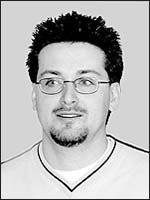
Jason Belac, Senior VP & Chief Technology Officer of NOITAMINANIMATION, feels that the lack of long term goals harms the animation industry. Photo courtesy of NOITAMINANIMATION.
"I started in animation thanks to James Cameron," says Hogg, "who I called back in '92 when I was still in high school and trying to figure out how to incorporate animation with computers." Hogg attended Algonquin College and studied there for a year before getting hired by Sir-Tech. Within six months, he was the lead animator/artist. After two years, he joined Artech Studios, where he helped acquire and complete Hasbro-Lucas products such as Star Wars Monopoly and the Star Wars Playset. After a brief stint in Toronto, he returned to Ottawa, where he produced and directed two live-action/animation music videos, Mr. President and Smile Like an Angel, for local reggae artist, Bingie Barker. Hogg has also been doing contract work with, among others, Stephane Faulkner (another important figure in the local animation scene) and his company, Digital Glass. Last month, Hogg was invited to Nova Scotia to help set up motion-capture hardware and software for a local college. Last Christmas, Hogg started a small production company called Cy's Matters.
Schools
Ottawa's Algonquin College first offered an animation program in 1989. The program was founded by former Sheridan College animation graduate, Gerry Paquette (who also worked as an animator on many Canadian television productions in the 1980s). "It was the second professional animation training program in Canada and the first to incorporate computers into its curriculum. We were also the first to include drama as one of the courses." The two-year program has grown from one class of twenty-five students to three classes and a third year will be added in early 2003. "The emphasis of the program," says Paquette, "is drawing with feature quality in mind. Traditional animation techniques are taught as well as life drawing, character design and layouts. Computer training includes Photoshop, Premiere, After Effects and TOONZ."
In 1998, Paul West took over as coordinator of the program so that Paquette could focus on the development of a five-month digital animation fast-track program. "I continue to coordinate the Computer Animation Fast-Track program, which is the first of its kind to target the new trends in animation. The focus is on animation produced for the Internet, multimedia and games. Both 2D and 3D techniques are covered along with several support courses."
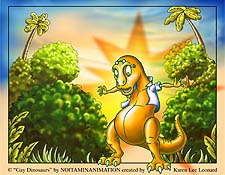
The palindromic NOITAMINANIMATION, which produces Gay Dinosaurs, offers full-service animation production facilities in Ottawa. © NOITAMINANIMATION.
Aside from an animation history course at Carleton University (taught by renowned animation scholar and curator, Mark Langer), the only other educational possibility for the youngins is the Ottawa School of Art. Jan Beath started the animation program in 1999. The aim of the school says current instructor, Gerard Belac, is "to prepare students for further studies in animation, build a better portfolio or seek a career." More specifically, the program was tailored toward students who were hoping to pursue animation at a college or university level. The program covers basic animation, life drawing of human and animal figures for animation, character design, painting (Photoshop and watercolor), layout and storyboard, concept and history of animation, drawing for animation (perspective and still life) and sculpture for animation (model making, stop-motion, 3D design). This hefty course load, which has about 15 new students every year, does not allow for any time to make individual films, although a few have done stop-motion pieces.
 IFCO member Calvin Climie at work on Hyperhelion. © 2002 Calvin Climie, hyperhelion animation. Photo: Owen Oulton.
Independents
While the bubbling productivity of the studios is economically good, it is the sudden emergence of a modest independent animation scene in Ottawa that is most encouraging and refreshing in a town that has often been labelled a "hick" town. A major contributor to the development of an indie scene is the Independent Film Cooperative of Ottawa (IFCO). The Co-op, formed in 1992, provides a more economical and casual alternative to the hefty fees that film schools extract from young, starry-eyed youths. IFCO production has mostly been in live-action film, but a handful of filmmakers have tried their hand at animation. Bridget Farr made a sombre scratch/live-action piece about alienation in the city called, Nobody's Nothing (1999) and most recently, Calvin Climie made what is possibly the first independent animation feature produced in Ottawa called, Hyperhelion (2001). But the two most successful IFCO members are Dan Sokolowski and Brian McPhail.
Sokolowski is perhaps the most important individual in the local Ottawa film community. Aside from his own experimental films, he has given an amazing amount of time and energy to many young filmmakers serving as both technical and creative support. Sokolowski is pretty much unknown to the animation scene primarily because his work combines live-action and animation, which is apparently horrifying to the puritan animation festivals.

replace_caption_robinsonottawa14.jpg
Sokolowski's first four films were entirely animated. While still a student at the University of Ottawa, he made his first film, Seraphim (1980), a simply drawn short about a snake chasing the sun. "I made it in Super 8 and then blindly applied for a grant to re-shoot it in 16mm and the Ontario Arts Council gave me a grant. When I went to Crawley's to get it shot, I found out the actual costs! They were incredibly nice to me, the animation cameraman [Ron Haines] gave me a great rate and the production guru [Paul Harris] sat me down and taught me all about post-production. It was that freedom of information that really made me like the film industry. I found people were always willing to share knowledge."
Following Seraphim, Sokolowski made Revolution and Picture Frame (both made in 1984). Both films are reminiscent of animator Rene Jodoin in their examination of the movement and perception of geometric shapes. After completing his fourth animation film, Photosynthesis (1984), Sokolowski grew tired of animation. "I think I got really tired of the process, hours and hours of planning and drawing for minutes of satisfaction."
During this period, Sokolowski travelled across Canada and became interested in the country's varied and striking landscapes. "I was amazed at the variety of images that we have in Canada, so I became a little more interested in photography and cinematography. I drifted away from animation a little but I think I always used the same process for creating the films; once I had footage I would draw each shot and then order them for a paper edit, so I was in effect, taking those photos and animating them in a way." Aside from Still Life (1992), Sokolowski has continued to mix animation and live-action in his explorations of the Canadian landscape.
The mixed method has caused reception problems for Sokolowski, especially in animation where he has been almost totally ignored by international animation festivals (even Ottawa). "The artists thought I was a filmmaker," says Sokolowski, "the filmmakers thought I was an animator and the animators just thought I was bad! People seem to need to pigeonhole things, even within filmmaking. You're either experimental or dramatic or documentary, or if you're an animator you're cel or clay or oil. If you mix things up people seem to get confused and unsettled in a way. It's too bad. I think animation festivals sometimes look too much at the craft and not enough at the ability of the medium to express. A great animation film has the same aesthetics as a great film, but it seems to get lost in discussions about technique and 'how long it took'!"
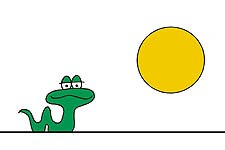
Dan Sokolowski discovered the Ottawa animation community's willingness to share knowledge when he made Seraphim, his first animated work. © Dan Sokolowski.
Sokolowski's most recent film, (winter)time (2001) is getting more attention from the animation community (including an upcoming screening at the Zagreb Animation Festival). Rooted in the abstract jazz films of Norman McLaren, Sokolowski interprets a version of George Gershwin's Summertime (called winter time) using seven styles of animation. "I had always liked the sense of freedom in McLaren's Begone Dull Care, but thought if I just did animation to jazz it wouldn't really be anything new. I heard the jazz piece (winter)time by the Peter Togni Trio and it really caught my attention; mostly as a totally different take on a tune that has been done to death. Their description of it as opening with a trudge through a slushy street in Toronto really hit upon me that they had made a truly Canadian piece out of a really southern American classic. I thought that I could do my Begone Dull Care to this music." Amazingly, the film took six days to shoot and three days to edit.

See how Dan Sokolowski combines an American music classic with a Canadian sensibility in (winter)time. © Dan Sokolowski.
Brian McPhail has no formal training in animation. He learned by "messing around with super-8 stop-motion in high school a little bit." He was strongly influenced by Rankin/Bass Christmas specials: "I think that was the first time I understood that a complete functioning world could be created on a table-top." Merge Rankin/Bass with a love of Tim Burton, David Lynch and Dr. Seuss, and you find a pretty strange animator.
The international animation scene best knows McPhail for his inverse-Cat Came Back short, Stiffy The Dog (1996), which is about a boy who receives a dead dog as a birthday gift. Stiffy the Dog was made as part of IFCO and McPhail initially wanted to do a live-action film, but when he couldn't find "a convincing dead dog," he decided to make a stop-motion film. McPhail also consciously wanted to make a dark film. "Other IFCO films all seemed a little soft. They were either cute or politically correct or otherwise harmless. I wanted to piss people off with a very incorrect (but still funny) film."
McPhail only spent two months animating Stiffy and the result was a funny but poorly animated film. "It was too fast and, along with my inexperience at the time, it hurt the quality of animation. I think I was more or less satisfied with it when I was finished but in hindsight I can see how bad it really was and now I can't even watch it." Nevertheless, Stiffy was invited to a variety of festivals, including its debut at the '96 Ottawa Festival, and was picked up by Spike and Mike where it was toured across North America. "When it was shown people reacted to it pretty well and I realized that I managed to do what I was trying to avoid: I had made a cute film that made people happy."
One happy viewer was Marilyn Read of Ottawa's MTR Entertainment (the company that gave the world another Ottawa product, Tom Green). Read saw a review of Stiffy when the Spike and Mike Festival came to Ottawa and called McPhail to discuss making a TV series of the film. "I was sceptical but she was pretty convincing so we went ahead with it. Only three episodes were made for insertion into Buzz [a comedy show that is produced for Canada's Comedy Network]. It didn't really fit in with Buzz and the last I heard was that MTR was still trying to sell it somewhere."
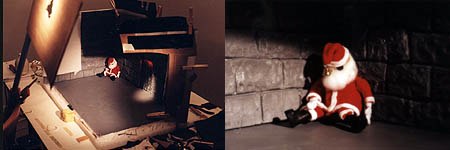
Brian McPhail's Down A Dark Chimney. © 2000 Brian McPhail.
Following a nifty little live-action piece called Bury Me Happy (1996), McPhail made the dark and wildly imaginative film Down a Dark Chimney (1998), about Christmas during the Nazi era. In the film, the Nazis take Santa prisoner while he's delivering presents. What begins as a Christmas parody á là Corky Quakenbush, soon turns into a dark powerful film about a desperate man trying to flee from his torturers. "I was making dinner one night (beans) and as my mind wandered (as it does most of the time) I imagined Santa being beaten in prison. I thought it made an interesting image so I built up a story around it. It was originally going to be a comedy but as I got deeper into the planning I thought it would be more effective if done straight, although most people who see it think they are watching a comedy at first."
McPhail is currently making a short "pseudo-experimental piece involving animating to music."
Outside of IFCO, there are a variety of scattered independents, most of whom have steady day jobs and simply make animation films out of a passionate need to do so.
Troy Little, a native of Prince Edward Island, studied illustration at Sheridan College and, despite having no animation experience, found work at Dynomight Cartoons. "They were looking for people who could bring something different to the studio," he explains. Currently, Little is splitting his time between the developments of his own series for Dynomight and publishing a comic book series. He also operates his one-man studio, which focuses on both animation and comic books (Little is the creator of the comic series, Chiaroscuro).
Nick Cross entrance into animation was quite by chance. He graduated from Sheridan College in the same illustration programme as Troy Little. "Troy had moved to Ottawa and gotten a job at Dynomight, which was just starting up at that time. He then recommended that they hire me; and since I was a complete failure at finding any illustration work, I blindly took the job and moved here from Mississauga. That was in 1996 and I've been here ever since." And despite working on "TV kiddie shows," Cross became hooked on animation, and wanted to try doing his own work. "Im a bit of a workaholic and I found myself wanting to try to make something of my own. I was frustrated at seeing my fellow workers treating animation as simply 'a job.'" Cross met Graham Falk, who was also at Dynomight, and was impressed with Falks determination. "Here was someone who had just thought up an idea [Untalkative Bunny] and then gone ahead and made a film out of it." Cross then went ahead and developed his first animation short, Tea for Two, a witty subtitled parody of Ingmar Bergmans The Seventh Seal. In the film, a farmer and dog sit comfortably in living room chairs and proceed to have a hefty conversation about death. The dialogue for the film was originally taken directly from a scene in The Seventh Seal where Death and the Knight discuss mortality. In the end though, Cross couldnt get the rights to Bergmans film and had to use actors speaking mock-Swedish. The use of subtitles was also an extension of Cross drawing animation insecurities: "I realised that if I made a subtitled cartoon, everyone would be too busy reading the subtitles and wouldn't have time to scrutinize the animation."
Motivated by the positive response to Tea for Two, Cross set up his one-man studio, Do It For Me Productions. "I knew that I was going to keep making more films and I figured it would be a good idea to give my productions a name." Cross hope is that Do it For Me Productions can one day expand into "a viable environment where independent-minded artists can come together and create films while at the same time possibly make a living doing it."
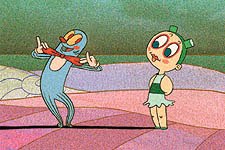
Nick Cross and Tavis Sibernagel created the very funny U-Girl. © Nick Cross.
The first film made under the Do It For Me banner was the very funny, U-Girl (2000), a parody of propaganda cartoons. "It was just a silly little idea that I had -- a 'fake' Nazi propaganda cartoon. Tavis [Sibernagel] and I both had a passion for old cartoons from the Twenties and we started to experiment around with this style." In fact, both Cross and Sibernagel collaborated on each other's films and produced Fruit, Juice! Protein? (directed by Sibernagel, who has since moved to Halifax) and U-Girl over a three-month period.
Sharon Katz's first animation film, Happy Birthday Hannah (1999) was made as a birthday gift to her daughter. "I expected it to take about two weeks to complete," says Katz. "In fact, it took two years." Katz was trained as a painter but turned to animation when a friend bought her an animation workbook. "She knew my paintings well and believed that storytelling would be instinctive to me. The animation was a natural choice since I already had the drawing skills. I spent a year just working on the exercises in the book, drawing hundreds of walk cycles and head turns."
In creating Hannah, Katz used an old Macintosh computer and found an old software program called MotionPaint. "That was a critical point because without the use of a computer working in animation requires expensive cameras and film and all the gear that comes with that." MotionPaint is an obsolete program, but Katz found it easy and effective: "It does a fabulous job of allowing onionskins; and the user interface is simple, direct and very intuitive. I've tried almost every animation software on the market and I keep returning to MotionPaint just because it is so simple and intuitive to use."
Most recently, Katz completed her second film, The Angel's Foot Cake (2001) and is starting work on a third film with the help of Belgian-Canadian artist, Jean Detheux. "Jean introduced me to the graphics synthesizer, Synthetik Studio Artist last year. While Painter tries to replicate real world media, Studio Artist lets all that go and works with digital media for its own graphic values. It also presents a paradigm shift for me. While some structure is essential to a narrative, I find working too tightly with a script and storyboard very rigid. Coming from a painterly background I've missed the immediacy of following the work's lead, rather than forcing the work along an orderly path. So in this next film I'm looking forward to shifting direction a little."
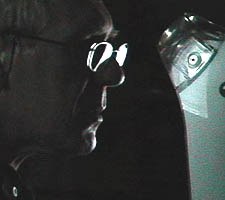
Health reasons led artist Jean Detheux to computer animation. © Ottawa International Animation Festival.
Jean Detheux was born in Belgium and moved to Canada in 1971. He is trained as a painter and has taught art across Canada and the U.S., and had exhibitions of his work across the continent. He moved to the Ottawa region (he lives in Perth, Ontario, which is about an hour's drive from Ottawa) in the early 1990s and today he teaches a digital art class to Junior High students and is an advisor for the Directed Study Program at the Academy of Art College in San Francisco.
Detheux's interest in animation evolved out of a very serious illness. "About 8-9 years ago, I became very ill and this was found to be caused by sudden severe [deadly] allergies to many things, including solvents and most of the material I used in painting for so many years. That was the brutal end of my serious involvement with natural media, extremely depressing." Detheux's wife urged him to sit down at a friend's computer and try the "painter" software. "That was a real revelation, and the opportunity to renew my marriage to image making. Very quickly, the digital tools being so very different from natural media, animation appeared not only as a possibility, but as an intense need."
Since then Detheux has produced a variety of digital paintings and digital abstract expressionist animations, and is well known to AWN readers for his series of provocative articles about the decay of animation.
My Bread and Non-Hydrogenated Margarine
On the festival front, the Ottawa International Animation Festival (OIAF) has grown into the second largest animation festival in the world (after Annecy). It attracts a large mix of students, teachers, independents and studio executives. In 1997, the OIAF created the Ottawa International Student Animation Festival (SAFO), which focuses on student and emerging animators. SAFO was the first of its kind in animation and it has had three editions and spawned imitators in Russia and Korea.

John Kricfalusi's return to Ottawa to make The Ripping Friends was warmly welcomed by the local animation community. © 2001 Fox Kids. All rights reserved.
Our Ripping Friend
Last but not least, perhaps the most impressive pat on the back for Ottawa animation came in 2001 when John Kricfalusi (Ren and Stimpy) returned to his hometown. Kricfalusi is making his new series, The Ripping Friends (a superhero parody in a similar, subtly raunchy, vein as Ren and Stimpy), in a basement rec room in the Ottawa suburb of Alta Vista.
Kricfalusi returned to Ottawa for a few reasons. First, because of the lower dollar and our tax breaks, it was cheaper to produce The Ripping Friends in Canada. Secondly, he loathed the Hollywood bullshit. But most of all, it seems that Kricfalusi just wanted to come home. As he told The Ottawa Citizen: "I've been wanting to move back for a couple of years anyway, and this was a good excuse to do it." Whatever the motivation, Kricfalusi's return to Ottawa gives the city and its emerging animation community a nice boost of confidence and a bit of visibility. "There's a really good animation pool here and Algonquin keeps turning out a whole pile more each year. There's no shortage of animators, that's for sure."
Da Future
Then as now, there are no guarantees that animation will continue to thrive in Ottawa. The hi-tech industry was hit hard in recent years, as was the animation industry. "[We've] been dealt some serious blows with poorly run studios," says Jason Belac, "and the short sightedness that is rampant in the industry that lets assets [people] leave on nearly every job."
"I have seen some really, really low times," adds Lee Williams, "and I have seen some great high points. I see all the other studios building themselves up, and that's a great thing. I see more and more animators moving back to Ottawa from Toronto, out East, out West and that's a good thing."
While the movement away from service work toward the production of original pieces is encouraging, what is far more inspiring is that despite the on-going uncertainty facing commercial studios, the fledging independent scene is, if not thriving, at least growing. Many of the independent animators in town have day jobs and create animation out of need and desire, not financial necessity. Not since the days of McLaren and Jodoin has there been such a community in Ottawa.
This started out as a short 1500 word piece, but because of the amount of work and history in Ottawa, it turned into something much bigger. So...the next time one of you comes up to me and asks, "Why is the Animation Festival in Ottawa and not Montreal or Toronto?" I'll slap you in the back of the head and dance on your freshly soiled grave. Got it?
Thanks to all the animation folks who gave me their time. I'd also like to acknowledge
The Ottawa Citizen, where I filled in a few gaps when people couldn't.
Chris Robinson is the artistic director of the Ottawa International Animation Festival and the Ottawa International Student Animation Festival. He is also the editor of the semi-annual
ASIFA Magazine. Robinson has curated film programs and served on festival juries throughout the world. He writes a monthly column ("The Animation Pimp") for Animation World Network and has written for Salon.com, Cinemascope, Take One, 12gauge, City Pages and others. Robinson contributed a chapter on English-Canadian animation to the book, North of Everything: English-Canadian Cinema Since 1980. He is currently working on two books: Between Genius and Utter Illiteracy: A Story of Estonian Animation (March 2003 by Varrak Publishing) and a biography of an ex-hockey player, Doug Harvey: Like There Was No Tomorrow (Spring 2004, Boheme Press).

A well-known figure in the world of independent animation, writer, author & curator Chris Robinson is the Artistic Director of the Ottawa International Animation Festival.