
Production designer Alex McDowell and previsualization supervisor Ron Frankel speak to Bill Desowitz about the wonders of the craft.

Production designer Alex McDowell and previsualization supervisor Ron Frankel are on the cutting edge of previs. They have collaborated on Fight Club, Minority Report and The Cat in the Hat, and are currently prepping Steven Spielbergs Terminal. Separately, Frankel also worked on Panic Room, getting a further taste of working with director David Fincher, who is a renowned previs practioner in his own right. Over the past few years, McDowell and Frankel have expanded the creative possibilities of previs, going beyond the notion of a design and approval tool for the director. When given the opportunity, they have made previs a hub between various departments: assisting with 3D budgeting and the hiring of vfx vendors, and helping to drive the look of the entire production, encompassing all digital assets. In other words, McDowell and Frankel are strategically using previs as a way of breaking down barriers between pre- and post-production.
The advent of 3D animation tools has just meant you can take that same lineage and keep pushing forward so that what you end up with is a tool that ultimately gives everybody access to a much deeper level of information than has ever been accessible to productionin pre-production, Frankel insists. And thats the beauty of it because you get access to all this information before youve committed yourself to anything. So we can do all this planning, we can do the animatics and watch how the sequences play out. The director can make editorial decisions, the production designer can make set design decisions, we can make location decisions. Lighting is still the one area that hasnt filtered into it yet.

McDowell agrees. Looking back on Fight Club, they had a previs group that consisted of two or three animators and a support person that helped with the building of models, including the explosive climax where buildings in the background collapse. It was extremely dense, McDowell suggests, and everything was planned and composited together with these different buildings from different parts of L.A. So we started setting up the camera angle to inform the 3D, but it all had to be put together in 3Dflattened but made into a Photoshop image that we could translate from. Previs was the only available tool. All told, we worked with half a dozen different sequences involving a few shots that were prevised. Our turnaround time was a dayso we could show Fincher something in the morning and then get comments from him at the end of the day.

Minority Report Opened New Possibilities for Previs
McDowell adds that Minority Report became a defining previs moment for this dynamic duo. We were developing a mechanical, global setting for the story, so we used previs extensively for all the urban planning and the mag lev [magnetic levitation] design and how it was all connected to the geography and the relationship to all of Washington, D.C. As far as animation studies for the way the mag lev worked, we did a lot of that in previs. In the early version of previs, we speed-tested the cars, so it was really this great analytical tool for working out the logistics of the physical set pieces. How much of the car are we going to build? Although a lot of that data was used in post, ILM took stacks of our visual files, which they translated into their final stuff. Apart from getting feedback from Steven [Spielberg] a lot of it was stuff we never saw. Which is to say that back on Minority Report we retooled what previs was from being kind of an animatic storyboard translator for the director into something that was much more integral to the art department for me. But as it happens, every part of that was informing the digital environment. The other great thing about Minority Report was that we got a lot of the other departments involved in previs like the key grip in planning the super techno crane shot with the overhead camera following the spiders in the tenement in a single shot. It was designed with a model of a techno crane and a model of a set, which translated into it being a live camera move instead of a motion control shot. It was so extensively prevised that they just set it up on the screen.
Both McDowell and Frankel like the idea of keeping previs down and dirty and accessible. However, the production designer acknowledges that it isnt the sexiest thing to show off at vfx conferences. I think a lot of people cant get beyond the surface, beyond the crude look so that they understand the actual sophisticated data that they can use. They just dont get it. To that end, Frankel is currently huddling with previs colleagues to come up with another name that better describes its multifaceted functionality.
Ultimately, what youre looking for is raw data, Frankel suggests. How big is it? How wide is it? How tall is it? How far away are we? How fast are we traveling? What piece of camera equipment might be able to do that move? Will it fit in the stage? And for all those kinds of things, you dont have to go beyond the simplest shaded style. It doesnt look impressive visually. But I always fantasize about the cyberspace version of previs where the numbers are streaming out of it to convey to people thats what youre looking at.

Ambitious Previs Plans for Panic Room Were Scrapped
At the outset, Panic Room was intended to be shot on a very condensed schedule and Fincher wanted to previs the entire film. He brought in his editors to work out each sequence in pre-production, Frankel adds. He worked out the design of the set in pre-production, we worked out all the camera moves based on our previs and fed all this information to the art department during the design phase then it would go to the composer for scoring; basically they would be able to start post-production during production.
Due to Nicole Kidman getting hurt and being replaced by Jodi Foster, the whole schedule got thrown so they ended up not pushing it in that direction. We did really rigorous documentation of every camera setup, creating the blue print. It became further visualization and refinement for Fincher. The [assistant director] got a lot of good info because it was a four-story set and there were a lot of crane moves, and moving a crane around a four-story set was quite an ordeal they had to assemble and disassemble it so the ad had a lot of information about scheduling.
[Previs] was helpful to the art department in terms of set construction where walls needed to be wildand set dressing issues in terms of continuitywe had the biggest picture of where everything should go, and for all of the visual effects previs was good for sending out to vendors for bidding; and in a couple of instances we sent out our previs as plates so they could actually start working on the final visual effects.

On Minority Report and Cat in the Hat, however, previs was integrated into the entire production in terms of 3D set design, illustration and locations. Instead of it being a peripheral tool, previs became useful as data shooting across the network. We had actual 3D set designs coming out of previs, props coming out of previs, McDowell says. The data became totally fluid and previs became this nexus where everything comes in.
Not only that but the previs on Minority Report prevented the kind of cost overruns that were experienced on Spielbergs earlier Artificial Intelligence: AI. The visual effects supervisor from ILM, Scott Farrar, was on the production and he had access to previs, Frankel relates. He and his producer were throwing up red flags, so we were able to incorporate all their comments so that when information was either going to or coming from Steven they had their budget in mind already.
There was one instance during the mag lev where Tom [Cruise] is trying to make his escape and hes crossing the city. We were involved in the early design of the city and the conceptual artwork was beautiful, but Scott told us that [we were too spatially ambitious]that he wanted it all in a tunnel, basically. But what we ended up doing is working between Alex and Scott and Steven on a healthy balance that everybody likedyouve got the money for those shots, they feature the design of the city well enough and they tell the story. And that to me is one of the ways in which you know the process is working well.

Shifting Gears with Cat in the Hat
Cat in the Hat, meanwhile, was the most prevised project theyve worked on separately or together. Oddly enough, director [and former production designer] Bo Welch wasnt proactive with previs like Fincher. We used it the way we wanted for very complicated interactions that have nothing to do with direction, McDowell asserts. How the set breaks apart, set extensions, how the house starts out as a conventional architecture and is transformed into something more complex. The whole house was built in 3D and then was stretched and pulled and distorted in 3D with form-Z. We had to start planning like a theme park ride that goes through the middle of this house, and it gets very expensive to do with visual effects, and you want to keep the Cat and the kids in-camera as much as possible, so we really got into tweaking by feet where the set extensions were and modifying it daily. We were analyzing ways of cutting down set extensions with visual effects, making those decisions internally.
This was a completely organic set where very few people could get their head around it. We built a neighborhood in Simi Valley, preplanning all of that. We did early planning in AutoCAD and form-Zsending it out to set designers and working out camera moves. The opening is this big swooping shot over practical landscape, 3D landscape, into a larger matte painting with 3D architecture that has at its core an in-camera practical set.

Frankel adds that previs helped determine the dramatic transformation of the house in Cat in the Hat, which is like a character unto itself. The geometry, he says, is incredibly complex as a result of the whips and folds and bends. Its great to see how fluid the process becomes. They have this clay model and went through a series of revisions and then at a certain point committed to it and went back into 3D.
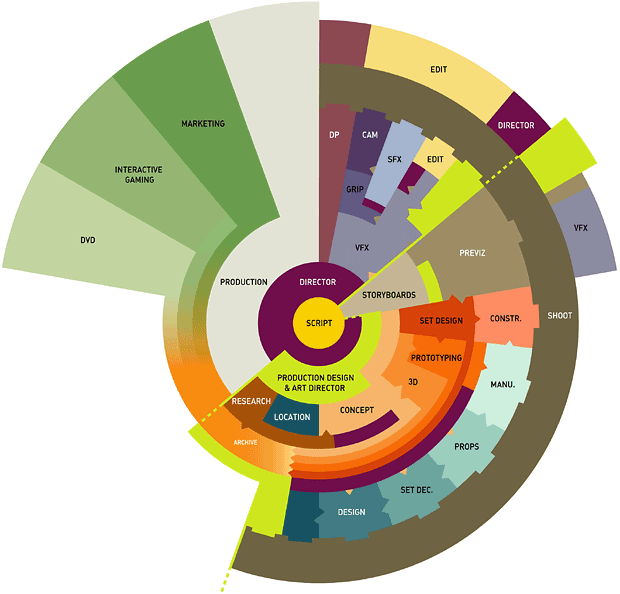
McDowell enjoys this pure data flow in which the art department and visual effects team are brought in early on through previs and the process starts connecting. Previs, in essence, plugs directly into storyboard, set design, concept design and vfx. What were trying to do is get to the point where this translation, through previs, through the whole 3D digital tooling, really has a direct flow to post, McDowell asserts. And by the way were archiving, everything also gets used in marketing and DVD. And in terms of the gaming, probably Cat in the Hat is the first time the gaming company had ever been brought into pre-production to actually be shown a model that was using data that they could directly take and build from.
Previs Reduced the VFX Load on Terminal
The previs work on Terminal, a romantic comedy starring Tom Hanks as an Eastern European immigrant stuck in a New York airport terminal when his country and identity are erased, is very different from Minority Report.
Terminals interesting, McDowell suggests, because Steven is not storyboarding at all not a frame. Its one huge environment. I mean, 95% of the movie now sort of takes place inside the airport and the big set [built in Palmdale] is probably 60% of the film, and so he has a 3D environment so he doesnt have to storyboard. What we did was put together a series of sample shots totally based on what Steven saw in dimensional model and simultaneously built a physical model of the airport.
Theyve just become a catalog of ABCstyle of shots and levels of complexity, which gives a very accurate shot breakdown. Based on the kinds of technical shots, the effects guys seem confident that its accurate as well. Basically what we have is one huge window in the set and a situation where were building backing so Steven can decide in post where his shots are going to hold. This is interesting because this is a character-driven movie and were setting it up in previs so that Steven can ignore the visual effects issue and just think about what he has to shoot within this space.
At the same time, Ron and his teams been building a very architecturally accurate 3D model of the exterior, which is wire frame, so we know whats exactly out there, but also that the datas going directly into a straight pipeline to visual effects. But because there are nine months of season changes that occur in the story, weve got a 3D matte painter and a bunch of guys with computers who are just starting to do lighting and rendering. So weve put all our money into a model thats based on the previs that is derived from the interior architecture of the terminal.
McDowell and Frankel are currently making great strides in bringing vfx teams earlier into the process via previs. They point to the great divide between practical and virtual set design, and how previs helps provide visual clues that allow more seamless transitions. Were just looking at different aspects of production and theres something very remarkable about getting production designers, visual effects supervisors and producers who are really buying into it, Frankel observes. Obviously because they just get that, its all about speed and more control.
Bill Desowitz is the editor of VFXWorld.

Bill Desowitz, former editor of VFXWorld, is currently the Crafts Editor of IndieWire.