
Karl Cohen has found a copy of Winsor McCay's long lost lesson on animation. Read about what it contains and what these tidbits mean to animation's history.

Animation pioneer Winsor McCay draws Gertie the Dinosaur for a group in this undated photo.
Winsor McCay is well known as the creator of the first animated cartoon star, Gertie the Dinosaur, 1914. He also is remembered for his animated recreation of The Sinking of the Lusitania, 1918 and for his long and amazing career as a comic strip artist. He also wrote Lesson One, but his work as a teacher of the art form he helped to create has long been forgotten.
A copy of Lesson One printed in Applied Cartooning, Division 11, a correspondence course from the Federal School of Applied Cartooning, Minneapolis, Minn., 1919, was shown to me a few months ago by one of my animation history students who remembered seeing an image in the lesson in class. He found it in a junk store and had no idea it was a rare document. He considered it an old fashioned oddity and was wondering if it had any value (perhaps the influence of Antique Roadshow). It is so obscure that I can find no references to it in printed bibliographies about animation. When I told John Canemaker, author of Winsor McCay, His Life and Art, that I had a Xerox copy of it, he asked for a copy. He had seen a 1923 version published by the school. It is mentioned in a footnote in his book.

McCay worked hard to make Gertie the Dinosaur's breathing pattern realistic.
McCays 15-page lesson isnt everything you ever wanted to know about the subject, but it does give insight into his work and his optimism for the future of animation. It was one of the very first published accounts of how animation is done. It dates a year before the publishing of Edwin George Lutzs Animated Cartoons: How They Are Made, Their Origin and Development (1920), the manual that Walt Disney and Ub Iwerks studied when they were beginning their careers.
Terms Have Changed
As you look at the pages of this manuscript reproduced in this issue, one of the first things you may notice is that McCays terminology is different from our present animation vocabulary. He never mentions animation cels, but says he uses transparent, bond and tracing paper. He says flit and flitter pad while we say flip and flipbook. At one point he mentions that seeing little flipper advertising pads gave him the idea that he might be able to create a film based on sequential drawings.
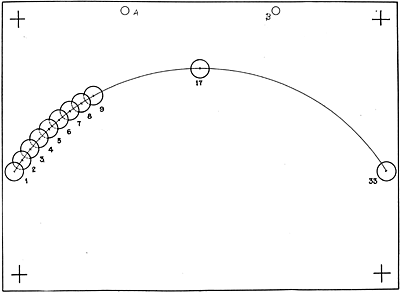
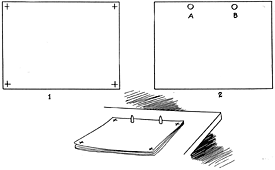
The crosses at the corners indicate register markings by means of which you place each subsequent drawing in correct position over the preceding. If you use punched paper and pegs on drawing board you may dispense with register marks. McCay reveals his invention, the split system, in his writings for Lesson One in Applied Cartooning, Division 11. All illustrations © 1919 Federal School of Applied Cartooning.

The most important technical knowledge he shares with us is what he calls his split system. He says it is my own invention. His system was used to carefully lay out and time an entire sequence. He began by laying out the path of the movement for the sequence on page number 0. The finished guide was then used under other drawings that were made on separate pieces of paper placed one at a time over the guide. This gave him the correct position for each drawing.
McCay tells us he began by drawing the first and last images of the sequence (extremes, he doesnt mention using key drawings), and then his center or middle drawing. He calls the center image the split drawing. By the 1930s this was known as the breakdown drawing or the passing position. If he were animating a sequence that was going to end in an odd number of drawings then he would have an even number of drawings on either side of his split and his split would be equal distance from either extreme. He then drew his subject midway between his split and an extreme, and continued drawing in this manner until the sequence was finished. McCays discussion of drawing for animation ends at this point (Richard Williams The Animators Survival Kit barely begins at this point) and he moves on to discuss his career, achievements and the future of animation.
The Real Basics
One of the charms of this publication is how primitive and unsophisticated it is. Most of the basics presented to students today are not discussed. There is no mention of squash and stretch, yet he used it for humorous effect in his first work Little Nemo, which premiered April 8, 1911 according to John Canemakers research. While he does present us with a ball in motion, there is no acceleration and deceleration. His drawing guides or charts show his movements spaced between the extreme positions.
In his discussion of timing he explains that when Gertie is lying on her side he wanted to show her breathing. He realized it doesnt take as long for us to inhale as it does to exhale, but he couldnt get his timing right by using his wristwatch. He says that by watching the second hand on a large clock he was able to figure out the correct timing of the sequence accurately. The movement of Gertie breathing while lying on her side is subtle, natural looking and the sequence is quite charming.
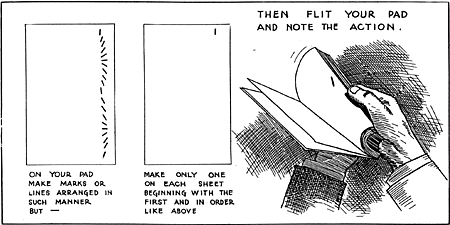
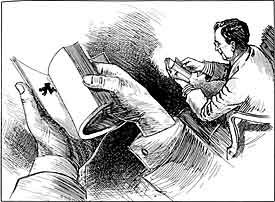
"Flit and flitter pads" are McCay's name for flip and flipbooks.
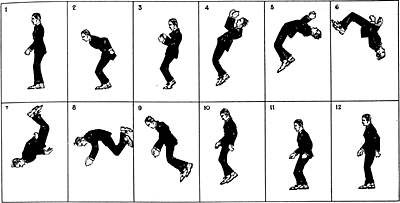
In his lesson, McCay stresses that the ability to time the progress of an action accurately is essential to good animation.
One aspect of his work that has always amused me is his flair for exaggeration and showmanship. He loved exaggerating how many drawings were in his films, so it was refreshing to read his discussion of repeating cycles of drawings as a labor saving method. He says there were over 15 repetitions of the cycle of Gertie breathing while she was lying on her side.
As for his love of exaggeration, he claims Gertie required him to make 10,000 drawings (mentioned in a title card in the live-action introduction to the film), yet the animated portion of the film is around 4 minutes long when it is run on a sound projector. (If I had measured the length of time title cards were on the screen the actual amount of animation might only be around 3 minutes long.) Gertie was made before cel animation had been invented so each frame of the film was one drawing that included both the star and the background. He had to redraw the background in each frame plus whatever his star was doing. Since his registration system wasnt perfect the background shimmers somewhat. There are close to 5000 frames/images of film in a 4-minute sequence if the projector is run at sound speed (24 fps).
Patent Confusion
A touchy problem for McCay was created by our countrys patent laws. He mentions several times that he had created the art production methods he used, but has no desire to patent his techniques. What he doesnt say is that others filed patents for similar approaches to the animation process. Earl Hurd filed a patent application for a process using transparent cels over an opaque background (granted June 15, 1915 and filled December 14, 1914). John R. Bray obtaining a copyright in 1914 for a registration system similar to the one McCay discusses (two round pegs or pins). Bray and Hurd formed a partnership and animators using cels with a pin registration system were supposed to pay a royalty fee for using the Bray-Hurd System until their patents expired.
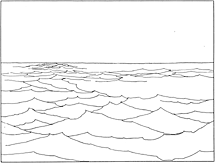
Nowhere in his article does McCay talk about using transparent animation cels (perhaps to avoid infringing on Hurds patent?), yet he shows a background drawing of water from The Sinking of the Lusitania, 1918. There is a vague reference to using transparent paper (does such a paper exist?). In The Flying House, 1921 his last film, he calls himself the inventor of animated drawing in one title card and in the next card he announces the work was done using the Winsor McCay Process of Animation. I suspect he felt it necessary to defend his claim to be the inventor of drawn character animation and that he was troubled by Bray and Hurd patenting key elements of the process.
Other Questions and Speculations
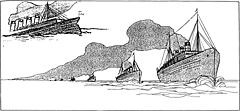
I can’t begin to speculate why McCay wrote this lesson. It appears he assumed the students might not be too sophisticated or talented as he doesn’t discuss some of the more complex animation problems he had solved in the making of The Sinking of the Lusitania. He was adding rich textures and tones of gray to his complex drawings while his contemporaries were content to draw simple characters that were black lines around white spaces. These artists did not seem interested in creating fine art. Their jobs demanded that they were able to draw their work quickly so they could meet their production deadlines. In contrast McCay loved rich details and seemed to take pleasure in creating sophisticated movements. In some sequences of Lusitania it appears that he used several layers of cels to create a complex play of movements between the ship, water and smoke.
The illustrations that accompany the text are, for the most part, not up to McCay’s standards. The drawing of Gertie is not from the 1914 film (different background, the film didn’t use shading and Gertie’s eyes didn’t look like circles placed on top of a head). Other illustrations appear to be drawn in an uninspired mechanical manner that is unlike McCay’s published work. I assume much of it was drawn by an assistant or even by somebody at the correspondence school. It is possible that only the Lusitania images came from McCay’s pen.
The historic information in the text is useful for several reasons. His mentioning that Gertie premiered in 1914 is important as several old books and articles have stated she was animated in 1909. I know a pompous animation teacher who still says she was created in 1909. There must be a lot of other people with the wrong date lodged in their brains as well.
McCay discussing his lack of success with his first two films should be sobering information for novice animators. Unfortunately a lot of projects are begun without everything being fully developed in the creator’s mind. If you are a young animator, hopefully your endeavors will be more successful than McCay’s first two works. While you won't face the same problems he had, you may be able to avoid others both big and small by running your ideas past other people.
The remaining 6 lessons in this book provide basic instructions on how to work with cut-outs, how to build a drawing table, ways to create movements without having to redo the entire character in each frame, etc. Some of the text focuses on how to create simple eye catching moving images that can be used to promote local merchants in movie theaters. It appears that by 1919 there were jobs available in several cities with firms producing these advertising films. Perhaps you have heard of one or two artists who got their start in the industry creating this type of work in Kansas City — Walt Disney and Ub Iwerks.
There is also an informative section on how to do chalk talks before a live audience. The book tells how to do these talks by using prepared gimmicks and other techniques that have little to do with filmed animation. Including these talks in the book was important in 1919 as animators could earn extra income presenting them. McCay’s Little Nemo premiered April 8, 1911 as a movie short in a theater, and later that month he premiered a different version of the film on a New York City vaudeville stage as part of an in-person presentation. Gertie was also introduced to vaudeville audiences by McCay. The opening page of McCay’s lesson includes a drawing of him on a stage standing next to his dinosaur on the screen.
Karl Cohen is President of ASIFA-San Francisco. His first book, Forbidden Animation: Censored Cartoons and Blacklisted Animators in America, is published by McFarland Publishers. He also teaches animation history at San Francisco State University.