
On the occasion of the official Disney tribute to the animation legend who passed away in April, AWN offers remembrances from those who knew and were influenced by him.
As part of the Ollie Johnston tribute, a photo montage created by Rick and Ken Johnston is now available for a limited time on AWNtv.

Invitation to the Special Life Celebration for Ollie Johnston held at Disney's El Capitan Theatre in Hollywood on August 19. © Disney.
The passing of the remarkable Ollie Johnston, the last of Walt Disney's original hand-picked team of animation pioneers, marked a sad transition for everyone who's ever enjoyed a Disney film. It also caused me to reflect not just on how much this magical man meant to me personally, but how much he influenced generations of animators, Walt Disney himself, and the shape of entertainment in general. Ollie remained passionate and enthusiastic about the art form he helped to invent well into his advanced years. He made a rare return visit to the Walt Disney Animation Studios in Burbank on his 94th birthday in 2006 and was surrounded by throngs of young Disney artists who came to celebrate the occasion. We showed him some of the new films we were working on, and his eyes flashed with excitement and welled up with emotion. Five months later, I visited him for the last time at his home in Flintridge, California. His energy was low, but his love of animation, interest in the future of the medium, and curiosity about our projects was as strong as ever.
Humble, quiet, and unassuming, Ollie was a master of his craft. Through his artistry, imagination, hard work, and determination to pass along the knowledge and experience of Walt Disney and his fellow "Nine Old Men," he proved to be an invaluable contributor to popular culture. In fact, modern animation would not be what it is today without the patience, wisdom and guidance of Ollie (and his equally brilliant and talented creative partner and lifelong friend, Frank Thomas).
I first encountered Ollie when I came to the Disney Studios in 1979. A wet-behind-the-ears graduate of California Institute of the Arts (CalArts), my first assignment (and Ollie's last) was on The Fox and the Hound. I now realize what a unique opportunity I had to learn from the guys who invented the art form. Ollie would flip my stack of rough drawings one at a time. He would place clean sheets of paper over my drawings and suggest how the poses and visual expressions could be improved. Most importantly, he taught me to animate feelings, not drawings. It was never about the animation; it was always about what the character was thinking and feeling. It was such a fundamental thing but it brought the character to life. It was an epiphany for me and I began to analyze my own body movements and how every thought process informed every movement.

(Left to right) Milt Kahl, Marc Davis, Frank Thomas and Ollie Johnston (seated) with Walt Disney. © Disney.
Ollie explained to us that no two characters would perform a similar action in the same way, and even the same character would have different approaches to the same action depending on his or her emotional state. He cited the Dwarfs in Snow White as an example of similar-looking characters with wildly different personalities and emotions. This knowledge proved extremely useful when I was animating the early experimental computer-animated short Luxo Jr. and tried to show the difference in personalities between the adult and child lamp characters strictly through their movements. And it was invaluable to us in creating the characters of Woody and Buzz Lightyear in Toy Story. Who they are and what kind of toy they are informed their movements. Woody, an older stuffed cloth cowboy with plastic hands, feet and a head, had a Gary Cooper laid-back personality, while Buzz, an older toy made of rigid plastic, had a buff, well-trained military kind of attitude.
While I was at Disney, Ollie and Frank began writing what was to become the "bible" for every animator -- their landmark book Disney Animation: The Illusion of Life. Many of the young animators at Disney would gather in the big story room on the second floor of the Animation Building to watch them pin up illustrations and vintage drawings as they laid out the book. On display were some of Ollie's most wondrous and heartfelt creations -- the distinctly personable Dwarfs from Snow White, the inventive Pinocchio lying to the Blue Fairy, the graceful centaurettes from Fantasia, Thumper's recitation about "eating greens" [in Bambi], the self-caricatured Mr. Smee from Peter Pan, Dalmatians Pongo and Perdita, and the carefree Baloo and his pal Mowgli, to name a few. We sat at their feet while they regaled us with stories and patiently answered all of our questions about the "old days." Ollie would tell us about the men who influenced him. He told us how Norm Ferguson's brilliant animation of Pluto stuck on a piece of flypaper gave them new insights into how a character would think and react, and how it elevated all of the animators to new levels of acting. And he talked about Fred Moore's approach to his work, and how he would spend most of his day thinking about a character's actions and analyzing every possibility before ever touching a pencil to paper.
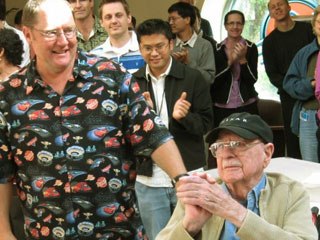
John Lasseter and Ollie Johnston at Walt Disney Animation Studios on the occasion of Ollie's 94th birthday. © Disney.
Ollie's legacy extends beyond animation. As a train enthusiast, he had a small steam train that ran around his home. He was the one who really got Walt excited about trains. The morning after learning about Ollie's hobby, Walt arrived unannounced at the animator's house to see the train for himself. He caught the train bug and then he built his own backyard railroad, the famous Carolwood Pacific Railroad. This led to wanting bigger trains, which became a major motivating factor in planning Disneyland. Ollie's passion for trains led him to buy an old narrow gauge steam engine, which he lovingly restored and operated for many years at his vacation home. The train was named the "Marie E." after Ollie's wonderful wife. Years later, when Ollie became too old to enjoy the train, I made arrangements to buy it from its interim owner. When I told Ollie the news, his advanced years seemed to fade away and he gleefully exclaimed, "You bought my train!" On May 10th, 2005, I arranged for Ollie to engineer his train one last time at a special ceremony down at Disneyland. When he heard the whistle blow on the Marie E. and saw the train come into view, he began to cry -- and so did the 100 friends, protégés and studio officials gathered there that morning. It was a moment that none of us will ever forget.
I'll also never forget Ollie's enthusiasm and encouragement when I left Disney to pursue computer animation at Lucasfilm Ltd. I invited him (and Frank) to speak to our small group of pioneers. The principles of animation that I learned from them gave me an edge in this new frontier, and were 100% responsible for our success there and later at Pixar. Competitors would ask what software was I using to make my computer animation so funny. Ollie taught us that it's not the tools that make something entertaining; it's how you use them. He was very excited about the possibilities for the future, and when he tried the computer himself, he told me, "I wish I was young again."
Ollie's mentoring and the teachings of Walt's "Nine Old Men" helped us advance computer animation from being perceived as a cold, soulless, perfect kind of imagery into an art form that came alive with characters that had warmth, heart and emotion. No one thinks of Toy Story as a computer-animated film. They get caught up in the story of Buzz and Woody. The principles of animation that we learned from Ollie became the foundation that built Pixar and set us apart from all the rest. The success of our films with audiences and families all over the world is a tribute to his achievements. It never would have happened without him and the other great animation pioneers at Disney. We proudly try and carry on their legacy in everything we do today at Walt Disney and Pixar Animation Studios. The world is a much happier place thanks to Ollie Johnston. His characters will live on forever; he helped to train some of today's top animators and filmmakers (including Brad Bird, John Musker, Ron Clements, Glen Keane, Andreas Deja, among others), his books continue to inspire future artists, and the love of trains that he shared with Walt led to the creation of Disneyland and continues at Disney theme parks all over the world.
John Lasseter, Chief Creative Officer, Pixar and Disney Animation Studios and Principal Creative Advisor, Walt Disney Imagineering.
Ollie Johnson was many things. He was a modest man... with a deep aversion to hyperbole. He would be embarrassed for me to say that I think that he made film history with his contributions to the Disney legacy… and he did it with a keen imagination and a pencil. He would try to stop me from talking about his genius for creating characters that will continue to inspire new generations of artists and enthrall moviegoers of all ages. And he would be humbled at the idea that we will be studying his work for decades to come. He never stopped being either a teacher or a student. And he would quietly dismiss the idea that he was a genius… but it's all true. And because of the power of film and its ability to capture someone's talents forever, Ollie Johnson will never be forgotten.
Jeffrey Katzenberg, CEO, DreamWorks Animation
I met Ollie when he and Frank were touring with their new book The Illusion of Life in the early '80s. They had a great little show where they would talk about the old days and show clips from the movies. This was at the Ohio State Computer Graphics Research Group in Columbus. I loved that they were embracing the bleeding-edge animation technology that was emerging then.
I remember talking to John Lasseter on the phone around that time, when I was working on a short called Tuber's Two Step and he was starting work on Luxo Jr. We agreed that computer animation had a long way to go before we could achieve the performance art that Illusion of Life outlined. We were amazed that so much of what we considered research was already laid out plainly in that book. In their talks Frank and Ollie made it clear that technology might be changing, but the principles of character animation remained the same.
My wife and I got to know Frank and Ollie a tiny bit over a dinner or two with their lovely wives Marie and Jeanette. They were all wonderful old friends, drawn together a generation before by work that they clearly loved. They told great old stories, but were fascinated with what was still to come in the evolution of animation. Together they expressed a way to work and live that I have aspired to ever since.
Chris Wedge, Co-founder, VP of Creative Development, director, Blue Sky Studios
When we started building the animation group at Imageworks in 1995, my first move was to bring Frank and Ollie in to do a lecture on the Art of Animation. In two magical hours they inspired a company to approach character animation from a viewpoint of emotion and acting. Their legacy of inspiring and grooming the next generation of talent inhabits every corner of the Animation world and at Sony I am privileged to be able to help carry that torch forward.
Barry Weiss, SVP, Animation and Artist Development, Sony Pictures Imageworks

Disney celebrated the work of Frank Thomas and Ollie Johnston in this 1995 documentary.
My start date at Disney was a little after Frank and Ollie retired. I did meet them however, along with Ward Kimball and Marc Davies, at a special Disney event on the Burbank main lot. It was a big deal for me -- their animation had brought me from a tiny mining community in South Wales, all the way to Burbank California; Frank and Ollie had a way of making dreams come true -- mine not the least.
The thing I remember about Ollie was that his advice to me was strangely prescient, even though at the time it caught me completely off guard: At the age of 27, in 1989, I was just starting work as an effects animator on The Little Mermaid, and I was wrapped up in the various ways that one might draw ocean waves, bubbles -- that sort of thing. Now considering Ollie was in his 70s, you might think that at his time of life, animation was all about the art of hand-drawn images -- that perhaps one might forgive him for being somewhat dismissive of computer animation. Well, this was absolutely not the case... when I told him that I was just beginning in effects animation, he told me to start "learning about computer -- that is the way of the future." Twenty-five years later I remembered Ollie's words as I watched the insanely beautiful waves in Surf's Up wash across the screen.
Ollie (and Frank) were predicting that animation would evolve into the art form we know it to be today. Far from having "settled" into being dinosaurs of an antiquated craft, these guys, even through the end of their lives, were true artists, and engaged in pushing the limits of animation. So, from the point of view of someone who has watched the animation world change dramatically over the last decade, I know that in Ollie's passing, I celebrate his spirit as much as his immeasurable legacy of animation.
Chris Jenkins, Co-writer and producer of Surf's Up
When I was growing up in the '70s, there wasn't much information on how to animate available, so I learned mostly through trial and error. The discovery of Frank and Ollie's book The Illusion of Life was an incredible revelation. I was stunned by the detail and clarity of the techniques. I had always admired Disney films, and I knew that the characters and acting were miles ahead of anything else at the time, but because of Frank and Ollie's book, I knew why. Their talent has had a tremendous influence on me as an animator, and has continued to inspire me throughout the years. Ollie Johnston's contribution to the art of animation is immeasurable. In today's world of digital animation, the fundamental principles that Ollie helped establish are more important than ever.
Spencer Cook, Sony Pictures Imageworks
I grew up in Minnesota. In 1982, when I was 24 years old, I traveled up to Ottawa for the animation festival. One afternoon they held a retrospective honoring the lifetime achievements of Ollie and Frank (with both in attendance). It was a very moving and inspirational experience.
That evening, as I was leaving my hotel room for dinner, I pushed the elevator button. Ding! The doors slid open... standing there with their wives where Ollie and Frank! I stepped in and mumbled something about how much I appreciated their work and thanked them.
They were very gracious and warm. It was the best elevator ride of my life.
Tom McFarland, Anoka, Minnesota

Ollie (left) and Frank try on some new shoes in Marken, Holland in August 1984. Courtesy of Hans Perk.
I first met Ollie Johnston when he visited Holland in 1993, together with his good friend and fellow animator Frank Thomas. It was a wonderful and inspirational experience. In the 14 years after that memorable day we stayed in contact through letters and lengthy telephone conversations. His enthusiasm for animation made me aspire to have a career in animation too, and I think myself lucky to have been working in the animation industry for the last six years. Ollie's passion for animation and his patience in answering all the questions I had through all those years will remain in a very warm place in my heart. Without him my life would have been completely different. Like Ollie had Freddie Moore's pencil taped to his window for inspiration, I have one of Ollie's pencils hanging next to my animation disc. It has never failed!
Hans Walther, The Netherlands
Ollie, like Lounsbery, was the type of person you were drawn to. Soft-spoken, easy to talk to. Never had a mean thing to say about anybody or their work. Ollie threw himself into the characters he did, and I feel he expected the same from you. He could tell when you put your all into a scene, and he didn't hold back his opinion when he felt you just knocked it out to get some easy footage. Ollie was very generous with his knowledge as well as his time, and will be fondly remembered by a lot of us.
Dale Baer, Character animator for Walt Disney Animation

A 1998 Xmas card in which Ollie depicted himself and Marie as Grant Wood's iconic characters. Courtesy of Tim Hodge.
I've had the pleasure of working at Disney Animation for nearly 20 years, both in Los Angeles and in the Florida studio. Every one of those days, I've walked the hallways passing one of Ollie's characters, a drawing of his or a photo of the man himself. His imprint on what Disney Animation was... is... and will be is indelible, in the very DNA of this place. I only met him in the latter part of his life, but through his work, I feel like I've known the character of the man all this time. Ollie lives on.
Chuck Williams
Ollie's work has naturally been an inspiration to me. His insights into character and character development have had an unparalleled influence on my career. But beyond his artistic achievements, his quiet attitude and professionalism had a resounding impact on all whom he touched. Godspeed Ollie!
Tim Hodge, Actor, writer, director, producer of many Veggie Tales titles and animator on various Disney projects.
Ollie Johnston will always be remembered as one of the great animators of all time, and a pillar of the Walt Disney feature-film classics... but what sets him apart in my mind is the way he and his lifelong friend Frank Thomas created a second career for themselves as teachers and mentors. The first time I saw them speak, many years ago, I was struck by how effective they were at explaining their mysterious art so that laymen could understand and appreciate what they did. It's rare that an artist -- in any medium of expression -- can be that articulate about his work. The last times I saw Ollie were sad occasions -- the funeral service for his beloved wife Marie, and a memorial for his pal, neighbor and colleague Frank Thomas. I didn't think he'd be able to speak at the evening in Frank's honor; he was physically frail by this time, but he wanted to be a part of it, and as always in later years he rose to the occasion. Ollie touched a lot of people during his long and fruitful life; some of them are now vitally engaged in the world of animation. Many others never actually met him, but have responded to his work on screen over the past 70 years. It's nice to know that those films will live on and keep Ollie Johnston's art alive and in the public eye.
Leonard Maltin, Film critic and historian
Our most craft-shaking experience with Ollie was when he and Frank came to Prague and actually performed their animation tips for a group of our Czech animators in the Kratky Film projection room. It was during the days of Communism here, when Czech animators had no other Western animation contact other than with me. But I am neither Frank nor Ollie. Their guidance was golden for all of us. And of course, that was just one example of how these two animation titans shared their incredible knowledge. Will we ever again see their like?
Gene Deitch, Animator and author
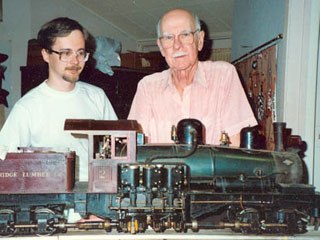
Ollie Johnston explains the intricacies of his Shay locomotive to Jan-Eric Nyström in Johnston's workshop in 1989. Courtesy of Jan-Eric Nyström.
In addition to Ollie Johnston's accomplishments in the field of animation, he was also a well-known veteran in the "Live Steam" fraternity -- building and running 1/12th-scale locomotives, operated with real steam. In the late 1940s, Ollie built a 1-inch scale backyard track, the "La Cañada Valley RR," at his home in Flintridge. There, in the lush surroundings of his garden, he ran his Pacific and Shay live steam locomotives, as well as a battery-powered diesel-outline engine. His sons now own the equipment and continue the hobby in other locations.
Over the years I've had the pleasure and honor of meeting Ollie many times, both at the Disney studio and in his home, and even here in Helsinki, Finland -- and of course, almost always together with his friend and colleague, Frank Thomas! The pair became like mentors to me, and I treasure the friendship and correspondence that lasted for over 30 years. With Frank, the discussion revolved around animation, but with Ollie, we always talked trains!

A cartoon tribute from Jim Bertram.
During an unforgettable visit to Ollie and his backyard railroad in 1993, I had the opportunity to be "engineer" on his train. Once you've experienced that, you're hooked! This led to my own live steam hobby a few years later -- by now, I have built a 500 ft track and three 1/8-scale locomotives myself, and am currently working on a fourth! More about Ollie's trains can be found on my website: www.sci.fi/~animato/rail/ollie.html.
Ollie was a genius, but still affable and very humble in his demeanor. My fond memories of this dear friend will stay with me all my life.
Jan-Eric Nyström, Helsinki, Finland, Animator and steam train enthusiast
When I was going to school in Philadelphia, at the University of the Arts, the Art Student League had an art show on animation from Disney. Some of the existing nine old men were there to sign autographs -- Ollie Johnston, Frank Thomas and Marc Davis. Maurice Noble, who was best known for his backgrounds on Warner Bros. animation, also happened to show up that day, so I was able to talk with him and Ollie and Frank and Marc. I was on cloud nine, I couldn't have asked for anything better to happen.
I was sitting there chatting with Maurice, when the curator for the show came up and asked him to join everyone for dinner. Then he looked at me and said, "You're invited as well." My mouth dropped to the floor like in a classic cartoon.
I got another chance to talk to everyone that night, and I also got to meet John Canemaker and a lot of other artists from the area. Never did I have such a grand offer happen to me. I was so thrilled for the chance to talk to these great artists, my mentors. It was an honor and I will never forget it.
It is so sad that many of these great artists are not with us anymore, but you know that they are still in all of us, in our hearts and memories.
Gary Yager
I never met Mr. Johnston, but like so many people throughout the animation industry, and more outside of it, I was touched by his animation. The level of art that he achieved, along with the rest of the Nine Old Men, is truly amazing and the feelings, emotions and memories we all share are due to their amazing legacy, transcending culture and age.
Marie-Christine Melhem, Beirut, Lebanon
I am an Italian director and animator. I always followed the advice and beautiful images and animations of "the duo" Frank and Ollie and I am sad to hear that Ollie, too, has passed away. I had the honor and pleasure to meet Frank Thomas and Ollie Johnston in Lucca, Italy in 1992 at a comic [book] convention and I had some beautiful moments with them. Ollie was kind and always available for advice, as was Frank. I remember his kindness in replying to some questions, even if I was a "nobody" and there were so many people that tried to speak to him. We will miss him. I hope he will find again his friend Frank where he is now, because... "all animators go to heaven."
Thank you, Ollie, for all you taught to us.
Valerio Oss, Pixel Cartoon, Trento, Italy
I was a 20-year-old trainee when I first met Ollie. I admired him for his amazing body of work, but since then I've learned to admire him for his extraordinary spirit. He and his colleague Frank Thomas worked harder than anyone to pass along their vast knowledge of animation to the next generation. When I found out he had a steam train in his backyard, it elevated him to hero status in my mind. The legacy of this gentle, gifted, generous man will last for a long, long time. He is truly a hero to me.
Don Hahn, Producer for Walt Disney Studios for over 30 years, whose films include Beauty and the Beast, The Lion King and Who Framed Roger Rabbit
Ollie was a gentleman animator. His soft-spoken nature and gentle teaching style penetrated my 20-year-old hyperactive enthusiasm. His words of advice were like animation proverbs. Words like, “Don’t draw what the character is doing, draw what the character is thinking," continue to guide my own animation 30 years later.
Glen Keane, Disney character animator on The Little Mermaid, Beauty and the Beast, Aladdin and Tarzan, and director of the upcoming Rapunzel

Ollie Johnston and Frank Thomas as traditional Dutch fishermen -- Marken, Holland 1984.
Having had the great fortune of having known Ollie Johnston since 1982, I was always struck by the passion this sweet man had for the medium of character animation. He would always offer to tell something about animation if he found in you a willing ear, and his stories would be precise and to the point, heart-felt, and always respectful of his subjects -- and of Walt. I still remember Ollie tearing up during an interview in 1984, when he was asked how he felt, the day Walt passed away. It never made it to the screen, but Ollie's wonderful wife Marie said it was the best interview they had ever given. Some years later, we walked through Copenhagen and a tear welled up in Ollie's eye as he pointed at a rack of Mickey shirts, while he said "It really is incredible how much this man has meant to the world!" Ollie would be the last one to point at himself, but without him the world would have been a much poorer place. With Frank he worked on our studio's -- as yet unfinished -- project Troll Story, where he had us put up signs over our tables with the words "Warmth, Charm, Humor." As we used to tell each other after having had some wonderful times in Denmark: I miss you at breakfast, Ollie!
Hans Perk, co-founder A. Film, Denmark and CEO of A. Film L.A., Inc., Los Angeles
As part of the Ollie Johnston tribute, a photo montage created by Rick and Ken Johnston is now available for a limited time on AWNtv.