
The director of such films as films as Crac!, The Man Who Planted Trees and The Mighty River talks with William Moritz about filmmaking, the environment and his teacher, Mathurin Meut.

72-year-old Frédéric Back, two time Academy Award winner for Crac! and The Man Who Planted Trees, was recently in Los Angeles for the opening of an exhibition of his animation drawings at the Academy of Motion Picture Arts and Sciences. The exhibition, with art work from nine of his films, will run until August 25, although the panels of The Man Who Planted Trees and The Mighty River will be sent to the Hiroshima Film Festival after August 11. I got a chance to ask Mr. Back a few questions just before the opening night reception.
Moritz: Do all your animation films, from Abracadabra in 1970 until The Mighty River in 1993 belong to the Société Radio Canada [the French language division of the CBC]?
Back:
Yes, that's right. I was an employee of Radio Canada--sometimes a freelance, because depending on how interesting I found the work, sometimes I'd quit, and then return at a later date.
Moritz: Now they've closed down the animation section of Radio Canada ...Back: Yes. And it's too bad. Hubert Tison at Radio Canada really gave me the opportunity to work in good conditions. Before that, I wasn't so interested in animation. The National Film Board was doing lots of fine animation, but no other place had good equipment and professional cameramen that could do that kind of work. Then Tison built up a professional animation studio at Radio Canada.
I had made many short pieces of animation for music broadcasts and documentaries, so when I began with Radio Canada, I made mainly short films. But the improved conditions Tison offered meant a more complex, higher standard of animation, and I gradually learned to make better, more complex films.

One of the good ideas Tison proposed to Radio Canada was an international exchange of animation films. Before that, and still now, there are regular exchanges of usual live-action television programs, but nothing with animation until Tison initiated it. It was very important, because it meant you could produce high-quality animations relatively cheaply, since for each film Radio Canada made, they got an additional 20 or more--one from each of the other participating countries. This exchange functioned for about 15 years, and it only stopped because gradually too many people too often would buy poor, cheap animation films just to have something to exchange, and the countries that worked hard for higher quality were disappointed. It was really too bad it stopped, since it gave work to animators in many countries, as well as Canada, and encouraged the production of short films.
Moritz: Is Hubert Tison still with Radio Canada?
Back: No, he retired. After the animation department was gone, I quit, and there was nothing really to interest Hubert. Closing down animation was such a waste. The wonderful computer-assisted camera, which allowed me to make so many camera movements, rotations and dissolves for The Mighty River (so that it seemed spacious, multiplane and flowing like the river), I was the only person who ever got to use it. Where is it now?
Moritz: At the same time, the National Film Board was also being cut back.
Back: Unfortunately, yes. The problem today is that there are no more artists and thinkers at the head of organizations, only bureaucrats who make notes and count numbers. They have no ideas to offer. They don't take risks--and artistic creation is always taking a risk; you can't guarantee how it will come out, there's no safety in art. And the bureaucrats actually don't even seem to be able to count numbers very well, because after Radio Canada dropped the animation department, I learned that more than half of the money that comes back to Radio Canada from sales of product comes from animation films, which are actually few in number: I made 9, Paul Driessen made 3, Graeme Ross made 2--that means 15 or so animation films gave as much income to Radio Canada as hundreds of hours of regular live-action programs. And the animation films also won hundreds of prizes at film festivals.
Moritz: One terrifying thought to me is that since the same Radio Canada which closed down the Animation Department owns your films, they could presumably withdraw them from circulation, not show them, they could be lost, decay in the vaults.
Back: Well, at least now they show them quite a bit, especially at fesitvals, where they are in demand. And Man Who Planted Trees and Mighty River are available on videocassette, so they are used by teachers and environmentalists continually.
Moritz: But even now, your earlier films, like the two based on Algonquin and Micmac myths, are hardly seen--though the artworks from them in this exhibit are very beautiful. In any case, does the demise of Radio Canada and the crippled National Film Board mean that you can't make any more animation?Back:
No, actually I could. I have had several proposals, even one from National Film Board, but I promised my wife Ghylaine not to take on another large animation project, because she became a sort of animation widow during the long making of Man Who Planted Trees and Mighty River. Now I have actually started animation work on a te10 minute film sponsored by Trees for Life, in Wichita, Kansas, which will promote planting fruit trees in third world countries. Also, I never really stop working. Right after Mighty River I made a number of book illustrations, one about Inuits, one about beluga whales, and of course The Mighty River book itself. And I worked a lot with Greenpeace, and other organizations that protect animals, seals. There's always a lot of work to do.
Moritz: After spending so much time making your filmed images move and change, do you mind seeing them as still book illustrations?
Back:
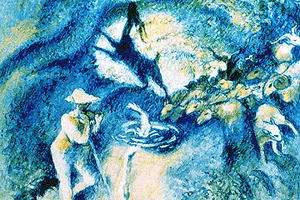
No, I think they work very well as books, and I always make some special artworks just for the books. Mighty River is particularly important as a book, because in 24 minutes you can't give too many facts, since the visual information is so rich, you would get dizzy if there were statistics, too. But in the book there are many details and facts that you can study at leisure, and learn, perhaps intellectually, as you learn emotionally from the film. The Mighty River book has been translated into Japanese, as well, so I hope the Japanese fishing fleet read it and disappear.
Moritz: Surprisingly, even Crac! worked very well as a book, I thought. One of the things that I liked most in Crac! the film was the way great Canadian paintings--Cornelius Krieghoff's Merrymaking or Lucius O'Brien's Sunrise on the Saguenay, for example--just seem to "happen" in the course of the action. When the ASIFA-Canada Bulletin devoted an issue to you in 1988, they printed a picture of your early art teacher, Mathurin Méheut, with his class (including you)--and a few of his sketches. He seems like such a romantic figure, you should make a film about him in which his paintings could also "just happen" in the course, since he is almost unknown here.
Back: Not a bad idea. He's getting better known in France: there's a museum devoted to him, and traveling exhibitions. When he died, his wife gave some 4,000 drawings to start the museum. His work is a rich documentation of something that no longer exists. During the war, when I was studying with him, Brittany was almost untouched, following its typical way of life for centuries. I had the opportunity to go with him and make drawings beside him. "Draw everything," he told us, "it will all disappear." He was right. Now in Brittany, there is hardly a port. No Bretons in traditional costume, no fishermen, no fish. No colorful nets of string and rope, no iron and wood tools and boats: everything is plastic. It's lost all its character and beauty. The Breton fishermen used to dress all in red or blue, and they would repair their clothes with patches from other material so they were like mosaics of colors, walking paintings. What Méheut drew is a fantastic testimony, a documentation of this lost world.
In France there is now a book about him, and I was interviewed by the director of a television documentary about him, but the program was not really very good, as they did not have enough money to give the full impression of the scope and color of Méheut's achievement. That's where I, too, would have trouble with such a project: I'm not a good enough diplomat, a negotiator to make a deal to support a project on Méheut, as it would be another big film.
Moritz: That's where we miss Hubert Tison.
Back: Yes indeed. I would have the idea, and he would make it possible. My wife was also enormously supportive and helpful--too few animators have such a good, understanding helper.
Moritz: Are any of your children animators?Back: No, but in a way, they are all involved with art. My daughter is a painter, and she also works with batiks. My younger son is an illustrator, who specializes in historical costumes and settings. And my older son is a biologist who worked for the World Health Organization, for 10 years he was in Africa, and he teaches using his knowledge of graphics, including computer graphics: he's very clever with computers.

I'm very honored and happy that the Academy is making this exhibition. Radio Canada framed all these artworks, and then they have been sitting around in a cellar.
I hope this exhibition is a success, not just for me, but because there are so many animators around the world who do fine artwork that should be exhibited, too. What you see on the screen is not a reflection of each individual drawing or sculpture, so it's wonderful to have a chance to see the artworks, and it can be very instructive to other artists.
When you're in your little room by yourself drawing, it can be depressing: it's so repetitive, and you never know, drawing after drawing, what will happen when they get on film; you just have to have faith in your project, and keep on. An exhibition like this should be a stimulation to work hard, and keep steadfast in your belief in the project, and give each artwork maximum quality.
William Mortiz teaches film and animation history at the California Institute of the Arts.