
As Disney's summer hit Lilo & Stitch reaches DVD, it is a strong contender for the Oscar, plus it has TV and direct-to-video sequels already in production. Andrew Osmond talks to the creators of Lilo & Stitch, Chris Sanders and Dean DeBlois, about their monstrous creation.

Chris Sanders (right) and Dean DeBlois, co-writers and co-directors of Lilo & Stitch. All Lilo & Stitch images © Disney Enterprises, Inc. All rights reserved.
There's something rather unnerving about seeing a man speaking fluent Stitch. From Chris Sanders' larynx emerges the familiar cackling, howling gibber that we've learned to associate with the blue-skinned, pint-sized genetic whatsit called experiment 626, puppy impersonator and maker of mayhem. Thankfully Mr. Sanders is more articulate in English, as he talks to AWN about his film, together with co-director and co-writer Dean DeBlois.
Throughout this interview (conducted in London's Dorchester hotel), Sanders was flipping through a wildlife magazine in search of future fauna inspiration. Trivia freaks may like to know that sea-otters have an archetypal "Chris Sanders head": low eyes and a nose that's big and high on the face. Hey, have we found Lilo's next pet?
Andrew Osmond: You've stressed that Lilo & Stitch was a very 'intimate' kind of Disney film. Can you talk more about the pros and cons of that?
Chris Sanders: It was a very pragmatic decision. We had just finished working on Mulan, which was a very big production, not only in terms of the number of people but also the scale of the story. We wanted to bring all that down in size and tell a more intimate story, just to keep ourselves fresh. And we realized through the experience of Mulan that the more people who are involved in the writing and directing of a film...well, it's not going to make it a better or worse film but it will slow the process. Anybody who has ordered a pizza with more than two other people knows the amount of discussion will increase dramatically. We wanted to get this film done quickly. We paid for our story freedom by promising to bring it in on a very low budget, very fast, and we knew we needed fewer people at the front-end to accomplish that.
So we wrote, directed and storyboarded it and this gave us clarity and speed. It also required that we be much more critical of what we're doing, because one of the things we lost by reducing the crew is the number of people that could question and contribute. We were a little bit concerned that we might get something up on screen that was way too personal to appeal to a mass audience. We needed to be very critical of our own and each others' work.
AO: Film pundits often say 'big' films involving lots of decision-makers become impersonal, lacking real vision. You've talked about speed and budget, but how did Lilo's intimacy affect its quality?

Sanders and DeBlois meet up with the Flying Elvises at a Lilo & Stitch publicity event.
Dean DeBlois: There's a compromise when you involve lots of people, because ultimately 30 people can only agree on something that falls in the realm of cliché. What happened with this film is that the studio understood it was going to be something unusual and quirky and unique for Disney storytelling. Having seen us work together previously on Mulan and having a certain amount of trust in us, they gave us the latitude and space to develop the story, the voice of the storytelling. We had a year to actually write the script and storyboard the film, just the two of us. That allowed us to challenge each other but also keep the voice in a very specific realm. From that point we could go to a crew of 350 people and say, "This is the film we're making," and sit down with every animator and every background painter, everyone involved, and say, "There's a very specific sensibility at hand here and here it is."
CS: One of the things we found out is that people appreciated the clarity. You worry a little bit that you're going to seem like [snooty accent], "Oh no, this is what I want to do, I won't have any of those other suggestions!" But they appreciated the clarity, and liked the purity of the story coming through.
AO: You've emphasized that you like extremely detailed storyboarding — not just movement, but also lighting and staging, close to the storyboarding for a live-action film.
DD: Both Chris and I have a philosophy — it isn't entirely shared within the studio — that composition and lighting are vital in storytelling. We're very specific and detailed about involving the background, the cinematography. Our choices of where to put the camera and how to light the scene compositionally have such an effect on us in our storyboards that it's automatically communicated to the rest of the crew. That means there's less of a discussion by the time it comes to layout. There might be an issue here and there about camera direction or whatever, but for the most part, our storyboards tend to translate exactly to the screen.
It's not an entirely shared philosophy on other Disney productions. It's a personal choice... It's a little more work but ultimately it makes me feel more like a director because I have more visual control of how my script pages are executed.
AO: Can you talk about the different forms Lilo & Stitch went through as it developed?
CS: Its earliest origin was as a failed children's book I tried to do back around 1985. I was doing the book on my own time, and came up with a character I thought was really fantastic and unique. It was the prototype for Stitch. He looked a little bit different, but he was pretty much Stitch in personality. I abandoned that because I realized the character was so subtle, there was no way to develop him successfully in 24 or 32 pages. I thought it was going to end up being too subtle, too intellectual. A great deal of writing was going to be needed to support that character, and that's a little bit contrary to a picture book. So it sat on the shelf...Around 1996, Tom Schumacher approached me and asked if I was interested in pitching a story, and so Stitch was revived.
DD: Chris pulled out this character and the story that involved him, which was about an alien who had crash-landed in a forest and the other forest animals who had sort of left it alone.
CS: The forest version would have been developed if we hadn't had the first meeting with Tom in the Salon hotel. He made the timely comment that the animal world already seems alien to us so the contrast wouldn't be very great, so we should consider putting the story in the human world.
DD: From the point when Chris pitched it, he was encouraged to develop it. That's when we started talking about it, off the clock. For a short while it was about a boy and an alien in Kansas.
AO: Might Stitch have worked with a boy?
CS: Your natural inclination is to say a boy and his dog, and that's what we thought would be a good idea, this little boy in Kansas. But we both felt simultaneously that the soft nature of the story, plus the nature of Stitch's change, was going to require a female influence. I think Stitch represented a male character so the balance would be to put him with a little girl. We wanted someone who was going to be in conflict with Stitch, and we realized a little boy might be a comrade (laughs). The relation would be, Break that! Woo-hoo! This is great! We would have two characters reinforcing their bad behavior. It would have been fun but we wouldn't have had the conflict; we wouldn't have had a story. A little girl would be the proper character to frustrate Stitch. In that conflict, we would have a story about if they were going to get along.
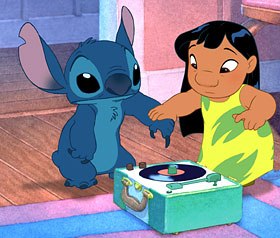
Lilo & Stitch began as an idea for a children's book over ten years prior to it becoming a feature.
DD: So it became about a girl in Hawaii and there was a slow evolution of ideas...
CS: I went away to Palm Springs, of all places. It was the Christmas break, between Christmas and New Year. I spent my entire week in the hotel — I ordered in food and coffee and worked on the outline. I was so concerned that people reading this outline might get the wrong impression that I put at least one drawing on every page. I thought, by the time people finish reading this, then if they don't like it, it'd be because they really didn't like the property. I was going to make sure they saw the same thing as I did! I also wanted a self-contained pitch, so that if I wasn't in the room it would be able to pitch itself pretty effectively.
The curious thing was that it ended up being, in a sense, the book that I never made back in 1985. It was a lot of work but I produced it pretty much in two weeks.
DD: By the time Chris' outline was officially submitted and had some illustrations, it was largely the story it is now, aside from a few things — the fact Stitch had a gang, there were a few characters missing, that sort of thing. It started in a slightly different place but the bulk of the story and characters were pretty much the same.
AO: Some scenes in Lilo, such as the screaming match between the sisters, are both very funny and yet quite uncomfortable to watch. It's new territory for Disney.
CS: I think it's a microcosm of the effect of the film, which is that you can't have a tender scene, a reconciliation, unless you go through a scene that's uncomfortable and probably crosses the line. We had just finished Mulan where we had both a father and mother — which is rather unusual — and a grandmother, and the structure of their family is a very rigid one, which was totally appropriate in that film. In Lilo, we wanted to completely break away from that and so we felt, what's the most inappropriate thing for Lilo and Nani to do... Well, instead of reasoning it out their frustration, they're just going to yell at each other, exactly like brothers and sisters really do. It was so freeing to do those kinds of things.
After the fight, Lilo and Nani reconcile in the bedroom... It's a really tender moment where they reconcile and confess to one another that they've pushed and yelled at each and they're sorry. It's nice because we operated on this philosophy that a lot of times people in real life don't come out and say what they want. They try to do it in a different way, because just going and saying it is a little uncomfortable. So Lilo and Nani had these wonderful scenes where they're really apologizing to each other for yelling without saying it as flatly as, "Boy, I'm really sorry. Let's make up," and stuff like that.
The only thing we had to so was go back and reinforce was that they were sisters. We had a few confusions after our first screening, with people wondering why Lilo and her mother were yelling at each other and how inappropriate that was! So in the second version of the bedroom scene they mention a few extra times that they're sisters. We wanted to make sure people understood that.
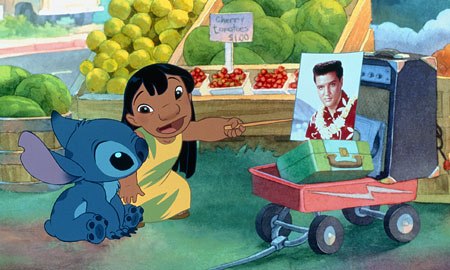
The element of Elvis Presley was added to give the story some levity.
DD: The whole film was really about testing boundaries. Particularly with the character of Stitch... It's a redemption story, so we knew we had to make him really manic and wild and misbehaved and then take him from a point of being almost completely unlikable to very vulnerable and loveable. We knew our story existed between those two extremes, so that was part of the process of testing how far we could go. What Chris and I like to do is not only imbue very human traits into the characters — making them very fallible and giving them little moments of nobility here and there. We also like to incorporate real-life problems. We have this whimsical and at times ridiculous, fantastic backdrop, the whole alien presence, but we also wanted to deal with the issues of loss and what is a family and how do you define that? Being this is a Disney film, there's a certain legacy of family themes. It's kind of neat to update that and include all those people who might have not previously been considered part of families. The Hawaiian ideal is that you define a family for yourself. That can be a community, that can be a circle of friends or blood-relations, and one does not negate the other.
All of these topics were on the table and we wanted to find... I guess poetic ways of getting those ideas across without hammering them. Like the death of the girls' parents, for example. We didn't want to spend a lot of time dwelling on it because we knew it was a dark issue. It was about balance, trying to balance the whimsy against the weight. We discovered the pacing of the story as we went on. At one point in development, our act two dipped into a very dark place for a long time. We had several sequences back-to-back, which were just low and depressing in spirit. We needed some levity to balance them because we had to get the audience ready for what they were going to go through in the third act.
AO: Is that why you put in the part about Lilo trying to make Stitch into Elvis?
CS: Exactly, and the surfing sequence.
AO: It's reported that you were influenced by Hayao Miyazaki, the Japanese director of Spirited Away.
CS: His stories are everything but cliché. There's never a cliché I've ever detected in his stories; the storylines are completely original and the way the characters interact is very believable. I think that's one of the things that inspired us to rewrite the book in the way our characters interact. You referenced that when we were talking about the scene with the sisters yelling at each other. It's so natural and cathartic to see that going on. When characters interact believably, you believe in them and it makes it seem much more real to you. One of the big reasons we didn't have this film as a musical in the traditional sense is that the minute a character begins to sing, it places that film in a certain realm, a musical realm, which is great but it's not really happening the way we wanted this film to feel like it's happening.

Sanders and DeBlois were influenced by animation master Hayao Miyazaki's deft skill at creating credible relationships in his movies. © 2002 Nibariki. TGNDDTM. All rights reserved.
DD: Specifically, if you reference a film like Miyazaki's My Neighbour Totoro, that film shares a lot of similarities with ours. We were inspired by the way Miyazaki created realistic relationships between the human characters, the sister-sister relationship, and wove in a realm of fantasy and whimsy very subtly. It's done in such a believable way... You've got these fantastic elements and yet you feel like you watched a story that really existed between a family.
AO: The original climax to Lilo & Stitch involved an aeroplane flying near skyscrapers. Can you talk about how that was altered after September 11th?
CS: The sequence exists almost entirely intact. It was just a matter of changing a few elements. It was something we all wanted to do... There was really no discussion. We met the very next day and thought, "How can we change this?" It only took a few weeks and it really works in much the same way. It's almost shot-for-shot the same sequence, it's just instead of skyscrapers, there's now a mountain ravine, instead of a 747, there's Jumbo and Pleakley's spaceship. The plane was digitally pounded into a different shape.
CG is always misleading. The things that seem difficult actually aren't. You ask, "Can we change the shape of this whole object?" — "Oh yeah." So you're like, "Oh really? That's not hard? So can we change the color?" — "Oooh (laughs), that's going to take a while..." It all seems so backwards. We had a fantastic artist named Brian Jefcoat and within a few days he had reshaped everything.
AO: Lilo & Stitch has been a big critical and commercial success. How much of a blueprint do you think it sets for future Disney films?
CS: We wanted to make a film that explored an unusual, quirky story, a more personal story. At the same time it was less expensive so it bought us freedom. Because the film has been a financial and critical success, the door's going to stay open for a while. I think the studio is far more enthusiastic about finding stories off the beaten path than they were when this was first pitched. So it's a proven experiment and hopefully we can take advantage of it again for the next couple of pictures.
The Lilo & Stitch universe is expanding; the DVD was recently released, and a video sequel and TV series are in the works.
AO: You're now involved in an upcoming TV version of Lilo & Stitch.
CS: There are two things going on. There's a weekly TV series for Saturday morning, to be shown next year, and there's also a direct-to-video sequel. Both will take up where the film ended and continue the story, which is natural given the original film is almost a prequel to the rest of the characters' lives. We've brought this family to a point where they're going to hang together. There's such a neat relationship between all the characters. The spinoffs explore something we were never able to explore with our film. We're envious of the guys doing that; we only look in on it now and again. It's good to see what these guys are doing and get a fresh perspective. They enjoyed the subtleties, the quirks, the things I think made the movie interesting and they're working hard to maintain that.
Everyone realized that if you're going to get something like that to market, you have to start way in advance. We felt strongly that Lilo and Stitch could lend itself to other things, so we started working with the spinoff guys quite a bit before the film was released. In animation terms, this is coming out at blinding speed!
AO: Will the spinoffs be inspired by the picture montage on the closing credits?
CS: Not really... It'll all be new kinds of stuff.
AO: Can you make any comparisons between the creative processes in a cinema movie and TV show?
CS: The needs of a half-hour show are quite different... A weekly problem for the characters to face up to, something that creates conflict. The fun thing is because you've only got a limited time to deal with it, you can be much broader in what that problem is and the solution to it. (Laughs.) Subtlety takes a while to develop... The direct-to-video enjoys more of what we had on the original film, so it can have subtler things going on. It's interesting, because we can take the characters and their relations both ways. I thought it might be difficult, but it feels very comfortable doing both things.
AO: The obvious problem with turning a cinema feature into a TV show is the lower TV budget. How do you ensure it doesn't disappoint fans of the film?
CS: The original film dismantled a lot of the machinery of our other features. We were going for something that was more inexpensive to create, without being impoverished. I think that's going to be good for the spinoffs. I've seen the preliminary artwork for both the DTV and the TV show and they're doing their best to give the same watercolor background, which is really the foundation. In a sense, the watercolors do everything for you. They give you the soft palette, the lush look, the relaxed feel and then the rounded characters flourish. You probably couldn't have a more convenient basis for a weekly series.
AO: Can you give any hint of what happens in the DTV sequel?
CS: I wish I could (laughs)... They're still in development so if I said something they'd probably come back to me and say, "We changed that!"
Andrew Osmond is a freelance writer specializing in fantasy media and animation.