With The Simpsons Movie hitting DVD, Russell Bekins took an opportunity to chat with director David Silverman about his long history with the TV series, as well as its huge jump to the big screen.

We didn't just catch up with David Silverman. We hounded him. We listened to his lectures at I Castelli Animati and recorded them. We chased him down the ancient Appian Way as he tried to do a bit of tourism. We rudely sat down at his table at the bar and barked questions. We plied him with wine at the Cinecitta commissary. Finally, we dragged him out of bed for some follow-up questions on a frigid December day in New York while he was nursing a cold. Intrepid reporter or restraining order? You decide.
The Simpsons Series
Russell Bekins: How did this all start?
David Silverman: In 1986, I was working on a film called One Crazy Summer. One of the other animators was named Wes Archer. He worked for a very small company called Klasky Csupo. Klasky Csupo got the contract from Fox to do The Tracy Ullman Show and that's how it all started. It was in March of 1987 that Wes Archer and I and Bill Kopp were hired to create animations. We did about a minute or a minute and a half in one week. We had to work a lot of hours to get that done. The next week it was painted. The next week we'd shoot it, add sound effects and then we were done. So it took three weeks to do one segment on The Tracy Ullman Show. We were essentially making a short film once every three weeks. We were working with Matt's style. We didn't know at the time, but he was relying on us to develop the characters further. That's why the characters changed in their appearance over time. To wit: Lisa and Maggie got their hair, it got more of a pointed design shape. In the very early going, I did a sequence where Maggie electrocutes herself. This was the most fun I ever had animating. I actually got high after the experience, my endorphins were flowing.
Another thing I didn't know was that Brooks and Groening planned to do the show from the beginning. It was the success of Who Framed Roger Rabbit in 1988 that made it possible. By the beginning of 1989 we had an order for 13 episodes of the show. The first year of the show was all about evolving the look. We had all these new animators who had never drawn the style, so it was a long learning process. Among them was Eric Stefani, brother of Gwen Stefani of No Doubt. He also wrote a lot of their songs.
RB: How do the writers and animators interact on the show?
DS: The writers will write the script in about six weeks, then there will be a table read with the actors. That's when the animators come in. We start doing the storyboard from that point on; the director and the storyboard artists will be at the table read. We have five weeks, then we show the writers the storyboard and get notes. Then we're off to the races.
But before the animation come the voices of the actors. You want to have the actors' voices untethered by finished animation, because not only will they improve their performance, but also they will ad lib lines. We are very fortunate to [have] such talent to work with. We have great performances, great writing, and great animation.

RB: Is it always precise?
DS: We basically animate more than we can show. We animate 22 minutes and we show 20 minutes -- it gives a little editing room. Any time you do a live-action sitcom, you film more than you end up showing. You want to have a little editorial room because sometimes you cut jokes out of it and the show moves faster. The joke may work in isolation, but it may not work with the comedic rhythm of the rest of the show.
RB: Some gratuitous animation advice?
DS: Animation is about big jumps for accents. [David shows an animation test of Homer as a huge fat blob.] Three in-betweens going down. I bring this up as an example of rhythm and timing: be sure to vary the in-betweens and don't be afraid to pop stuff. Everything is timing in comedy.
RB: Music?
DS: When we do a song, we do a piano track first. We are fortunate to have some great singers among the acting staff. I'm always amazed about how much you can get away with. [He smiles as he cues up a more refined sequence of Homer as a huge gelatinous mass, quivering down the street to the tune of the song Big Butts.] It's good to have music to work with because we can get a better flavor for the animation. See how we hit the accents. Notice how little head-moves and eye-moves go with the music.
RB: What's your weirdest outtake?
DS: We did this episode where Bart and Lisa tour the "Itchy and Scratchy" studio. We have an outtake in which different animators, including myself, appear. "Our animators study real cats and mice," the tour guide extols as we draw from the model of a cat. "Is that real dynamite?" Lisa asks. Once Bart and Lisa are outside the room, we hear an explosion. "We can't do that to a cat," we are told once the sequence was animated. "We do that to Scratchy all the time," we reply. "Yes, but that's a cartoon" was the reply. That's show biz.
RB: When you talk about the people who influenced you, you talk about Charles Schulz?
DS: Schulz, I think, helped me develop as an artist. So much of what he did was about subtle line movements to convey a wealth of expressions.
RB: Tex Avery?
DS: "Itchy and Scratchy" is like channelling down King-Size Canary.
RB: Chuck Jones?
DS: Chuck Jones I think affects me subconsciously, his sense of pacing. It's also the small movement, holding a scene and having a small eye movement, and that's the joke.
RB: Jay Ward and Bill Scott?
DS: At the very beginning of The Simpsons, Rocky and Bullwinkle was the sort of successful adult animated show we hand in the back of our minds as an idea.

The Simpsons Movie
RB: You said that you worked differently on the film than on the series. You didn't do an animatic?
DS: Yes. We did story reels instead of an animatic. Look, we had 18 months to do it all. I thought: if we do the entire film the way we do the show, we'll run out of time, so we'll do this technique. I did this little short proof and convinced them it was gonna work. The editor, John Carnochan, editorial staff, then sequence directors were very important at this point. We had the real voices final soundtrack from the beginning of January.
RB: Were you involved in the script development?
DS: I didn't get involved until the first table read. I was working on the show. There were things in the first draft, however, that I knew would be changed. One of the biggest things at the time was that there was no setup for Homer and the motorcycle. The initial scene at the carnival involved a clown character. It was funny in isolation, but it didn't work in the overall film.
RB: A lot of critics talked about the opening sequence...
DS: We intentionally started the film with a smaller aspect ratio -- started 177, then to 239. The banner was done on the computer in After Effects. We always use a rough track for the music, so we used Richard Strauss music [Also sprach Zarathustra] from 2001. Hans Zimmer noted some musical similarities with the Simpsons theme, hence the opening music.
RB: You were initially concerned about the Bart skateboarding sequence?
DS: We were very worried that that shot wouldn't get through the ratings, but they loved it.
RB: Can you name a sequence that the actors contributed?
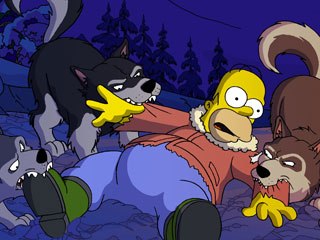
DS: Dan Castellana improvised the entire sequence of Homer staggering through the snow... 'Yes I can. No you can't. Oh shut up. You shut up.'
RB: Tell us about the evolution of the Cargill character.
DS: The character of head of the EPA was originally a much different character. He had a whole long backstory -- downtrodden, under-funded -- then this thing happens in Springfield and he gets a lot of power. Very interesting. [He yawns.] It wasn't getting any laughs. We kept with it because of this one scene in the White House. Every other scene with him just died.
We decided to redesign Cargill and went through many different tries. Matt did this drawing of Bart at the age of 45 as a joke. I liked the drawing, so I took it and cleaned it up and it became Cargill.
RB: Everyone wants to know where Spider Pig came from...
DS: Spider Pig was a last-minute idea... We started with the notion that Lisa would tell Marge about her boyfriend, which was great because they hadn't had a scene together. Then David Mirkin had the idea that Marge would be saying, "The important thing is that he listen and... how did those pig tracks get on the ceiling?" He suggested that Homer is... dooda do da, walking the pig on the ceiling. Then Al Jean said, "Oh, he's leading Spider Pig" and we laughed. I just started singing these crazy lyrics: "Spider Pig, Spider Pig, Does whatever Spider Pig does. Can he swing from a web? No he can't, he's a pig." It just came off the top of my head. I don't know.
RB: He sings the refrain three times...
DS: Things are better in threes.
RB: One of the really off-the-wall scenes was where the forest animals prepare Homer and Marge for sex...
DS: Here we just followed the script, but there were two fortunate things: We had a great animator in sequence director Lauren MacMullan, and John Pomeroy [was] animating. He's a great animator, a veteran of An American Tail and A Troll in Central Park. He practically did the stuff blindfolded. So that made that so much easier. Okay, it's done. Sit back and relax. Pretty simple.
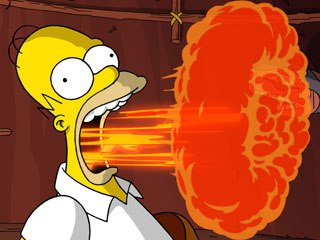
RB: Another fantastic sequence was the Inuit woman epiphany...
DS: That took quite a bit of working out. Lauren MacMullen was the sequence director, and it involved a very elaborate board. Mostly I was waiting for things to shake out. You don't want to cut the fat before you see it, because it may stay. One problem was the way the Inuit woman was approached; it was too grotesque. Some things stayed, but a lot of it got cut out. The result was a better presentation, like Homer doing his stupid dances. I can't think of anything we should have kept.
RB: The M.C. Escher-inside-the-head bit is great...
DS: I was working carefully with board artist Lucas Grey, as well as Chris Roman. I gave him a rough sketch, and he came up with a great design. That's it, I thought. That's fun. At one point Homer was walking all around it.
RB: What about the dismantling of the body?
RS: Originally it wasn't a grove of trees, but a library of books, a sort of house of learning. Then Al Jean came up with the idea of pulling him into little tiny pieces. I saw a Salvador Dali bit, a part that starts melting. It was a nice visual image. The film needed that surreal moment. A lot of the really great composition work was done by Colin Heck. John Rice boarded it out. He and Rich Moore did a lot of work on the final motorcycle sequence.
RB: What else got cut from that sequence?
DS: There was a sort of Portrait of Dorian Gray bit. There was also a totem of Springfield. One joke we tried involved a giant hourglass, but that got cut too. Our concern was for keeping the pace going.
RB: You keep talking about things that worked and didn't work. You did test screenings?
DS: Yes. We did what was called "friends and family" screenings on the Fox lot starting in September. We did this for two reasons. One, we wanted people we could trust, and two, we were terrified about leaking information to the public. We were very secretive about the idea and the jokes. So we had about two or three screenings. We used them to see what got laughs and what didn't get laughs. You get a feeing in your gut about how it plays in front of an audience. It's out-of-town try-outs. Somebody from the art's-for-art's-sake crowd would say, why would you need that? Why would Tennessee Williams need it? We also had screenings in the outside world. One in Portland, Oregon, one in Tempe, Arizona and one in San Diego.
RB: So you could make revisions quickly?
DS: We were used to working fast and we found ways to work even faster. One reason is because we were doing storyboards on a Wacom tablet. Storyboard could go into editorial right away. If you get a storyboard on Monday, you could have editorial same day.
RB: The actors were on call?
DS: We had the actors on call all the time, and if they were not in town, off at some burg... they could always get to a studio. Sometimes Karl Wiedergot would be on call to sub in on the scratch tracks. Sometimes I would.
RB: People you wish to single out for praise and thank?
DS: All the sequence directors, Steve Moore and Rich Moore. Steven was very good at helping out on the beginning church sequence. It was tricky because at first it was Marge who has the revelation. We animated a lot of Marge, but had to change it to Grampa. "Trust me, it's better, we have to do this," I would say. I kept my cool when things were cut out that had required a lot of work. Barely. I now tell all my new animators: you will hit the cutting room floor!
RB: How much was cut out?
DS: No man can say. A lot, an awful lot. Some finished work from almost every scene. There are about three or four movies in there.
RB: Will we see the outtakes in the DVD?
DS: Yes.
RB: What is the meaning of life?
DS: Coffee, cigars, and alcohol.
A special thanks to Oscar Grillo and the other participants at I Castelli Animati for asking some of these questions, and to David Silverman for his lectures and patience. And the judge. I thought he was real swell. 100 yards and no phone calls. Got it.
Russell Bekins has served time in story and project development for Creative Artists Agency and Disney. He now lives in Bologna, Italy, where he specializes in concept design for theme park, aquarium and museum installations.