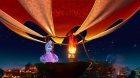
Ellen Wolff traces Bob Abels legendary power to do magic on the eve of his posthumous VES honor.

The Visual Effects Society recognizes Robert Abels influence by awarding him its first George Méliés Pioneer Award posthumously on Feb. 16 at VES Awards 2005. All images courtesy of the estate of Robert Abel.
"The power to do magic" was how Bob Abel often characterized the visual effects techniques pioneered at Robert Abel & Associates, the seminal visual effects studio of the 1970s and '80s. Almost two decades after the lights dimmed at RA&A and three years since Bob's passing, the Visual Effects Society will recognize his great influence on the field with its first George Méliés Pioneer Award, tonight at the Hollywood Palladium as part of the VES Awards 2005 ceremony.
Those of us who worked with Bob (for many years I wrote his speeches and SIGGRAPH presentations) can readily imagine what he would say if he was here to accept this honor. The word "magic" would figure prominently, because Abel, an avid student of film history, would remind us that Méliés was a master magician before he pioneered film effects. He would stress that Méliés used effects to tell stories, and not just for their own sake. Bob wouldn't miss the chance to explain the connection between the illusionist's sleight-of-hand and the art of visual effects.
Abel was, in fact, a frustrated magician who rued that his small hands hampered his abilities. But he clearly possessed a performer's flair, glibly able to persuade a skeptical client to take a chance on untried effects techniques -- and equally able to convince his studio crew that they could deliver on his promises. One early Abel associate, Richard Edlund, the four-time Oscar-winning visual effects supervisor and Technical Awards committee chair for the Academy of Motion Picture Arts and Sciences, recalls: "Bob had this uncanny ability to charm the socks off you, and he also had no compunction about pushing you to the edge." The "Combo" Years Founded in 1971 by Abel and animator Con Pederson (of 2001: A Space Odyssey acclaim) Robert Abel & Associates used streak photography and photo-fusion techniques to create a dazzling array of TV logos and commercials like 7Up's See The Light. The studio's painstaking combinations of motion control, live action and graphics -- which Edlund dubbed photo-masochism -- became RA&A's stock in trade, and they began amassing a record-setting string of Clio Awards that would eventually total 33.
Abel wooed the advertising industry's elite by telling them that a great commercial "should remind you of something that you've never seen before." And he pointed to more than Clio honors to measure his studio's success, often noting the boost in sales that followed the airing of TV spots like Levis' Brand Name.
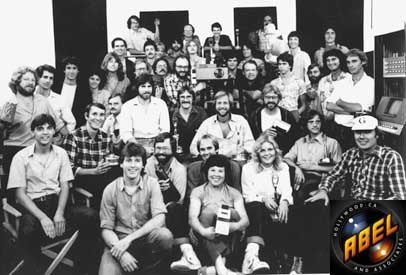
The seminal Robert Abel and Associates, circa 1980. Abel nurtured a new generation of artists to create the studio's award-winning CG spots. Kenny Mirman likens Abel to Jedi master Obi-wan Kenobi for his mentorship. © Robert Abel and Associates.
A self-described "engineering school dropout," Abel was always willing to bet on a new technology that might help RA&A create breakthrough effects. He was fond of quoting Thelonious Monk, "The only cats who are worth anything are those who take risks." Bob's bets didn't always pay off, however, at least not right away. The most infamous example was Abel's attempt at tackling feature film effects for 1979's Star Trek: The Motion Picture. Paramount had high hopes for turning the popular TV show into a motion picture -- and to capitalize on the Star Wars craze that was sweeping the country. Abel had grand plans for creating the film's effects; plans which included harnessing computer technology in unprecedented ways.
Abel was no stranger to motion picture production, having previously made the concert film Mad Dogs & Englishmen and the Golden Globe-winning Elvis On Tour. But his experimental ambitions for Star Trek outstripped the practical realities of delivering shots on time and on budget, and Paramount pulled the plug.
The supervisory assignment was transferred to Doug Trumbull, Con Pederson's collaborator on 2001, and all of RA&A's elaborate models and miniatures were taken away. But left behind was one piece of unproven technology that Abel had acquired for the project. That technology, a computer called the E&S Picture System, would prove to be the spark that fueled the resurgence of RA&A.
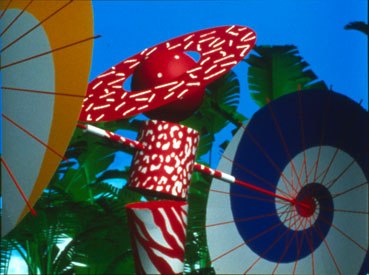
Randy Roberts created some of Abel's best-known CG pieces, including the studio's first raster graphics short, High Fidelity. © Robert Abel and Associates.
The Rise of CGI
Manufactured in Utah by the renowned team of Evans & Sutherland, the E&S computer could generate vector graphics. It was used largely for flight simulators at that time, but Abel saw its potential for previsualizing complex visual effects shots -- creating a kind of moving blueprint that could be manipulated interactively. The virtual camera moves created on the E&S could then be used to drive motion control cameras with remarkable precision. It was an idea whose impact resonates to this day.
Before long, the E&S became useful for more than previs -- programming gurus like Bill Kovacs began filming images off the E&S' monitor and creating "CG" effects. Kovacs would lead the RA&A software team in creating a menu of CG techniques before leaving to found the successful software company Wavefront Technologies. The vector graphics created at the studio during these days brought Abel a measure of recognition in feature film circles via images for the movie Tron. RA&A alumnus Richard Taylor was the movie's supervisor, and he provided the opportunity for Abel and other fledgling studios to create the movie industry's first CG feature film effects.
Sadly, the box office failure of Tron cooled opportunities to create more CG effects for quite some time -- both for RA&A and other fledgling CG studios. But Abel, invigorated by the creative potential of computer-generated commercials, became an ardent champion of this new medium. Through numerous speeches and SIGGRAPH presentations, Bob put a face on the emerging field of CGI.

Abel thought big. RA&A rode the rising tide of CG effects in the 80s and Abel added live action and rock video divisions. His vision included a costly, unsuccessful effort to market the studio's CG software.
A New Generation
To accomplish his goals, Abel nurtured a new generation of artists to create the studio's string of award-winning CG spots. Kenny Mirman, who had worked on Tron, directed a series of innovative commercials for clients like TRW and Benson & Hedges. Mirman has likened Abel to Jedi master Obi-wan Kenobi, for the way he mentored the talent at RA&A. Bob believed "one of the things that makes us special is that we pool people's talents," and RA&A paired art and technical directors together in highly productive ways.
Just as Mirman collaborated with technical whiz Frank Vitz (who went on to create Universal Studio's Spider-Man ride-film), director Randy Roberts created breakthrough work with Tim McGovern (who became a charter member of Sony Imageworks after his RA&A days.) Roberts, now a director at Rhythm & Hues, created some of Abel's best-known CG pieces, including the studio's first raster graphics short, High Fidelity, and the prize-winning Sexy Robot commercial, which presaged modern MoCap animation.
Abel, an admitted workaholic, pushed his younger associates to the limit, as he had done since the beginning of RA&A. "If you don't live up to the tradition, you're off the squad. It motivates people to out-do what they've done before. I think that 'fear factor' -- that someone might be gaining on us -- is probably the greatest motivator. None of us thinks that the brilliant thing we've just done is something that we can retire on."
The End Of An Era
Abel was right about increasing competition, which came not only from his studio's cross-town rival, Digital Prods., but also from companies like Pixar, R/Greenberg Associates and PDI. RA&A rode the rising tide of CG effects throughout much of the 1980s, and the studio ballooned in size as Bob added live action and rock video divisions. Abel's sweeping vision even included a costly, unsuccessful effort to market the studio's CG software.
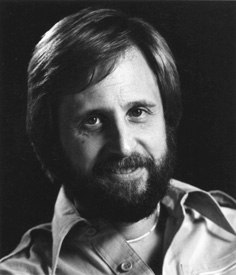
Post-RA&A, Abel remained a pioneer of new media. He created an educational CD-ROM for IBM that sits in the Smithsonian. He also entered academia when he became a lecturer at UCLA, where he was an alumnus.
Unfortunately, Bob had never operated with a financial cushion, since he was always willing to spend his own money to make a project look better. By 1987, even a merger with Canada's Omnibus Computer Graphics and Digital Prods. wasn't enough to save RA&A.
While Abel's career in visual effects ended with the studio's demise, he remained a pioneer of new media. He created the educational CD-ROM Columbus for IBM, a watershed project that is now in the Smithsonian Institution. And he became a lecturer at UCLA, where he had once been a student himself. It was at UCLA that he had first glimpsed the future of image-making, working as a camera assistant to the father of computer graphics, John Whitney Sr. Being back at UCLA brought things full circle for Bob.
The Influence Remains
The VES honor for Abel recognizes not only Bob's personal accomplishments, but also his enduring influence on many individuals who came of age at RA&A. The list is a long one, including John Hughes and Richard Hollander (Rhythm & Hues), Tom Barron (Image G), Ray Feeney (Silicon Grail), Sherry McKenna (Oddworld Inhabitants) and Allen Debevoise (Creative Planet).
The RA&A alumni who've won Oscars for visual effects is especially notable as well. In addition to Edlund, it includes Tim McGovern (Total Recall), Rob Legato (Titanic), Charlie Gibson (Babe), John Nelson (Gladiator) and Scott Farrar (Cocoon).
Bob would have pointed to these artists' accomplishments with pride were he here to accept his VES award. And his remarks would undoubtedly attempt to paint a big picture of the creative challenges that artists have grappled with ever since the days of Méliés himself. As Bob once observed, "The challenge to us as filmmakers is that we don't know what the solution is going to be until we inherit the problem." While today's visual effects assignments present problems far more complex than those that Abel conquered, his words still ring true.
Ellen Wolff is a Southern California-based writer whose articles have appeared in publications such as Daily Variety, Millimeter, Animation Magazine, Video Systems and the Website CreativePlanet.com. Her areas of special interest are computer animation and digital visual effects.