
Gene Walz chronicles the mysterious career of Charlie Thorson, a crucial character designer who was quite a character himself.
In June 1939, Charlie Thorson broke a five-year contract with Leon Schlesinger's Looney Tunes and Merrie Melodies Studio and moved on to work for Dave and Max Fleischer at their new operation in Miami, Florida. Thorson was only one of many workers lured away from Hollywood to help the Fleischers complete their first animated feature film, Gulliver's Travels. His contribution, however, was immediate and not insignificant. He designed a wacky bird named Twinkletoes and cooked up some comic business so that the character could be shoe-horned, at the last minute, into the finished film.

Thorson, however, was not all that impressed with the movie when it was finally rushed into theaters less than a year later. So he withdrew his name from the credits. It was an odd and uncharacteristic gesture for Thorson. For the rest of his life, Thorson would fly into a jaw-clenching rage at the mere mention of Walt Disney's name because of the anonymity Walt imposed on his workers. He was especially furious that Disney left his name out of the endless credits for Snow White, evidently because Thorson had quit the studio before the movie was finished. When Thorson ventured into children's book publishing, he was so thirsty for recognition that he often signed every single illustration in his books. As it turns out, Gulliver's Travels would prove to be Thorson's last chance to see his name up on the silver screen. He worked in the animation business from 1935 to 1946, but his contribution to the golden age of animation has gone virtually unrecorded. The Character Designer Charlie Thorson was a character designer or, as Schlesinger termed it, a character model man. In the assembly-line method of cartoon production refined by Disney Studios in the early 1930s, and later copied by all its competitors, the position of character designer was of utmost importance. Combining the talents of a casting director, a costume designer and a make-up artist from live-action movies with the precision of a portrait painter and the imagination of a sculptor, the character designer created distinctive anthropomorphized animals or familiar caricatures that would star in animated movies. Sometimes the design of the characters was determined by studio competitions; several employees would submit drafts of the proposed characters for a story, and the final design would be chosen by formal or informal voting. Usually the character designer simply consulted the animation supervisors or directors or took his cue from notes or rough sketches. After the look of the cast of characters was determined, it was the character designer's job to provide model sheets or action sheets for the film's animators and in-betweeners. These model sheets showed the characters in the film's significant poses and provided front-views, side-views, and back-views, if necessary. Model sheets also delineated the underlying geometries of circles and lines that defined a character's size and shape and proportions. They could also include close-ups and written instructions for the precise details of costume and expression. With so many different people involved in drawing as many as 5,000 cels for each seven minute cartoon, the character designer had to draw enough precise reference points so that even the clumsiest and least observant artists could work together. Along with the storyboard, a series of vivid, careful model sheets provide the indispensable blueprints behind each animated cartoon, even today. For the kind of personality animation that Disney emphasized, and especially at studios trying to create animation stars to compete with the likes of Mickey Mouse, Donald Duck and Pluto, the character designer took on a special importance. As with John Wayne or Shirley Temple, the look of a cartoon character was central to the success of a film.
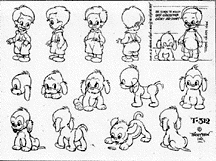
Thorson's Beginning
Charlie Thorson wasn't the first character designer to work in America's animation factories, but circumstances, plus his own talent and adventurous spirit, made him one of the most sought after and influential.
Thorson was 45 and divorced when he left a secure position as a graphic artist and catalogue illustrator in Winnipeg, Canada to try his hand at the animation business. He was twice the age of most of his co-workers and ten years older than his employer when he was hired by Walt Disney in early 1935.
At the time Disney was fixated on "cuteness." Impossibly precocious and cherubic infants plus cuddly and charming anthropomorphized animals predominated. All his characters had large, expressive eyes for communicating wonderment, varying degrees of apprehensiveness, and sensitivity. Most of the characters had heads as big as their bodies and were built on pear-shaped or vertical dumb-bell-shaped armatures. These shapes readily connote vulnerability and equipoise, symmetry and instability and help to create overpoweringly cute characters.
Although he had a robust sense of humor, a Viking's taste for women and alcohol, and a restless, pack-up-and-leave attitude, Charlie Thorson soon became an expert at the sentimental cuteness that defined Disney in the 1930s. He could do "cute" better than anyone. For Disney he designed characters for Elmer Elephant, The Old Mill, Wynken, Blynken and Nod, Country Cousin, Toby Tortoise Returns, and most importantly, Little Hiawatha. He also worked on Snow White and the Seven Dwarfs, telling his friends back in Winnipeg that his design for the main character was modeled after his Icelandic girlfriend. On this is based the local legend that Snow White is Icelandic.
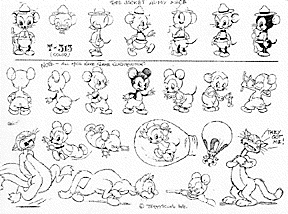
After Leaving Disney
Angry that he was getting neither the money nor the recognition that his contributions deserved, Thorson quit the Disney's employ and immediately went to work for Harman-Ising Studios. He then quickly switched to MGM where he was mainly charged with transforming the ill-fated comic-page characters from The Captain and the Kids into potential movie stars.
After a year at MGM, Thorson jumped to the Warner Bros. camp where he was recruited to provide characters for the young Chuck Jones and the neophyte team of Cal Dalton and Bugs Hardaway. For Jones he created the Sniffles the Mouse characters, Inki, the Little Lion Hunter, and his nemesis, the Mynah Bird, and the curious puppy and pals. Most famously, he designed the prototype for Bugs Bunny, the infamous Elmer Fudd, plus the Rainmaker and the Lady Known as Loo for Dalton and Hardaway. It was one of his most productive and influential periods. He helped initiate Chuck Jones as a director, and he played a crucial role in the creation of characters that are still with us today. But the ever-restless designer stayed at Warners for less than a year.
At first glance, the new Fleischers Studio in Miami must have looked like the best of all possible opportunities for Thorson when he moved there in 1939. His work on Gulliver's Travels was quickly followed by the redesign of all the characters from Raggedy Ann and Andy for an important film featurette and even the redesign of the studio's most famous stars, Popeye and his cohorts. His favorite commission at Fleischers, however, was for The Stone Age cartoon series. This prototype for The Flintstones was based on scores of prehistoric creatures and characters. Thorson both designed and created story ideas for the series. Made in black & white and largely forgotten today, these cartoons were the closest Thorson came to studio contentment. When the Fleischer Brothers Studio was closed, he was devastated, but not without prospects.
After working successfully as a children's book illustrator and in billboard and magazine advertising in New York for a while, Thorson returned to animation at Paul Terry's Studios in 1941. He was there when Mighty Mouse was created, but his specific contribution to this famous character is unknown. In fact, the exact nature of his work at Terry's Studio, at Columbia/Screen Gems where he worked during 1942, and at George Pal's Studios where he worked after this are all mysteries. A Mystery Since Thorson's name never appears in movie credits and he is rarely cited in the studio records that remain, the task of determining his output as a character designer is not an easy one. Luckily, he was so enraged at the fact that Disney would not acknowledge his contributions that he decided to keep his own personal animation archives. These include inspiration drawings and photostats of model sheets for many of his most famous character designs. Sadly, Thorson was an unreliable archivist. His vagabond's nature and his extravagant lifestyle caused him to sell, lose or discard much of his portfolio. What remains affords only a glimpse of his effect on the golden age of animation. The current popularity of animation artifacts may help expand on his reputation. Thorson model sheets must exist in collections not yet examined. Since model sheets were rarely signed by the character designers, however, identifying Thorson's work is not as easy as it might seem; he has a distinctive signature but it is rarely ever seen.

Tell-Tale Signs
How is a Charlie Thorson model sheet identified? The easiest clue is his slightly flamboyant handwriting. Thorson makes very recognizable curves on the second leg of his h's, m's, and n's. His v's, w's and y's, used less often, also have a curvy leg, and his t's, and less pronouncedly his e's and f's, have a curved-up top. Other tall-tale features are his r's, with its angled leg penetrating its upper curve, his s's, with the top larger than the bottom, and his c's, which continue their counterclockwise swirl almost into a g-shape. But Thorson's work can always be distinguished by the formality, precision, and attractiveness of his character designs. Thorson's enormous capacity for liquor and his ribald, anarchic sense of humor are never betrayed in his drawings. The firm, unwavering lines have an ease and lightness that must have been come from both raw talent and a tremendous exercise of will. The soft, unforced three-dimensionality and the simple suggestion of an attractive inner life to the characters are his gift to the medium. Character designers are certainly not as crucial to the art of animation as animation directors and studio heads, but until their roles in the creation of our animation classics are recognized, our understanding of the craft and the process will be incomplete. Charlie Thorson created hundreds of distinctive characters with recognizable personalities. To assist in the animation, he likely drafted model sheets with many hundreds, if not thousands, of poses. He also provided story ideas for some of the films he worked on. He helped to launch the directorial careers of at least three animation supervisors -- Chuck Jones, Cal Dalton, and Ben Hardaway. He made a definite contribution and there must be others like him who should also be recognized. Charlie Thorson worked for Disney (1935-1937), Harman-Ising (1937), MGM (1937-1938), Warner Brothers (1938-1939), Fleischer Studios (1939-1940), Paul Terry's Terrytoons (1940?-1942), Columbia/ Screen Gems (1942-1943) and George Pal Studios (1943?-1945?). Anyone with model sheets that might have been drawn by Thorson, or with stories or photos of him is asked to contact Gene Walz at walz@cc.umanitoba.ca Gene Walzis head of the film program at the University of Manitoba, Winnipeg. He is currently finishing a biography on Charlie Thorson and is now editing a book called Great Canadian Films.