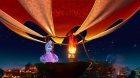
Dubbing Spirited Away wasn't a straight translation jobthe translation had to be carefully crafted into a screenplay that stayed true to Miyazaki's vision, made the film crystal clear and matched the characters' mouth movements. Bob Miller reports on how it was done.

Writers Cindy Davis Hewitt and Don Hewitt worked 24/7 for three weeks to adapt Spirited Away into English. Photo courtesy of Cindy Davis Hewitt and Don Hewitt.
In bringing Spirited Away to North America, director Hayao Miyazaki credits his long-time friend John Lasseter of Pixar, "who bulldozed his way through every obstacle to make this happen."
Lasseter served as executive producer of the English adaptation, with the goal of preserving Miyazakis vision while making it relatable to North American audiences. His creative team included producer Don Ernst, director Kirk Wise, and husband-and-wife writers Cindy Davis Hewitt and Donald H. Hewitt.
The Hewitts attended the Hollywood premiere of Spirited Away at the El Capitan Theater on September 10, 2002. A charming and delightful young couple, both were understandably thrilled with the enthusiastic reaction to their translation.
Bob Miller: How did you get the assignment?
Cindy Hewitt: We were working for Pixar for a year-and-a-half on another project, and so when this project came up, they thought of us.
BM: What project was that?
CH: Top secret. We're signed to secrecy.
Don Hewitt: It's just in treatment form right now.
BM: It's that early in production?
DH: Yeah. It's an original thing they were working on.
BM: I see. Can you tell me your other credits?
CH: This is our first credit. We sold a screenplay so we got some other jobs from working on it, but this is our first screen credit.
BM: How did you translate this film?
CH: We didn't do any kind of research. We watched the film with subtitles and were also given a direct translation, which was much choppier. They do a pretty good job, I think, actually, with the subtitles, making it sound American. The direct translation is very bizarre.
DH: They wanted us to start working on it immediately. Even if we had wanted to do research, we had to start turning in pages right away, so...
CH: It was good, because we were really trying to just say, "Here's the film. We're an American audience. What don't we get?"
DH: We just wanted to make it sound good and as understandable as possible to us as Americans. Not necessarily having to understand Japanese culture to 'get it,' but just get the simple logic of the movie.

John Lasseter spearheaded the effort to bring Spirited Away to American audiences. © 2002 Nibariki. TGNDDTM. All rights reserved.
BM: How much input did John Lasseter have?
DH: We were turning [the script] in a third at a time to Disney. Anything that we thought was a change that was controversial, like making it a little clearer, we put a little asterisk in the screenplay by it. And we sent it in to Disney and they talked about it, and they sent it up to John Lasseter and then we would have these live video conferences. We were here at Disney and he'd be up at Pixar. It was kind of like talking to the Wizard of Oz...
CH: With the floating head.
DH: He was very, very positive of most of the work. He would make a few minor suggestions here and there, but he was in support of us, trying to make it as clear as possible.
CH: He did go over all of the stuff that we did. He'd write down, "Great job," with exclamation points.
DH: We saved those things.
BM: Does John know Japanese?
CH: He refers to Miyazaki as Miyazaki-san -- that's all I've heard him say in Japanese!
DH: And when I see him talk to Miyazaki there's always the translator right there. So I think each of them knows very little of the other's language.
BM: You said you didn't have much time to do this. How much time did you have to translate?
CH: About three weeks.
DH: Three weeks.
BM: Three weeks to do the entire screenplay?
CH: Yes.
DH: We worked pretty much 24-hours a day on it. It was a grueling affair.
BM: Did you do it in shifts?
DH: Uh, a lot of coffee and (laughs) we just kind of sat there and watched it, and we just wanted to go over it as many times as possible. So you go through a section and get a rough idea, trying to get a sound that kind of matches, that kind of fits [the mouth movements. Sometimes] you go back and you go, "Well, this part really doesn't work that good." And you keep going over it. You could tell after about two or three hours where you get pretty sloppy, so you have to go over those parts again a lot.
CH: Yeah, if it started to sound like Speed Racer, we had to stop. (laughs)
BM: What feedback have you had from the Japanese on your work?
CH: We got mostly feedback just from Steve Alpert [executive representative for Tokuma Publishing]. He was glowing. He was great. He thought it was just the best translation of any Japanese film ever. Well, that was an encouragement. I thought, "Yeah!"
DH: I ran into a Japanese reporter and she said, she actually understood some things watching this version that she didn't understand in the Japanese.
BM: That's a high compliment.

The Hewitts' goal was to make the dialogue in Spirited Away unstilted to American ears. Here, Chihiro befriends Haku and they become allies in the strange spirit world. © 2002 Nibariki. TGNDDTM. All rights reserved.
CH: Yeah! That was great. But that was something that we were really concerned about. We were hoping, most of all, that we would have their endorsement, from Studio Ghibli. Because we know how many fans they have.
DH: It was kind of nerve-wracking for us. We had to get it approved by three studios. We were going through Disney, and then up to John Lasseter at Pixar, and then to Studio Ghibli.
CH: It was amazing. (laughs)
BM: That's great. Well, I hope this does very well for you.
DH: People have been very positive so far. It's been a great experience. The people we worked with are so talented. And the movie is so great to begin with.
CH: Don Ernst was amazing. Kirk Wise, the voice director. John Lasseter.
DH: The voice actors were just fantastic. And yes, John Lasseter, of course.
Bob Miller is an animation professional who has written extensively about the industry for Starlog, Comics Scene, Animation Magazine, Animato!, Animation Planet, Comics Buyer's Guide and APATOONS. He was storyboard supervisor of Courage, the Cowardly Dog in its first season, storyboarded episodes of The Simpsons and Ozzy and Drix, served as creative director at Cornerstone Animation for a year and is now storyboarding on Cartoon Network's Harvey Birdman: Attorney at Law.