
Philippe Moins reveals the current state of the European feature production, benefiting from the boom in TV production, and what we have to look forward to.

Chicken Run is considered the Holy Grail of European feature production opportunities. © DreamWorks.
Between 1926 and 1997, Europe produced a total of 51 animated feature films, most of them after World War II. In the six-year period 1997-2002, 34 feature films were produced in Europe (1). Today, there are at least 20 features in development or currently in production and nothing seems likely to stop this growth phenomenon. Europe now produces more animated features than the United States and Japan combined. However, these figures require some qualification. Many of these films are released on a small scale, to a very local market, and, with very few exceptions, do not sell abroad. A list of the top 10 most successful international animated feature films in Europe contains only one European feature film, namely Chicken Run, which is a truly exceptional case.
Very few European films achieve real international success. Some of them do not even manage to perform across Europe as a whole. Some enjoy critical success in their home country, but this is clearly not enough to ensure their profitability. Yet a number of European animated features, such as Kirikou and the Sorceress, Chicken Run, Belleville Rendez-Vous, Lucky and Zorba, Raining Cats and Frogs , Black Mors Treasure, are, whatever their flaws, proof of a new creative energy. This might well contribute to a renewal of the genre by moving away, once and for all, from the post-Disney style, which is proving increasingly unsuccessful at the box-office, even though it remains, in quantitative terms, the dominant tendency.

Kirikou and the Sorceress has had a lasting effect on feature production across Europe.
A Kirikou Effect?
What has really happened in Europe in recent years? In France there has been much talk of the Kirikou Effect. Michel Ocelot, previously known for his short films, alongside his producer Didier Brunner, battled for years to get financing for an unusual story and a personal graphic style for the animated feature film Kirikou and the Sorceress. After many ups and downs, a long and complicated process, which meant the physical production being spread out over several geographical locations, the film was released in French cinemas in 1998. The film was an unexpected success in cinemas, compounded by its triumphant video release. Two million Europeans finally saw the film in cinemas and the film was also sold to many other countries in several continents.
The period immediately following saw a flood of feature film projects developed in France, hence the notion of the Kirikou Effect. Although the films strong sales have undoubtedly helped overcome skepticism and encouraged a range of different initiatives, the gestation period required for animated feature films suggests that in fact most of the films attributed to the Kirikou Effect were already in pre-production or even in production before Kirikou was released. Nonetheless, Corinne Jenart, from Cartoon (the European Association for animation film, part of the European Unions Media Program) stresses that Kirikous success helped her organization to sell the industry on the idea for Cartoon Movie, an annual forum held near Berlin which has, year upon year, attracted an increasing number of producers and investors to look at projects seeking funding.
On the evidence of its dazzling European box office results, why is there no talk of the Chicken Run effect? Nobody dares, since that particular hit film is quite atypical. Financed by Pathé and DreamWorks and benefiting from their worldwide distribution networks, the film is in a totally different category from other European films, if in no other terms than its budget, considerably higher than any other animated film in Europe. The film is all the more problematic as an example since Aardmans production of further feature films seems, for the moment, to be somewhat delayed.

The unique looks of Black Mors Treasure may make dreams come true for director Jean François Laguionie. © Dargaud-Marina.
DreamWorks Again
Several European filmmakers, when asked about the reasons for the rapid burgeoning of European animated features cite a more fundamental phenomenon that goes back to the early nineties, with the emergence of DreamWorks and the end of Disneys domination. This could be considered, in Europe (and doubtless elsewhere), as a long-term psychological DreamWorks effect. It is related to mutations the non-Disney animation world has undergone since the turn of the century, which has led to it becoming more confident and ambitious.
However, Rome cant be built in a day. Fragmented across a multitude of small studios, often economically marginal, in the 90s a section of the nascent European animation industry started forming associations with one another to produce TV series. European TV, which hitherto had acquired most of its animation from the U.S. and Asia, gradually began to take on board the existence of local production whose quality was improving at the same time as studios were professionalizing and uniting to offer the volume and rate of production required. Without mentioning the word protectionism, the world of European TV found affinities with these productions that, at times, had the advantage of being closer to European sensibilities and cultures.
The boom in TV demand boosted this developing industry and a number of countries emerged in particular: France, Germany and Spain. This movement was encouraged by European institutions such as the Media program which, without getting directly involved in production, encouraged synergies between studios, as well as training animators, producers, etc.
The result was that for the first time a genuine animation industry emerged in Europe, initially centered on television and fairly low cost animation.

With a lofty seven million euro budget, El Cids success or failure may determine the future financing of other European features. © Castelao Productions S.A All rights reserved.
Birth of the Feature Film Industry
The aura surrounding the feature film should not be under-estimated. For many, filmmakers as well as producers, fulfilling their dreams means moving into features and this is what happened in the mid-90s. Although it is more expensive, financially riskier, and more complicated to get right, the feature film has always exerted a fascination for animation professionals, particularly in terms of the considerable number of individuals it can involve in the long-term and, above all, in terms of morale.
Thus once certain financial and psychological barriers had been overcome, many have taken the plunge.
The ways in which the move into features happens are as many and varied as the projects themselves, although it is significant that most of the teams involved in feature films in Europe have emerged from a background in TV projects.
If one compares the disparate corpus of European animated feature films with what is produced in the U.S. and Japan, one notices that. apart from a common origin, there are some recurrent characteristics. First, the under-financing of projects. The budgets for European features, even the most well-off, are still far lower than those of American blockbusters, Between 1997 and 2002, the number of European animated features with budgets over 10 million euros can be counted on one hand. Most of the others had budgets well below this amount.

With a Fellini writer behind the story, The Dog, the General and the Birds brings a true independent spirit to animated features. © Bac Distribution.
Common Features
The majority of European features are basically independent films, which do not enjoy contributions from the majors or large European groups.
This means that, just as in live-action, the instigators spend an enormous amount of time raising money, gradually stacking up contributions from many different sources, mainly comprised of public funding and partnerships with national television channels. Critics will snipe that with this system, financial break-even is guaranteed for some films even if nobody goes to see them in cinemas. This is a rather glib and partial view of the enormous problems generally encountered. To pull off this kind of project, it is often still the case that a studio has to be put together from scratch, and then dismantled once the film is completed, since there is no, or hardly any, continuity of production.
Partly as a response to this problem, and partly to keep costs down, many films rely on sub-contracting out, usually to the east. And here the word east is meant in the widest sense, since it stretches from Estonia to the two Koreas. Sub-contracting out is not without its problems: take the example of the problems encountered by the French-Belgian-Luxembourg production, Corto Maltese en Sibérie, adapted from the Hugo Pratt comic book, where the poor quality of animation delivered led to the producers switching sub-contractors in mid-production, having to start one whole section of the film again, with the obvious attendant delays.
Once a film is completed, the coffers are usually empty. The marketing budgets for European features are often very skimpy, and it is not so long ago that thinking seriously about marketing only began once the film was finished. One example, amongst many it took four years from the time Kirikou was released in France to its sale to the U.K. Of course, over time things change, but it is revealing that the European institutions program for audio-visual development, Media and its animation organization Cartoon, are now stressing the measures urgently required to remedy the continuing weakness of European features in terms of distribution, in Europe as elsewhere.

Raining Cats and Frogs has been a long time in the making, but its whimsical style may make it well worth the wait. © Folimage 2002.
European animation, remarkably diverse in terms of its creative inspiration, suffers from the very qualities that are its strengths. Some critics like to reiterate that the more firmly a film is rooted in its own culture, the greater the chances of achieving something universal, and hence appealing to a wide international audience. Whilst this is undeniably true for really outstanding works, it should not prevent us from acknowledging that many European features are successful in their home market, but do not manage to repeat this success in other countries, even and including countries relatively close to them, whatever the merits of the film. To take an extreme example, German box office hits like Werner - Volles Roaaa or Kleine Arscloch (1997) remain largely unknown outside their own borders. Almost the same could be said about the interesting films made by the prolific Danish filmmaker Yannick Hastrup who has had some considerable successes in Denmark.
Today, things might be about to change. The Living Forest, the first film to be made entirely in 3D in Europe (Spain) is on the way to a (partially) European-wide success, modest but effective, as was the case with Enzo dAlos earlier film Lucky and Zorba (Italy). French films like Belleville Rendez-vous, Raining Cats and Frogs and Opopomoz have been sold to a substantial number of territories, some of them outside Europe. Simultaneous and large-scale release in all European countries remains, however, a distant dream for many producers.

Enzo dAlos Opopomoz features the voice of Hollywood actor John Turturro. 2003 © Albachiara s.p.a.
What is Coming Up Over the Coming Year?
This is a brief (and non-exhaustive) survey of some European feature films that are currently on release or soon to open in Europe.
Charley & Mimmo (director: Jean-Luc François, France/Lithuania/ Luxembourg)) Targeted (quite unusually) at a very precise niche market - very young children, this French feature was produced by Didier Brunners Les Armateurs, which is backed by the Carrère Group.
Black Mors Treasure (director: Jean François Laguionie, France) This is the third feature film from Jean François Laguionie, produced by Dargaud-Marina, a powerful French group of companies involved in publishing comic books. Based on his own original script, Laguionie brings something new to the action cartoon as well as giving it an elegant visual style. Undoubtedly a highlight for 2004.
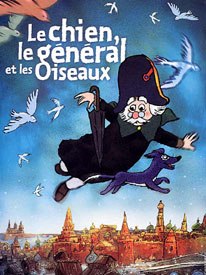
Solaris brings The Dog, the General and the Birds to the big screen. © Bac Distribution.
The Dog, the General and the Birds (director: Francis Nielsen, France/Italy/Portugal) Based on a story by Fellinis scriptwriter, Tonino Guerra, this low-budget Solaris production is undoubtedly one of the most original of the current crop of animated features.
El Cid, the Legend (director: José Pozo, Spain/France/Italy) This feature film produced by the Spanish group Filmax is being released for the end of year holiday period in Spain with a substantial marketing budget. It is based on the Christian reconquista of Spain in the Middle Ages.
Opopomoz (director: Enzo dAlo) A co-production between Alba Chiara (Milan) and MK2 (France), this is the fourth feature film from Italian director Enzo dAlo and the second venture into animation by Marin Karmitz company MK2 (the first was The Rains Children by Philippe Leclercq).
Other World (director: Derek Hayes, Great Britain/Hungary/Russia) This film based on Gaelic legends is aimed at teenagers and adults; and signals Derek Hayes return to drawn animation after a previous incursion into puppet animation. It is another rare example of collaboration between Western Europe and two Eastern European countries.
Raining Cats and Frogs (director: Jacques Rémy Girerd, France) This 100 % French production, a feature film from the studio Folimage has already been released in French-speaking countries. It was entirely made at the Folimage studio in Valence, and the visual style is based on the designs of the Ukrainian Iouri Tchrenkov, who has been working at the studio for 10 years.

Production value in Opopomoz shows what can be done on a small budget. 2003 © Albachiara s.p.a.
Renart the Fox (director: Thierry Schiel, Luxembourg /France/Belgium/Italy) Based in Luxembourg, which offers fiscal incentives (tax shelter) to encourage film production in its territory, the production company Oniria also has its own studio. It was instrumental in making this feature film in 3D, but whose final rendering has a curiously 2D quality.
Toto Sapore (director: Maurizio Forestieri, Italy) Produced by la lanterna Magica, this 2D animation aimed at family audiences is inspired by the Commedia dell arte and Neapolitan folklore.
(1) The statistics cited in this article are taken from the European Feature Animation, Report by Tim Westcott, Cartoon European Association of Animation Film, 2002
Thanks to Cartoons Corinne Jenart and Folimages Jacques Rémy Girerd for their informative and useful contributions to this article.
Philippe Moins is a writer and teacher in Belgium, and also the co-director of Anima 2003.