Bill Moritz chronicles the work of pioneer experimental animator Mary Ellen Bute, whose films gained an unexpected acceptance by both Hollywood and the public.
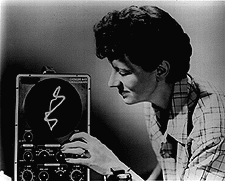
As with many pioneer animators, Mary Ellen Bute is hardly known today, primarily because her films are not easily available in good prints. This was not always true. During a 25-year period, from 1934 until about 1959, the 11 abstract films she made played in regular movie theaters around the country, usually as the short with a first-run prestige feature, such as Mary of Scotland, The Barretts of Wimpole Street, or Hans Christian Andersen--which means that millions saw her work, many more than most other experimental animators.
The diminutive Mary Ellen grew up in Texas, and retained a soft southern accent and genteel demeanor throughout her life. She studied painting in Texas and Philadelphia, but felt frustrated by the inability to wield light in a flowing time-continuum. She studied stage lighting at Yale in an attempt to gain the technical expertise to create a "color organ" which would allow her to paint with living light-and also haunted the studios of electronic genius Leo Theremin and Thomas Wilfred whose Clavilux instrument projected sensuous streams of soft swirling colors.
She was drawn into filmmaking by a collaboration with the musician Joseph Schillinger, who had developed an elaborate theory about musical structure, which reduced all music to a series of mathematical formulae. Schillinger wanted to make a film to prove that his synchronization system worked in illustrating music with visual images, and Mary Ellen undertook the project of animating the visuals. The film was never completed, and a still published with an article by Schillinger in the magazine Experimental Cinema No. 5 (1934) makes it clear why: the intricate image, reminiscent of Kandinsky's complex paintings, would have taken a single animator years to redraw thousands of times.
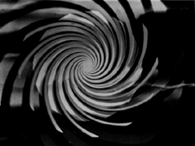
Mary Ellen continued to use the Schillinger system in her subsequent films, often to their detriment, for Schillinger's insistence on the mathematics of musical quantities fails to deal with musical qualities, much as John Whitney's later Digital Harmony theories. Many pieces of music may share exactly the same mathematics quantities, but the qualities that make one of them a memorable classic and another rather ordinary or forgettable involves other non-mathematical factors, such as orchestral tone color, nuance of mood and interpretation. In Mary Ellen's weakest works, like the 1951 Color Rhapsodie, she is betrayed precisely by this problem, using gaudily-colored, percussive images of fireworks explosions during a soft, sensuous passage--perfectly timed mathematically, but unsuited to mood and tone color.
Egg Beaters, Bracelets and Sparklers
Mary Ellen made her own first film, Rhythm in Light, together with Melville Webber, who had collaborated with James Watson on two classic live-action experimental films, The Fall of the House of Usher (1928) and Lot in Sodom (1933). Webber contributed his experience on those films with making models of paper and cardboard and filming them through such things as mirrors and a cut-glass ashtray to get multiple parallel reflections of the shape. The cameraman, Ted Nemeth, who worked commercially on advertising and documentary films, would soon marry Mary Ellen, and worked on all her subsequent films. Rhythm in Light, with black-and-white images tightly synchronized to "Anitra's Dance" from Grieg's music for Peer Gynt, uses not only Webber's models, but also cellophane, ping-pong balls, egg beaters, bracelets and sparklers to create abstract light forms and shadows. Many of these images are "out of focus" or filmed reflected on a wall for soft nuance and distortion that conceals the origin of the abstract apparition.
Mary Ellen made two more similar black-and-white films, Synchromy No. 2 (1936) and Parabola (1938), which also are not exactly animation, nor completely abstract in the sense of Oskar Fischinger's films. Synchromy No. 2, synchronized to the "Evening Star" aria from Wagner's Tannhäuser, uses a statue of Venus to represent the star. The effect of constant flowing forms, however, is quite striking, especially in Parabola, which is a bit long at nine minutes, and could well drop the jazzy finale since the lovely middle slow section provides a satisfying closure.
In 1931, Universal had run one of Oskar Fischinger's Studies as a novelty item in their newsreel. Mary Ellen had seen it, and proposed to Universal that they use one of her films in a similar fashion. Since they could use only two or three minutes, Mary Ellen made a special piece, Dada, which Universal distributed in 1936.
Working in Color
Beginning with the 1939 Escape, Mary Ellen began to work in color, and used more conventional animation for the main themes in the music, but still combining it with "special effect" backgrounds--sometimes swirling liquids, clouds or fireworks, other times light effects created with conventional stage lighting, such as imploding or exploding circles made by rising in or out a spotlight.
For the 1940 Spook Sport, Mary Ellen hired Norman McLaren (living in New York before he went to Canada) to draw directly on film strips the "characters" of ghosts, bats, etc., to synchronize with Saint-Saëns' Danse Macabre. Mary Ellen kept McLaren's painted originals, and reused some of the images in later films, including Tarantella (1941), Color Rhapsodie (1951) and Polka Graph (1952), where they seem less at home stylistically than in their original context.
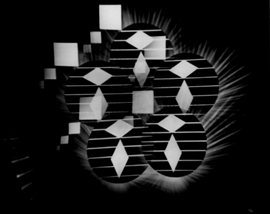
Tarantella seems Mary Ellen's best film. Using an eccentric modern composition by Edwin Gershefski, Mary Ellen herself animated most of the imagery, using jagged lines to choreograph dissonant scales. Even the sensuous McLaren interlude is not totally out of character. Another of her finest films, Pastorale (1953), reverts to the technique of the early black-and-white films, creating continuous flows of colored light, swirling in various directions to mime the multiple voices of J.S.Bach's Sheep May Safely Graze. The music's conductor/arranger, Leopold Stokowski, appears at the end superimposed over the abstract images--reminiscent of Fantasia!
Combining Science and Art
In 1954, Mary Ellen began using oscilloscope patterns to create the main "figures" in her films. In her publicity, which is often repeated, she claimed to be the first person to combine "science and art" in this way, and she sold her last two films Abstronic (1954) and Mood Contrasts (1956) on their novelty. Actually, Norman McLaren used oscilloscope patterns in 1950 to generate abstract images for his Around is Around, which was screened at the Festival of Britain in 1951--and described in technical detail in American Cinematographer. Hy Hirsh also used oscilloscope imagery in his 1951 Divertissement Rococo in his 1953 Eneri and Come Closer. The sort of shapes that Mary Ellen captured from the cathode ray tube for her films seems somewhat simpler or weaker than the forms McLaren and Hirsh use in their films. But she makes up for the "slinky" look of her main figures by imaginative backgrounds and animation supplements. In the 1954 Abstronic, Mary Ellen uses her own paintings, with a kind of surrealist depth perspective, zooming in and out in rhythmic pulsations synched with the beat of "hoe down" music. In the exciting Mood Contrasts (1956, incorporating animation from a 1947 film Mood Lyric), she created her most complex collage of animation and special effects, including a striking sequence of colored lights refracting through glass bricks in oozing soft grid patterns.

Mary Ellen made two more commercial shorts, a 1958 Imagination number for the Steve Allen television show, and a 1959 commercial for RCA, New Sensations in Sound, both of which are clever, sharply edited collages of effects from her previous films. In 1956 she made a live-action short The Boy Who Saw Through and spent the next decade working on a live-action feature based on James Joyce's Finnegan's Wake. In the 1970s, feminists "rediscovered" Mary Ellen as a pioneer woman filmmaker, but by that time many of her abstract films were no longer available in good prints, and the original nitrates were dispersed to archives in Wisconsin, Connecticut and New York. She was still, however, celebrated justly for a major achievement in making her films and distributing them herself, against all odds, successfully. Mary Ellen is also quite important as a formative influence on Norman McLaren. The kind of titles Mary Ellen used to preface her films, explaining them to an average audience as a new kind of art linking sight and sound prefigure McLaren's similar audience--friendly prefaces to his National Film Board experiments. Mary Ellen also proudly announced that she had used combs and collanders and whatever else to make the imagery in her films, encouraging a delight in simplicity and novelty of experimentation. Surely this left its mark on McLaren, too.
William Mortiz teaches Animation History at Cal Arts, and has widely published articles on Animators. He has also made dozens of films, and received and American Film Institute Grant to complete a half-hour animation film All My Lost Lovers.
Mary Ellen Bute Abstract Filmography
Synchronization (1934) collaboration with Joseph Schillinger and Lewis Jacobs [paper or cel animation; lost? incomplete?]
Rhythm in Light (1935, b&w, 5 min.) in collaboration with Melville Webber. Music: "Anitra's Dance" from Grieg's music for Peer Gynt. Moving models with lighting: "cellophane & ping-pong balls," sparklers, egg beaters, bracelets & barber poles, and some drawn animation.
Synchromy No. 2 (1936, b&w, 5 min.) Music: "Evening Star" from Wagner's Tannhäuser, sung by Reinald Werrenrath. Light reflections from cut glass, collander, etc. "Gothic arches, a flowering rod, and stairs recognizable."
Dada (1936) 3-minute short for Universal Newsreel.
Parabola (1938, b&w, 9 min.) music: Création du monde by Darius Milhaud. Based on a sculpture by Rutherford Boyd. Small models and bent rods on a turntable.
Escape (1939, color, 5 min.) Music: Toccata in D Minor by J.S. Bach. Comb, cut celluloid, mirrors & lighting. [cel animation]
Spook Sport (1940, color, 8 min.) Music: Danse macabre by Saint-Saëns. Cel animation + McLaren's drawn-on-film effects.
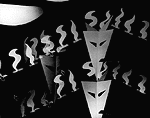
Tarantella (1941, color, 5 min.) Music by Edwin Gerschefski. Drawn animation and cut-outs with light effects, McLaren.
Color Rhapsodie (1951, color, 6 min.) Music: Hungarian Rhapsody No. 2 by Liszt. "Paint on glass, fireworks," animation, fireworks and clouds optically colored.
Polka Graph (1952, color, 5 min.) Music: "Polka" from The Age of Gold by Shostakovich. Cel animation over graph pattern, using Schillinger system. cutouts and cellophane layered.
Pastorale (1953, color, 8 min.) Music: Sheep May Safely Graze by J.S. Bach. "Kaleidoscope of ever-changing shapes, colors, forms, vapors, illuminations and mobile perspectives."
Abstronic (1954, color, 7 min.) Music: "Hoedown" from Billy the Kid by Aaron Copeland and "Ranch House Party" by Don Gillis. Oscilloscope patterns over drawn backgrounds.
Mood Contrasts (1953, color, 7 min.) Music: "Hymn to the Sun" from The Golden Cockerel and "Dance of the Tumblers" from The Snow Maiden by Rimsky-Korsakov. Oscilloscope over backgrounds, including colored liquids, clouds, and grids of colored light shot through glass bricks or cut-glass plate.
Imagination (1958, color, 3 min.) Collage of effects from earlier films. [Abstract bit for Steve Allen]
RCA: New Sensations in Sound (1959, color, 3 min) Commercial. Collage of effects from previous films.