Bill Desowitz sits down with Peter Jackson to discuss lessons learned about vfx that Weta Digital applied to The Return of the King.
Peter Jackson acknowledges that The Return of the King, the last and most satisfying of Tolkiens The Lord of the Rings trilogy (opening Dec. 17), contains the best vfx because Weta Digital improved with time and experience. The hobbit-like director, who next tackles another icon, King Kong, recently spoke with VFXWorld about Wetas incredible learning curve and groundbreaking accomplishments. He even addressed the multiple climaxes that have vexed certain critics, explaining: Tolkiens themes were very much about the fact that whilst there were things worth fighting for and going to war for your freedom, there were no winners in war. That even if you were the victor, you were never going to be the same person again. And I wanted that melancholy in and I also figured we had deserved to have a tranquil, slow finale because we had been in this film for nine hours.
Bill Desowitz: It seemed that the visual effects were much improved in Return of the King, particularly the character animation. What was the main reason?
Peter Jackson: Our crew. I mean, I agree with you. I think that the effects in this movie have improved and there is double the amount of effects shots than there were in the last film. I just think that its a combination of learning what worked on the previous two films and the collective experience of everybody who has gone through the three films. So by the time they got to the third one, everyone was working at the top of their game. You know, the harder shots on The Two Towers were obviously all the Gollum shots. And then the easiest shots on The Return of the King were the Gollum shots. You know, we had Gollum in a very tight type line. We made improvements to his facial expressions between The Two Towers and The Return of the King and we kept improving him.
BD: I understand there were improvements in hair and skin shading as well.
PJ: What weve been doing all the way through is refining the techniques, improving the Massive [A.I.] software, improving the shaders for the characters, and so its never been stagnant. And also what I found on Return of the King was that Ive been so impressed by what Weta had achieved on the first two movies that I was determined to push the envelope even further. So I made more and more demands on them. There are additional shots, there are more complicated shots and they rose to the challenge.
BD: Were there any improvements in software?
PJ: Im probably the wrong person to ask, actually, about the software because I really didnt get involved in all that technical side of it these days. I used to long ago, but not now.
BD: Shelob, the spider, and the Fell Beasts were impressive too. After a while, you forgot they were CG.
PJ: Yes, well, I wanted everything to be really photoreal. You know CG is wonderful, but at least if its very well lit it can look well textured. If done bad, it can [descend into] Playstation territory very quickly. So photorealism was something that I felt very strongly about. And that was achieved through a lot of revisions and a lot of time. One of the beauties of me working with Weta is the fact that Im the owner of the company. I dont allow myself to get locked into a rule where Im allowed two revisions and then it becomes an overage. We just keep basically working the shots over and over again until were happy with them. My contribution, really, to the visual effects, once Weta was doing them, was to look at them as often as I could. And if they didnt seem photoreal, then I would try to figure out what was wrong. I tried to suggest ideas, whether it was something to do with the direction of the light or the contrast values or the shadows of the characters were casting on each other the specular highlights. Id look at it and we would keep revising the shots until wed achieved what I considered to be a very realistic image.
BD: And you had the benefit of working on the effects over a three-year span.
PJ: Yeah, we learn as we go. The Gollum shots were the simpler shots in this film because we had obviously gone through such a pipeline on Two Towers. And the reality with a lot of the effects was to do one or to shots at the beginning. With the Shelob, we picked a couple of shots and we completed those shots, and then we worked out everything that made Shelob look real, the way that her texture should look, the contrast. At that point, you sign off on those, and we were then able to do the other 40-odd shots very quickly.
BD: What about improvements with Massive?
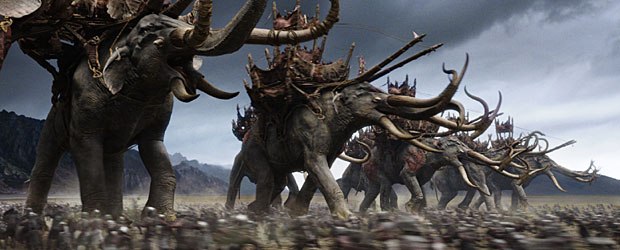
PJ: We made improvements on the models we used for Massive we made them more realistic. You know, we had [digital] horses for The Two Towers, except for this movie we wanted them to hold up a lot closer to the camera and to look realistic, so we remodeled a few of our models that we used for Massive. And Im not 100% sure what improvements were made within the Massive code. But I know that Massives real organic and it keeps being refined and worked on all the time.
BD: And the digital grading?
PJ: The digital grading is interesting because in some respects it should happen during the effects pipeline. In an ideal world thered be a certain amount of grading that would occur before you comp the elements together. But what we generally did was, in order to get through the number of shots that we had, as we would comp we would just do a very neutral, basically lit and graded shot, and then that would go to a post house and then Peter Doyle would then do a digital grade on the final comp shot, which for the most part worked fine.
BD: What are the lessons learned that would aid you with King Kong?
PJ: One of the big lessons that I learned on The Return of the King, and I sort of exploited it, is that during the course of making the films motion tracking is actually one of things that improved a lot. Having the camera department, the CG camera department, be able to track hand-held shots has become faster and more efficient, more accurate. And so Ive discovered that theres much less emphasis now on shooting the plates for vfx shots.
You know, when we started out several years ago, we would try and use motion control as much as we could, but we very rarely use motion control now. The main use for motion control is when were doing a Gollum scene with Andy Serkis, and we want to move the camera around but have a clean background plate to paint Andy out before putting Gollum in, and do a motion control pass bit in the same try with a moving camera. We did the motion capture on-set, which I dont think has ever been done before, because we were using motion capture to get a lot of Gollums basic body movements. The usual approach we used in The Two Towers was that wed shoot the scene with Andy on-set with Elijah [Wood] and Sean [Astin] and then much later sometimes a year or more wed have Andy on a motion capture stage and hed have to duplicate his performances that he did before. But what we did on this film was set our motion capture cameras up on the actual set where we were shooting because we did some pick-ups this year. We shot two or three of Gollum. And wed set up our motion capture cameras on the stage with Elijah and Sean, and we had Andy in the motion capture suit with the reflective spots and we did everything at the same time. So when I came to cut the film on the Avid, we didnt have to go back and do any mocap during post-production.
Bill Desowitz is the editor of VFXWorld.

Bill Desowitz, former editor of VFXWorld, is currently the Crafts Editor of IndieWire.