In Part 3 of this series, Ellen Besen discusses the impact of new technology on performance and the future roles of technology, new and old, with former Disney animation artist Charlie Bonifacio and former Pixar animation artist Stephen Barnes.

Big hit game World of Warcraft offers a stunning cutscene. Courtesy of Blizzard Ent. Inc. ®.
2005 is quickly turning into a very interesting year for game development studios. If we stretch that timeframe backward just a bit and include the holiday games of 2004, such as Doom 3 and Half-Life 2, things become even more intriguing. These games were the first of a new breed, perhaps even a renaissance. Not only did they sell very, very well and receive nearly universal acclaim, but they did so while breaking new technical ground.
Filmmakers may scoff at game developers and their fear of new technology, but they dont contend with our picky audience. Gamers demand more and more realism, usually choosing flashy technique over quality gameplay and storytelling. However, the new games are so polished and deliver such a stunning experience all-around that the rest of the industry has no choice but to mature in order to stay competitive.
In general, games are maturing but sadly, game animators are forced to work to a lower standard than their main competition, the film industry. This is mostly due to smaller budgets. Game animators also receive an unfair amount of the blame when games are negatively compared to the latest Hollywood blockbuster. There are many reasons these hardworking, talented folks are so mistreated. Game animators often have less experience than their Hollywood brethren, usually coming up through the self-trained ranks.
Mocap, which can stand out like a sore thumb in games, is often forced on developers when budgets are restrictive or realism is what the publisher demands. Mocap isnt going anywhere, but it is yielding greater results than ever before. Fortunately, all these things are beginning to change with the new games. Developers are investing in software, training and most importantly the talent to truly compete with the big boys in Hollywood. With a whole new generation of console gaming systems set to launch between the end of 2005 and late 2006 game animators will have even more opportunities to flaunt their stuff.
Artists wear many hats at game development studios. Our pipelines are quite similar to Hollywoods, with the main distinction being more overlap between modeling/texturing and rigging/animating. Without getting too much into the niche specialties, there are concept artists, modelers, texture artists and animators. Most animators are also responsible for their own rigs, although this work is sometimes assigned to modelers. Occasionally, there is the monster that can do it all (coming from a fanboy like me, monster is a huge compliment), but generally these are the job divisions. Not all of these disciplines have been rewarded as much as the modeling community. Their prize, of sorts, came in the form of two new, powerful software packages. Not the usual version upgrades, but entirely new applications containing seriously amazing new functionality.
;)
Zbrush allows digital artists to model organically with an immense amount of detail and can generate high-resolution meshes, used to create normal maps. © 2005 Pixologic Inc. All rights reserved. Image created by Pixolator.
While, at first, information on modeling apps might seem out of place in an article titled, The Future of Game Animation, further consideration lead me to highlight two modeling apps here. My reasoning for this? Well, like it or not animators are always working side by side with modelers (unless they are the aforementioned monster) and rely on them to tweak a model here and there to allow for more expressive movement. Animators may not use modeling tools every day but some of the best animators are the folks who understand the creative process from start to finish.
The best of the batch is Zbrush, my favorite new graphics app. If you are a digital artist and havent tried Zbrush yet stop reading and try it, now! No excuses, theres even a free, downloadable demo available at www.zbrush.com. Pixologic developed Zbrush and it is truly one-of-a-kind. No other software allows you to model organically with such an immense amount of detail. Zbrush is mainly used to generate super high-resolution meshes, which can then be used to create normal maps.
Normal maps are one of the new tricks of the trade helping games compete with Hollywood productions in the realism category. A normal map is a special sort of texture map that is applied on a per pixel basis (rather than directly to the geometry). Normal maps allow a low-resolution mesh to appear as a high-resolution mesh. The result is far superior to a bump map, which only alters how light reveals height, or one dimension. Normal maps can reveal much greater detail because they allow the light to reveal height alterations, plus additional detail within the height change. When created carefully, normal maps can paint a nearly photographic image, except for the edges, which give away the true low-resolution nature of the geometry.
Just about all first-person shooters utilize this technique and until something even better comes along, its a great way to bring characters closer to reality. While Zbrush isnt quick to pick up, it is powerful and worth the hour or two youll need to get a handle on its workflow. I recommend also downloading the quick start guide for some excellent tutorials.
Another app that deserves nearly equal recognition and acclaim is modo, made by Luxology. modo is mainly a modeling app but it also deftly handles UV texturing. You can read a full review of modo on AWNs sister site, VFXWorld.com. modos great strength is its ease of use and flexibility. modo takes the pain out of modeling and truly makes it fun. Animators with little modeling experience would be wise to start with modo as its so quick to learn. Its also less expensive than some of the bigger packages, like 3ds max or Maya. Interested folks can request a free production evaluation of modo from Luxology.
If you want to jump all the way in, and price is not a problem, Autodesk 3ds max and Alias Maya are both industry standards and both offer full modeling, texturing and animation in one application. These are probably overkill for animators looking to explore modeling, but they are standard. The acquired skills can be directly transferred to most game industry jobs.

replace_caption_game03_modoDefaultLayout.jpg
modo
The use of mocap (short for motion-captured animation data) can be the dividing line between game developer and hardcore gamer. A gamer may look at a mocapped game character and exclaim, Wow! Look at that guy run, jump and shoot! It looks totally real! Awesome! while many game developers, especially the animators, might say, Wow! I just blew 20 hours cleaning up that mocap session data just to make it look like the guy running, jumping and shooting didnt just get off the short bus! What an awesome waste of my time, talent and training! Ive talked to animators that use mocap and animators that do it all by hand and the unanimous opinion is that mocap is a necessary evil. Animators have a responsibility to please the gamers, but that doesnt mean they have to give them what they ask for.
Given a choice between a wonderfully hand-animated character, displaying all of the implied style of same, and a mocap character, I predict most gamers would gravitate to the hand-animated one. Sure, the mocap character has a certain something that appears realistic, but the hand-animated character has so much more. Just look at a few recent hit console platformers (games that focus on jumping, puzzle solving, etc.). The Ratchet and Clank series is a great example of how hand-animated characters can be highly effective. The animation in this game is on par with a Disney film. It is apparent that this animation was done by hand, by folks with training, experience and passion. Compare that to the latest football or baseball game and my point becomes immediately apparent.
While its all too easy to compare the end results of both, any discussion of mocap versus hand animation must include budget considerations to be fair. Most games are developed in less than two years, many in under one year. Budgets rarely exceed what would amount to an indie film by Hollywood standards. These budgets mean restrictions, especially in the animation department. Animation teams are usually the smallest group of artists on a project. Mocap is appealing to publishers because they get an enormous amount of data in just a few mocap sessions. Mocap is by no means inexpensive but generating an equal amount of animation by hand takes months and therefore, is often out of the question.
The biggest detriment to a projects mocap budget is the need for cleanup. This cleanup requires a skilled animator to smooth out mocap data to remove any inconsistencies and blend one animation sequence into another. Hopefully, mocap cleanup will become its own unique discipline and leave animators to the good stuff; creating interesting, believable characters by hand. Mocap isnt a cure all and there are some alternatives on the horizon.

The Ratchet and Clank series is a great example of how hand-animated characters can be highly effective. The animation in this game is on par with a Disney film. Courtesy of Sony Computer Ent. of America.
The future of game animation is displayed most prominently by the increasing amount of realtime cutscenes versus the declining use of pre-rendered sequences. Nothing else speaks to the maturation of this medium as much as this shift. Pre-rendered cutscene is really just a fancy way of saying short film. Pre-rendered cutscenes have certainly not disappeared, but they have diminished. One of the biggest recent hits in games has been the massively multiplayer online game World of Warcraft, developed by Blizzard Entertainment. Blizzard is known for producing some of the most incredible games ever, with the Warcraft series the peak of its output.
With each new game Blizzard offers not only gorgeous in game graphics, but some of the best cutscenes available. Blizzard cutscenes are as close as any game has come to Pixar level of quality. Each new game usually brought a handful of these cutscenes. They are not cheaply produced and accordingly, World of Warcraft arrived with only a single cutscene. Granted, this single cutscene is Blizzards crowning achievement, until you play the game. The online massively multiplayer format doesnt lend itself to cutscenes, but the game itself is completely stunning. Its so beautiful I cant help but wonder why they bothered with the expensive pre-rendered opening sequence. Blizzard hasnt yet abandoned pre-rendered cutscenes but its only a matter of time, and budgets, until they create a game that pushes the boundaries of realtime cutscenes.
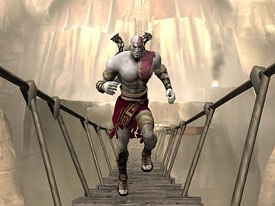
Sonys brand new game, God of War uses game environments and characters in specially scripted scenes. Courtesy of Sony Computer Ent. of America.
Console games are really becoming a showcase for realtime cutscenes. Games like the Grand Theft Auto III series, some of the Star Wars games, and most notably Sonys brand new über game, God of War. These games use the game environments and characters in specially scripted scenes, including camera moves, cutting and carefully written and recorded dialogue to tell their stories. These realtime cutscenes have even spawned a digital filmmaking revolution called Machinima, a style of filmmaking that exclusively uses game engines to create films. God of War, a Sony PlayStation 2 exclusive, makes use of both realtime cutscenes and pre-rendered sequences. The inclusion of the pre-rendered sequences seems at first over the top. However, as the main characters story progresses, gamers will appreciate the added complexity and nuance the pre-rendered scenes achieve. This reveals the chief remaining flaw of realtime cutscenes.
Most console game engines still cannot draw high-resolution, realistic textures that perfectly convey specifics such as subtle emotional shifts. With the advent of normal mapping techniques similar emotion will be conveyed in realtime and game developers can begin to push the boundaries of their medium and leave old filmmaking habits behind.
By the holiday season well have an opportunity to truly glance into the future. Thats when Microsoft plans to release its next game console. It hasnt been officially announced yet but rumors have flooded the Internet about Xbox 2 or Xbox 360, as it may be called. This system is the first of the next generation. Nintendo and Sony plan to follow in 2006 with new systems of their own. However, developers find themselves at a crossroads. Great tools exist, their audience is starving for the new games, but the publishers arent quite ready to open their checkbooks much wider. Any worthwhile developer wants to produce great works despite its limitations.
In the process, game development studios may teach Hollywood a thing or two. The question is how do we compete with Hollywood? Part of that battle may already be won. Gamers are instantly wowed by high-resolution graphics. In that regard, games have arrived. PCs and the next generation of consoles boast hi-definition graphics. Games have been delivering high framerates for years, with most games aiming to deliver 60 frames per second. What more could an animator want?
The problem for game animators is that high framerates dont equal superb animation. Animation is just one piece of a large puzzle contributing to those framerates. Even given more processor and memory allocation, game animations still have an uphill climb. Budgets are actually shrinking and development cycles shortened. For things to change games either need some mega, Hollywood style blockbusters that appeal to the mass market or we need some new magical software that can both cleanup mocap data and speed the process of hand animation. I dont think either is very likely but I am looking forward to the new generation of games.
One thing has been true throughout the 20 plus years of electronic game development; game developers are an amazing group of forward thinking professionals who deliver unique, captivating experiences unlike those of any other medium. I wouldnt miss this next generation of games, and the awesome animation they are sure to display, for anything.
Fred Galpern is the art manager for Blue Fang Games in Waltham, Massachusetts. Since entering the videogame field more than six years ago, Galpern has held management positions in several game and entertainment companies, including Hasbro and Looking Glass Studios. He began his art career as a comicbook creator and also has professional graphic design experience. He has created characters and developed stories for numerous childrens television series. Galpern has satisfied his long-standing interest in education by teaching at several New England colleges. He is also an adjunct instructor at Bristol Community College, where he co-created the associates degree gaming curriculum.