Peter Sohn gives us an exclusive about the importance of Dumbo, his mother and animating clouds in directing his first Pixar short, Partly Cloudy.

Prior to going Up (May 29) with Carl and Russell in the latest Pixar feature, we discover how storks deliver babies in Partly Cloudy, the whimsical short from animator/story artist Peter Sohn (Ratatouille, The Incredibles, Finding Nemo, The Iron Giant). Turns out that Sohn, who voiced Remy's brother, Emile, in Ratatouille, also served as partial inspiration for Russell, the youngster who bonds with the 78-year-old Carl in the Pete Docter-directed Up. Never has there been such a strong thematic and visual pairing between a Pixar short and feature. In Partly Cloudy, a neurotic gray cloud named Gus is tasked with making dangerous babies, which puts an extra burden on his beleaguered pal, Peck, the stork assigned to deliver crocodiles and porcupines and electric eels -- oh, my! A misunderstanding nearly wrecks everything, but, like Carl and Russell, they come to realize the importance of their friendship.
Bill Desowitz: How did the first public screening go in Austin last Saturday?

replace_caption_cloudy02_PeterSohn.jpg
Peter Sohn: It was really fun. I was breathless for a while, but right at the first couple of laughs with the kittens in the beginning, I was thrilled. It's a great town down there. I had never been there before but everyone was so friendly. And I got to see Up for the first time in its finished form. I was moved by it and I was with Pete [Docter] and I had a lovely time.
BD: They certainly go well together -- I don't think you could've found a better match. Was it a coincidence?
PS: Yes, it was a coincidence. I had been helping out with Up and then had asked if I could pitch some shorts. So I pitched three of them, all thematically different, and this is the one that JL [John Lasseter] really connected with.
BD: So let's start at the beginning with the influence of Dumbo.
PS: Yeah, I had seen it as a kid and it was one of those things -- I'm sure that countless kids have experienced the same thing with their parents -- it was very moving to me. I don't know, maybe I was just a sensitive kid, but the whole idea of where the storks get the babies from started that young. I was inspired since then but [the story and characters didn't come together] until the making of the short this past year.
BD: Talk about the pitch and how it went from there.
PS: The original pitch was just as I explained: There's the world of storks that deliver babies, but where do they get these babies from? And my answer was obviously the clouds. And I had done some drawings of these cloud characters -- taking some photos and Photoshopping eyes and a nose in and then having some birds all flocking up to the skies. I pitched this story of a smaller gray cloud that [lived below and] made some of the dangerous babies. And I showed John these images and he touched on one of them and said let's start developing this one.
And that was close to a year-and-a-half ago and it's been a really interesting learning experience for me. Obviously, this is my first [short]. It really is like raising a baby. I felt very much like Gus during this thing -- making something and wanting people to like it.

Sohn pitched the idea a year-and-a-half ago, visualizing where baby-delivering storks actually get their babies from and picturing clouds creating them out of thin air.
BD: And what was the experience like?
PS: It was really wild because I had worked on a lot of other projects here as a story guy and an animator, and what's funny is that during that kind of production it's not my story. But I'll put my heart and soul into whatever I'm doing. So I would be more experimental with my ideas I'd be giving the directors of the other story teams. And with this one, because it was my idea, I'd be so protective of everything. "This is my kid -- I gotta raise him right!" During story production meetings, I'd pitch certain ideas and there were different endings; there were longer versions. Really early on, the stork gets its own baby. And there was a version where the cloud gets its own cloud baby. But they were too complicated and plot-driven and never got to the root of [whom] these characters were. It's a very interesting thing when you're directing to allow yourself to go to places [that don't work] to find where the story really needs to go. So, in the beginning, I may have been more tightly gripped around some of my ideas, but once I started letting go, it really allowed me to find these characters, and it was really a great lesson for me.
BD: How did you find the tone?
PS: I always wanted to have something with heart. And what I mean by heart is characters that are sincere in what they are doing. That was something I had to really look for and find. There were many different tonal characters. Gus was more like a bartender or a frat guy. And Peck went up and down. But ultimately it came down to being a story about miscommunication when I originally pitched it to John. I had grown up in New York and from Korean parents and they spoke very broken English and there were always miscommunications between my mother or father and me. So, from the very beginning, it was: How do these two guys work, a bird and a cloud? That miscommunication idea is a subtle thing: most of the shorts around here don't have any dialogue, but I really wanted to play with how they communicate with each other. And the way Gus looks off at the other cloud [Gloria] was inspired by my mother's reaction when I was going out to play with my friends. She would take it a certain way. That didn't change but how I moved the characters around did.
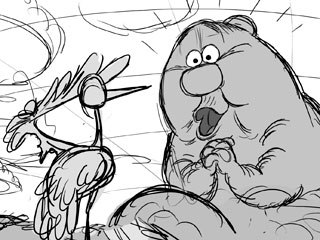
Peck and Gus in their early stages.
BD: As you say, there's a misunderstanding between Gus and Peck about their partnership, which Gus takes the wrong way.
PS: Exactly. He loves those babies. They need gators and porcupines in the world and he loves what he does. He just doesn't want to hurt his friend because he knows those babies are dangerous. It's really about how hard relationships can get but sticking with them.
BD: Let's talk about the animation, which is obviously very cloud-driven.
PS: The animation is heavily based on rhythm and timing... but to describe how a cloud moves was a huge hurdle for us because the short needed to be snappy. And we did tests of Gus moving sharp and crisp, but it just didn't feel like a cloud. And we had to slow him down and get him to be floaty and have his nose and exterior parts move in a certain way and keep the crispness with Peck. So there were many experiments we did with him without even the cloud effect on him: "naked" Gus, who looked kind of like the Michelin Man. And a couple of animators [Matt Strangio and Dylan Brown] found this really amazing style of keeping him floaty: he doesn't stop ever, he just moves around. John Lasseter had a great call of that where he overshoots his overlap but doesn't rubber band back. He just floats out to that extremity and comes back. That call gave us a great place to shoot for with Gus and we experimented a lot with that and then added the cloud effect on top of that really helped sell Gus' look.
BD: How was this achieved technically?
PS: Gus is literally wearing a 200,000-particle suit. Because he had to be kept transparent, we have an invisible character that we animate that we turn off, essentially, and leave the suit on that we never get to see until later. The suit pretty much looked like a lint guy when we were using him because a cloud is basically moisture and light and the final lighting process is what brought him to life. It wasn't just the cloud movement but how soft the shadows are, how the light works underneath him and what kind of detail we get in the shadows. But he was really an amazingly difficult character to build. In the beginning, when I first pitched this to some of the technical folks, they gave you a lot of options and different "Yellow Brick Roads" to what Gus would finally look like. There was a gaseous-looking Gus and a ghosty-looking Gus. We came up with this version that was more of a caricatured puffy cloud. Sort of like Ralph Kramden from The Honeymooners. The really tough challenge was that, because he is transparent and made up of so many particles, the rendering and lighting times are really long. It was a big fear that we wouldn't have enough time to render this short.

Animators Matt Strangio and Dylan Brown found a style of keeping Gus floaty and see-through. This is achieved by having Gus wear a 200,000-particle suit.
BD: But obviously you did. What were some of the other challenges?
PS: What I loved about it was we were using techniques in a new way that no one had ever done before in the lighting and in the particle world like blending shadows. But it was so hard to sell his eyes and his mouth. They were so soft that you could hardly read what was going on the face or the hands. We had to do some tweaks to finally get a smile on his face. And we tried cloudy eyes and it looked scary. Or it was difficult to make the eyelids work. Because the cloud effect is so thin, when he closed his eyes you could still see the eyeball beneath it. We just wanted someone appealing and really cute. And we came up with these eyes and mouth.
BD: And was any of this repurposed for Up?
PS: No, actually we took something from Up. A storm sequence was tweaked for our own purpose. It was lucky that this technology had just been achieved.
BD: What about the color palette?
PS: I always wanted the short to take place in a day: it starts in the morning and ends in the evening. But Noah Klocek, the production designer, brought it to life with the pastels that he had done so that morning and sunset can look exactly the same. So he caricatured it to look really warm and golden for that classical drop of the storks and toward the evening to come up with a look that is its own kind of world. It's so abstract that you want it to be believable, but you also want to caricature it so that every time you saw those colors it would be iconic in a way. And then Tim Best and his lighting crew translated that and brought it a whole new level. It was really surprising for us because there were so many times when we were working that we don't even see the clouds above or Gus in the cloud form. When the lighters come in, which are the last few months, that's we finally get to see Gus and the world.
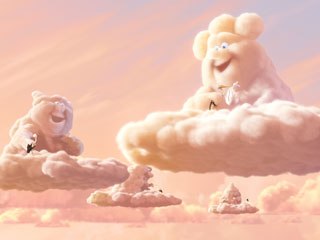
The pastel color palate moves from sunrise to sunset over the course of the short, keeping the look iconic but also abstract enough to look believable.
BD: And what about the storks?
PS: I really love the Dumbo storks in the beginning and was trying to get that realistic feel. There are really two Dumbo storks: the realistic storks in the beginning and the cartoony stork that actually delivers Dumbo. It was a mixture of both extremes: the realistic and finding how to caricature the stork's eyes to get the appealing faces from far away when they're flying in.
BD: And the babies?
PS: It was funny because JL kept saying to make them as cute as possible, even the more dangerous animals, because you want them to be the cutest things you'll ever see. We really tried pushing them and caricaturing them and that's what sold them.
BD: And your mother was obviously a big influence.
PS: Ultimately, the spine really came from my mother and me, trying to find our relationship through growing up in New York. That was something I always came back to during the making of the short. How would my mother feel about that? Or how would she react to that? Yeah, that was a big deal. I should tell her that, actually, before she sees it...
And a lot of inspiration really came from the team here. There were some problems that I didn't have the answers to, so the Pixar family of John Lasseter and Andrew Stanton and Bob Peterson and Pete Docter and Brad Bird were always there to fuel a different kind of inspiration.
BD: What were some of their ideas?
PS: John Lasseter was always pushing the pain stuff with Peck. For instance, how the lamb cloud was a porcupine underneath it. He thought it was funny that it would look like one thing and turn it into something else. Andrew really helped me out with the performances and selling ideas from beginning to end because one of the challenges with a short is to keep the jokes and character beats clear through every level. "Is his idea that he looked up to another cloud still selling?" And then with animation going into lighting: "We need to brighten that background so that his feather cutouts pop out." Andrew always says, "Know where your audience is and know where you're at with what you're showing." The rhythm is like a poker hand -- don't reveal what you have all at once.
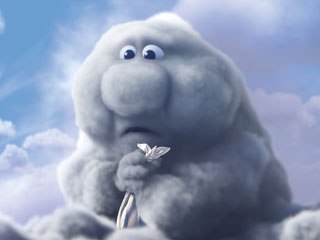
Gus thinks even his most dangerous babies are loveable.
BD: And what was it like working in 3-D?
PS: We've just done some of the right eye rendering the last couple of weeks, and that's what forms the 3-D. That world of 3-D has been really amazing. It's fun but it's a whole other set of challenges. You really feel like you're up in the sky in 3-D. It falls really far back in the depth, but you also want to focus where the audience's eyes go, and sometimes Gus' shoulder will be way in the foreground and you'll start looking at his shoulder instead of [what we want you to focus on]. It's a real balancing act of where the focus plane lies on the 3-D. But it was very successful and it's a really crazy thing to fly up there in the clouds in 3-D.
07
BD: One last thing: What was it like serving as the inspiration for the little boy, Russell, in Up?
PS: Yeah, that was really early on when I was boarding it. They did these drawings and the [initial] inspiration was me and Pete Docter's neighborhood friend, Russell, an actual kid in his town. I did a lot of scratch voice for it early on... there were some mannerisms that they would catch, but the resemblance with me as a kid is pretty much where it ends. It is such a family at Pixar: you pretty much want to talk about movies and nerd out with these guys all the time.
Bill Desowitz is senior editor of AWN and VFXWorld.

Bill Desowitz, former editor of VFXWorld, is currently the Crafts Editor of IndieWire.