
Mary Castillo looks at some of the leading players in the rapidly growing world of virtual communities.

When Tobi-Dawne Smith enters World of Warcraft, she encounters trolls, ogres, monsters, humans, dwarves, elves and dragons in the skin of her "toon," "Prairielily."
"We designed her to look like me and she actually did end up looking quite a bit like me, except for being ultra-thin," she said. "There wasn't an option for making a human character with a more 'human' build."
Customizing toons or avatars, whether they resemble the user or reflect that user's physical ideal, is one of the greatest demands on the creators of virtual worlds such as Second Life, Minyanland, World of Warcraft, Stardoll and others. The bottom line is that users want to animate themselves.
The interaction in virtual world communities now ranges from creating businesses, training in simulated exercises, and fighting against a common enemy, to engaging in romance. (According to a story on ShowbizSpy.com, a British couple met in Second Life and then left their spouses to continue their online relationship in the real world.) You name the activity and, more than likely, there is now a virtual world out there that allows one to do it.
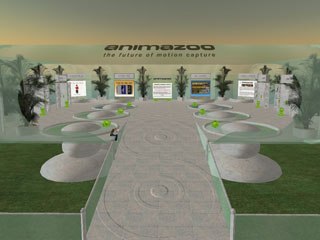
When motion capture company Animazoo began animating avatars in Second Life, the biggest challenge, according to Animazoo Director of Technology and Co-Founder Ali Kord, was to allow users to enjoy real-time character movement.
"What we're doing and have always been doing is to allow users to move in real time," he said. The two-year jump from superimposing movements in Flash to Animazoo's motion capture technology is nothing short of a time-warp in advancements.
Animazoo asked performers to come into their studios -- everyone from martial artists to pole dancers -- and then, using their proprietary gyroscopic MoCap system, recorded and looped those movements. Animazoo's IGS-190 features 19 tiny inertial sensors or gyros attached to a flexible lycra suit allowing precision and stability of motion data. Coupled with their Gypsy software, which according to Kord has been perfected over years of development, the IGS-190 allows for realistic animations that Second Life users can "grab" and then attach to their custom avatars.
Animazoo's Second Life project launched 14 months ago and, within one month, sales covered the original investment.
"The challenge now is to give nuances to the movements to differentiate the characters from each other," Kord said. "Taking a dance and having an avatar do somersaults repeatedly gets boring. It's very hard to create individuality; it's like writing pop music."

The Next Generation
After Minyanville launched Minyanland, the financial virtual world targeted at children ages eight to 12 years old, they registered more than 35,000 kids within the first two months.
In a nutshell, Minyanland is Second Life for kids, but with an educational mission. When kids sign up, they can choose one of six characters (designed by John Bell, whose character design credits include Antz and Jurassic Park) and then receive $5,000 in Minyanland money and a condo worth $50,000. Minyanland is free for users and allows for parents and teachers to teach kids in an interactive forum of games and activities the core concepts of earning, spending, saving and giving.
"No one is doing anything like this," says Kevin Wassong, President, Minyanville Publishing and Multimedia, LLC. "Quite honestly, the family and kids' side of the financial world are probably the least served. We're trying to say to the people that the earlier kids are involved and learning, the better."
Laurie Petersen, general manage of Minyanville Family Media, said that users are very vocal in what they want to see in Minyanland and what they feel is missing.
"The key with virtual worlds is that you evolve them," Wassong said. "It's not a product you launch and then let sit."
The kids at Minyanland spend most of their time customizing their condos and dressing their characters to make them unique. At the same time, the games and activities are showing, rather than instructing, them that what they do in their world affects their economic status and the world itself.
While users in Second Life or Gaia Online are driving Scion cars or purchasing real-world brands for virtual use, the creators of Minyanland do not yet have name brands in their world. But they are open to allowing advertisers to create relevant marketing experiences.
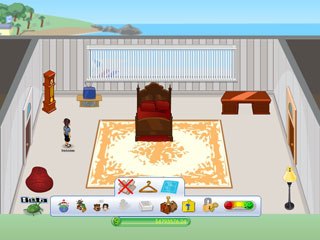
"Clearly we want Minyanland to reflect the real world where corporate money supports what you're doing," Charles Mangano, chief marketing officer for Minyanville Publishing and Multimedia, LLC said. "We want to do it in an experiential way that adds value to the world, as opposed to slapping on a logo."
Minyanland is also used by parents, who can give allowances to their kids, as well as by teachers in the classroom and in after-school programs. "They love that it's free and has educational value," Petersen said. "Parents love that they don't have to go out and buy a toy."
Filmmaking in Second Life
Filmmaker Douglas Gayeton spent a year in Second Life, documenting his experiences and the people he met via a character named Molotov Alva. Molotov Alva and his Search for the Creator: A Second Life Odyssey will air on HBO, Cinemax, OnDemand and online on May 15, 2008.
The first challenge, however, was capturing the experiences that he could splice into a narrative.
"It's not a simple thing to do," he said. "I went three months using different processes of trying to capture what was happening onscreen and then getting it into the hard drive."
With a few fixes and customizations here and there, Gayeton broke through the technical barriers to create the first documentary "filmed" in Second Life.
"The people that are in [the documentary] are the people I met," he said. "The documentary is about what happened in our experience together."
When the documentary was completed, the first episode was accidentally posted on YouTube. Within three days, the video had 500,000 hits. Gayeton signed a deal with HBO, allowing Molotov Alva to be distributed across multiple media including TV, OnDemand and on the web.
"[HBO] wanted to distribute the document where people are," Gayeton said, as opposed to simply airing it on TV and expecting audiences to tune in. "People are spending less time on TV and they're spending more time on the Web."
The first episode takes place in Second Life and Gayeton has plans for 12 more episodes in which Alva will document and report what he finds in virtual words such as World of Warcraft. He sees that virtual worlds are competing for audiences with Hollywood and that they are winning.
"When Halo does more in its opening weekend than any movie in the last two years, people are spending an amazing amount of their time in the video game world," he said. "Mainstream Hollywood thinks they own people's disposable time, but they're not even close to the time captured by video games and virtual worlds."
The facts add weight to Gayeton's argument. The NPD Group announced in a press release dated March 11, 2008, that video game industry retail revenue tripled in growth in 2007; at the same time consumer spending on music fell 10 percent and DVD revenues also took a downturn. In September 2007, Microsoft reported that the video game Halo 3 earned $170 million in sales in its first 24 hours on the U.S. market. In contrast, Spider-Man 3, which in May 2007 broke movie box office records for the highest ticket sales in one day, brought in $59.3 million.

Audiences Are Hooked
Smith, who plays in World of Warcraft as "Prairielily," has also found that this fantastic virtual world is a viable social network.
"A few of the people we've gotten to know are unable to interact in a positive way in regular society for a number of reasons -- health issues, mental illness, etc.," she said. "For them, World of Warcraft has become one of their only social outlets and as such is a huge part of their lives."
As Animazoo's animated avatars become more popular in Second Life, Kord will continue to focus on bringing real-time motion capture technology to the user. He foresees Animazoo offering an inexpensive MoCap system that the average user can wear for more true-to-life game play and interaction.
"Real-time motion capture gets cheaper and cheaper," he said. "Eventually people can go online wearing a MoCap suit and you literally could be shooting someone onscreen who is in Iceland while you're in London."
Within four years of launching Second Life, Linden Lab reported eight million residents in July 2007 on its website. When a basic membership costs $9.95 per user per month and you do the math, the numbers alone point to the massive appeal of virtual worlds that allow the audience, or the users, to be the stars in a narrative of their own making.
A lifelong professional writer, including a stint as a reporter for the L.A. Times Community News (second best job in the world), Mary Castillo is now living her dream writing sassy comedies for Avon Trade and Latina lit for St. Martins. Together with her fearless colleagues Francoise and Rascal (aka The Pugs), she is also writing young adult fiction, as well as a mystery series about a cub reporter in a small town. One day, Mary swears that she will write a great American epic.