
Ellen Wolff explores how LucasArts re-imagines the Star Wars universe for the first time as a next-gen game with The Force Unleashed.

Making a next-gen game is a perennial goal for creators of interactive entertainment, even though the bar for what constitutes next-gen keeps rising. But with Star Wars: The Force Unleashed (due Sept. 16), LucasArts stakes a claim on that achievement by following a unique strategy: a collaboration of animation and vfx with sister company Industrial Light & Magic.
Ever since George Lucas moved both his game company and ILM into the Letterman Digital Arts Center in San Francisco's Presidio in 2005, the hope has been that technical and creative synergies would emerge. According to members of LucasArts' TFU (The Force Unleashed) team, collaboration with ILM enabled them to attempt game images that went beyond what they had tried before.
"We had access to anything that ILM has done," suggests Art Director Matt Omernick. That included digital models that ILM created for the Star Wars feature film prequels, though Omernick notes, "We didn't need the millions and millions of polygons in some of the things they built, like a giant star destroyer. A lot of times we leveraged what they've done as reference, to make sure that we get everything right. We've shared characters, but we did spend time cleaning them up to make them work for our game engine."
One major challenge was to adapt familiar elements into a game set in the time between the last Star Wars prequel film, The Revenge of the Sith, and the first Star Wars (Episode IV). "There's about an 18-20 year gap between those two," adds Omernick, "so we got to describe how the two trilogies linked together. Being able to bridge that gap was a gift from heaven for our artists." In Star Wars: The Force Unleashed, players deal with the exploits of Darth Vader's apprentice, and push the boundaries of Lucas' iconic "Force."

replace_caption_tfu02_172311233-image16.jpg
Omernick, who previously worked on the LucasArts game Star Wars Battlefront and DreamWorks Interactive's Medal of Honor games, believes that this mileu presented rich possibilities. "It's the time when the Empire is taking over the galaxy. So we get to show that devolution, and we're able to leverage existing planets but at the same time create many new locations and characters."
LucasArts spent two years developing the concept for The Force Unleashed, and during that time the LucasArts/ILM collaboration focused on advancing the technologies that would yield better simulation of sets and environments, including the dinged-up spacecraft that has been a Star Wars trademark since the beginning. "That's what made Star Wars stand out in the seventies," observes Omernick. "When we decided to build this game we decided to lean more heavily towards that classic trilogy for that reason, so we could leverage all the shaders and materials to provide that earthy, gritty realism."
Senior Visual Effects Artist Tim Nice, who was part of the LucasArts/ILM team that developed tools for The Force Unleashed, remarks, "Because the time period of this game had a lot of conflict, there was a direct effort to make sure that things didn't just look pristine or plastic. The specular highlights on the materials were broken up nicely with grit and grime. The artists did a really good job of using the technology to make things look like they belonged in that environment."
According to Lead Engineer Cedrick Collomb, "We tried to provide so many variations of materials to artists that we went to the other extremes -- like 16,000 variables at a time -- and we didn't have enough memory to handle all of those! We had to keep the same look, and at the same time reduce the number of variations on the technology side of things while still providing all those materials.
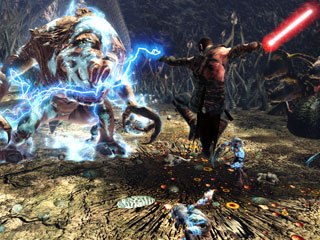
Advanced simulation technology helps add detail to the effects.
"We've developed, in collaboration with ILM a tool that allows the artist to really create, with a combination of materials, more complex effects. For example, in previous games an object was either reflective or refractive. Now we've managed to combine those things together so that depending on the angle that you're looking at an object from, it's either reflective or refractive or blurred to create a glowing effect."
Collomb, who previously worked on games for Electronic Arts, Sega and Sony, notes that the LucasArts system used to create The Force Unleashed is comprised of several components. "It includes cloth simulation and animation technologies, our artificial intelligence technology and game engine technology. And we have our own rendering engine. We have a collection of custom technologies developed in-house to support the full range of game play and interactivity."
Simulation technology played a major role in creating convincing environments for the worlds within the game, and Collomb cites as an example, "Our particle effects simulate all the dust when something falls on the ground." The particle system was an area where collaboration with ILM was especially notable, says Nice. "I got to work on a team that was made up of an ILM employee and a LucasArts employee. I've never worked at a company before where we've had that kind of talent working together. So all the particles were a true shared engineering experience. The tool that I used is actually being used now for some of ILM's simulation stuff. So the particle effects stuff was shared in both directions.
"The biggest thing that LucasArts has been offering ILM is the fact that LucasArts has been developing everything from a realtime standpoint, whereas ILM does finished renders that take hours and hours to create. A lot of our rendering technology has helped push ILM's rendering and lighting and shading technology. They can now get feedback in realtime. When an artist is adjusting properties and tweaking something, the faster they can have feedback the easier it is for them to create higher quality art, and the cheaper it will cost."
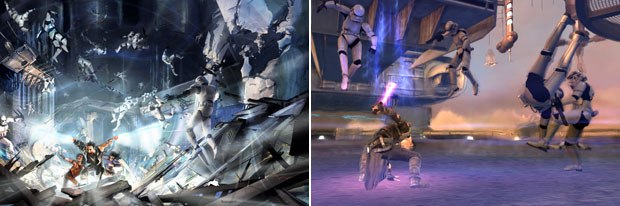
One of the key elements of the game is Force blasts, rendered here in the concept phase and the final gameplay.
While the give-and-take between LucasArts and ILM enabled the game team to achieve some sophisticated simulations, some effects were still beyond the reach of the game platforms currently available. That includes water effects, though Nice notes they did consult with ILM on this topic. "The engineer who worked on a lot of the fluid simulation for the Pirates of the Caribbean maelstrom was able to give us input. But because we know how water SHOULD look, we actually avoided it in a lot of situations this time so we wouldn't have to solve a lot of those issues. We knew where we wanted to spend our manpower." Omernick adds, "We made that call really early on. Because it is Star Wars we had the luxury of being able to design and build our own worlds, so we could avoid liquids for the most part!"
The Force Unleashed team was able to create worlds that featured vegetation, and they employed DMM (Digital Molecular Matter) software from Pixelux Ent. As Omernick notes, "We knew that we'd be using DMM and we had a vision of what that was going to be, so we chose to build worlds that would leverage that." Collomb adds that "There's more interactivity with soft body objects and plants, and we really tried to push the technology to empower our artists and designers."
LucasArts also employed the Havok physics engine to handle rigid body simulation, and Collomb cites a typical example. "Imagine the 'apprentice' in the game takes a boulder -- which is a Havok object -- and throws it at a soft plant -- which is a Digital Molecular Matter object. Having those systems work together was a necessary condition for making this game, and that actually was one of our biggest challenges."

In this concept art, Darth Vader is shown to be a powerful force in the game's story.
But it's in the character details where the next-gen aspects of The Force Unleashed are especially evident. When Darth Vader strides across the screen, his infamous mask reflects light in familiar ways and his cape flows convincingly. "We didn't have a choice about that," admits Collomb, "because Darth Vader without his cape wouldn't be Darth Vader! That was a key challenge but also one of the key achievements. It's another form of the collaboration with ILM where we really leveraged the experience of those guys to get a solution that would give us the responsiveness that we needed -- so that the game would be enjoyable to play -- while delivering a fidelity that's at a higher standard than other games."
Which is not to say most characters featured cloth sims, such as flowing robes on Jedi knights. "We wanted to stay away from those as much as possible," acknowledges Omernick. "And we made decisions to keep the characters' hair short or tied back in a Samurai bun. You won't see a lot of long hair -- except maybe on a Wookie!"
Getting Darth Vader to move in the way Star Wars fans expect was the challenge for Christine Phelan, whose first job after graduating from the Savannah College of Art & Design was as a character animator for The Force Unleashed. Phelan notes that "people know Darth Vader's gait, so we had to keep to that or people would pick up on it immediately. We spent a lot of time with reference footage, really watching the movies and paying attention to his walk so we could nail that."
"There are a lot of things that went into making Vader look good," notes Omernick. "One of the things that we created for this game, again working with ILM, was a piece of technology we refer to as subdivision smoothing. We were able to take a game-ready model, and when we got it closer to the camera, we could actually subdivide it and smooth it out, and lose all that faceting that people associate with games. Vader has always had faceting in every other Star Wars game. Now when we get close to him, we can smooth out his helmet and you get the contours that we KNOW is Darth Vader. The game cinematics have great examples of that."
"The beautiful thing is with this technology," adds Collomb, "was that it was available to all artists anyplace in the game where it was needed to improve the silhouettes of objects so they didn't look faceted as games previously did. We still have a ways to go but we feel quite proud of this."
The character animation challenges involved in The Force Unleashed were multi-level ones -- from the artificial intelligence software that enabled multiple character reactions, to facial animation. LucasArts employed euphoria software from Natural Motion to imbue characters with a sense of awareness, and leveraged technologies developed at ILM for facial animation. "For the movement," explains Collomb, "ILM has a technology which allowed us to approximate facial animations to look as good as they can, given the constraints of the game hardware."
The Force Unleashed is being released on multiple platforms, including Sony PlayStation, Microsoft's Xbox 360 and Nintendo's Wii, and Collomb notes that the appearance of the facial animation will vary from platform to platform."We're really trying to leverage as much as possible the power of the current generation of hardware. The additional power of the PlayStation 3 and the Xbox 360 really enabled us to deliver a higher quality experience. So the look is different on the PS2 than it is on the PS3 and the 360."
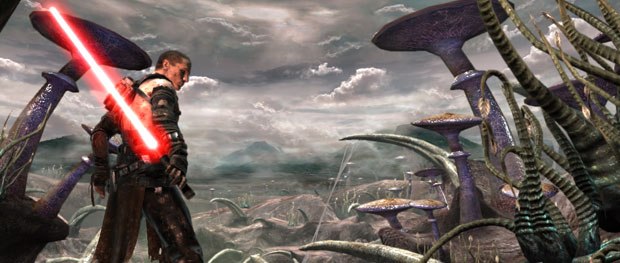
Of course the iconic lightsaber plays a key role in the gameplay of The Force Unleashed.
LucasArts and ILM share the advanced MoCap facilities at the Letterman complex, but Omerncik notes some obvious differences, including the number of blend shapes they can use in a game. "We're creeping as close to ILM as we possibly can but we're always dealing with the limitations of game hardware."
Christine Phelan observes, however, "That the most successful thing, at least from an animation standpoint, was being able to see those textures blending in real time as we were working with them. When we were animating, we could really see how the face was going to deform and how it was going to be changing."
"Part of the technology that we got from ILM is what we call the fitting technology," adds Collomb. "It's actually fitting a given model to a given animation. When we're fit a face to a different motion capture, it could be considered a 'palette' of basic emotions. These would then be applied to different faces. We can't always get to the high quality that is used in movies because of hardware limitations. But on a case by case basis we sometimes can transfer animations from one model to another."
While the challenges involved with facial animation and simulation are obvious, one problem facing the TFU team that may seem surprising was how to create better looking versions of Lucas' famed lightsabers. "You would be surprised at how much effort went into the technology behind the lightsabers," admits Collomb. "If you compare our lightsaber in the current game with the old generation of games they look like something that was not as intense as they were in the movies. We had one of our most senior engineers working for quite a bit of time on the lightsaber to really deliver the intense and vibrant look that we can get now."
Nice agrees. "The lightsaber was almost like a personal project for a lot of our senior engineers. They did not want to just use some of the standard, accepted solutions from the past but to generate a truly three-dimensional, glowing lightsaber that we could completely interact with in the game -- as opposed to trying to fake it with 2D images all the time. It was not on the schedule; it was basically a group of people and myself deciding to push the lightsaber because it's so iconic for Star Wars. We wanted to make sure it was at the next-gen level of quality."
The LucasArts team firmly believes that what they learned making The Force Unleashed is already producing benefits for the people making the upcoming Indiana Jones games. "I can say that we're not afraid of water anymore!" laughs Collomb, who anticipates that the collaboration with ILM will only continue to produce innovation. "There is really no company out there that's united movies and games and made those people fit together and develop breakthrough technologies. In terms of size, scope and talent, it's really an unprecedented effort."
Ellen Wolff is a southern California-based writer whose articles have appeared in other publications, including Daily Variety, Millimeter, Animation Magazine, Video Systems and the website CreativePlanet.com. Her areas of special interest are computer animation and digital visual effects.