Andrew Farago reviews three short films: Abridged byArjun Rihan, Doxology by Michael Langan and Film Noir by Osbert Parker.
Within the world of animation, most experimentation occurs within short-format productions, whether they are high-budgeted commercials, low-budgeted independent shorts or something in-between. The growing number of short film festivals around the world attests to the vitality of these works, but there are few other venues for their exhibition, nor are they often reviewed. As a result, distribution tends to be difficult and irregular. On a regular basis, Animation World Magazine will highlight some of the most interesting of these films.
This month:
Abridged (2007), 3:35, directed by Arjun Rihan, U.S. Contact: Arjun Rihan [T] 650.814 3145 [W] www.arjunrihan.com/abridged [E] arjunrihan@gmail.com
Doxology (2007), 6:10, directed by Michael Langan, U.S. Contact: Michael Langan [T] 334.220.5805 [W] www.DoxologyFilm.com [E] Michael@MLangan.org
Film Noir (2006), 4:48, directed by Osbert Parker (U.K. Contact: Osbert Parker [T] +44(0) 778.601.5728 [F] +44(0)208.347.6711 [W] www.osbertparker.com [E] very.fizzy@virgin.net

Abridged
The greatest love of all, it has been noted, is the ability to love yourself. If that's a big deal when it happens to a person, then it must really be a big deal when it happens to a National Landmark.
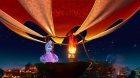
Abridged is a quirky, charming love story created by director Arjun Rihan as a graduate student project. Inspired by the foggy weather during a visit to San Francisco, Rihan decided to tell a love story about the Golden Gate Bridge... and the Golden Gate Bridge.
Two bridge supports notice each other one day, and their determination to be together, whatever the cost, causes no small amount of trouble to Bay Area commuters, but maybe, just maybe, there's a way that the bridge can strike a balance between duty and love.
Rihan devoted a considerable amount of research to the project, using Autodesk Maya for modeling, rigging and animation, with mental ray and RenderMan for rendering. The telltale San Francisco fog was created through the use of live-action photography, and was composited separately. The use of nontraditional character types in the film posed some unique questions for Rihan (how does a non-mobile, non-legged edifice express movement and emotion, anyway?), but through his own creativity and judicious use of Maya, he managed to overcome the numerous technical challenges inherent in the subject matter.
Sound designer Elizabeth Johnson, whose day job involves editing sound for video games at Technicolor, is responsible for the soundtrack, a fun, folksy guitar-driven theme paired with the chaos and calamity that goes with intra-bridge romantic entanglements.
The story is a simple one, told simply, but it's done very well, and definitely worth a look -- hopefully from a safe, stable, landlocked vantage point.

Doxology
The filmmaker describes Doxology as "a tangent-peppered exploration on a spiritual theme." Once I read that and re-watched the film, it all started to make sense; my own guess at the theme had been "prep school demons will destroy humanity through tennis," and I'd like to think that I wasn't completely off-base.
Through a series of sometimes directly connected, sometimes not, vignettes, director Michael Langan explores religion and man's place in the universe. Do we have free will? Is it possible to connect with God in a direct manner, and if so, should we? Although this film has a lot of big questions -- some may argue that those are the biggest questions -- at its core, there are plenty of amazing visuals for those who'd just as soon not ponder Life, The Universe and Everything while passing an afternoon in front of a computer. But I digress...
Langan filmed a number of friends (including himself) and the world around him from multiple angles in locales ranging from tennis courts to airplane interiors in order to obtain all of the raw footage necessary for his film. Utilizing pixilation, basic stop-motion animation, time-remapped live-action footage, time-lapse photography, 3D animation (in the form of Maya-generated snow), and original postproduction stabilization techniques, he assembled a ready-made religion, Doxology, and managed to create an entire world, and everything in it, over the course of a six-minute film, which is no small feat. (I'm assuming that, in the seventh minute, he rested.)
The film's score is quite impressive, as well. Langan enlisted a choir, two organists, a box of cornstarch and a mariachi band to get the exact soundtrack that he wanted for the film. This pays off in a big way at the film's climax, which demands nothing less than a full church choir (created with a small church choir, by the way, with multiple recordings at different octaves and some skilled digital artistry), and the music doesn't disappoint.
And again, those who aren't spiritually inclined will at least get a kick out of the weird tennis ball tricks, floating carrots, automobile tango and Shiva shaving sequences. Langan himself admits that each audience member is likely to walk away from the film with his own unique interpretation. As for me, I'm stocking up on tennis balls and carrots, just in case Langan has discovered the one, true religion. It never hurts to be prepared.

Film Noir
Rounding out this month's "Fresh from the Festivals" is Film Noir by director Osbert Parker. This is the first of Parker's experimental animated noir trilogy (the second being Yours Truly, which was covered in last month's FFF). Homicide, shady dealings, mysteries, dames... what else do you need in your animated shorts?
As with Yours Truly, Film Noir is experimental and engaging from beginning to end. Created in-camera, this mixed-media animated adventure combines archival footage, still photography, found objects, scale models and just about anything that Parker could get his hands on to achieve the dark and moody atmosphere and psychological tension of Film Noir.
Armed with a small budget and a burning desire to take a break from his more commercial work, Parker produced Film Noir as a labor of love, and it shows. He kept meticulous sketchbooks and collected photos and clippings, while jotting down notes about characters and plotlines over the course of a 15-year period, picking away at the film bit by bit, in-between major animation projects for clients including Nike and Budweiser. In 2002, he decided to get serious about his solo projects and conceived of an animated noir trilogy.
Drawing from an array of influences including Max Ernst, Man Ray, Roman Polanski, Alfred Hitchcock and Jan Svankmajer, along with contemporary, surrealist and collage artists, Parker has constructed a compelling and engaging film experience that's not to be missed. It's true that Film Noir is not quite as ambitious as Yours Truly, but all of the same elements are in place, and the total package is nearly on par with its successor. I'm sure that I'm not the only one eagerly awaiting the conclusion of this trilogy.
Andrew Farago is the gallery manager and curator of San Francisco's Cartoon Art Museum and the creator of the weekly online comic serial The Chronicles of William Bazillion.