
Animated Christmas specials haven't always been synonymous with the season, it just feels that way. Martin Dr. Toon Goodman discusses their history and the uneasy balance they strike when trying to depict the "true" meaning of the season.
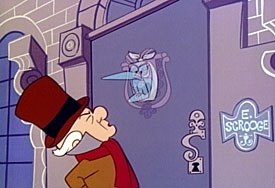
The one that started it all: Mr Magoo's Christmas Carol. © 2002 Classic Media.
Sometime between 4 and 7 BCE, likely during the month of October, a baby by the name of Jesus Christ was born in ancient Palestine. During the time of his ministry Jesus surely noticed that every year between the 17th and 24th of December the local populace gave it up for the harvest god Saturnus and partied down in a ritual celebration known as the Saturnalia, a holiday marked by the giving of small gifts and the license to play harmless practical jokes on friends (or so we are told; this is the same culture, after all, that had gladiators hacking each other to fettucine). One hundred and thirty years later, after the humble carpenter had gained quite a following, a Bishop of Rome named Telemachus co-opted the Saturnalia, declaring that the Nativity would now be celebrated in December. However, old habits die hard and in 274 AD the Emperor Aurelian declared December 25 to be Natalis Solis Invicti, or, the birth of the invincible sun. The whole megillah was settled for good by Pope Julius I who made December 25 the official birth date of Christ.
The Evolution of Christmas
In Europe (and later in America), Christmas was dutifully observed, but the real blowout was reserved for New Years. For centuries, this day was the capstone of the Holiday season, replete with feasting, rowdiness, riotous consumption of alcohol, and the giving of gifts. New Years held sway in America until around 1820, when the two holidays finally merged into one big Season; Christmas became a domesticated family holiday while New Years retained more of the profligate aspects of the celebrations. In 1823, a Christmas poem entitled The Childrens Friend first introduced Santa Claus to American children in protean form; it is here that Santa first acquires a reindeer-powered sleigh. In 1834, Clement Moore shaped the modern Santa Claus mythos with his landmark poem, Night Before Christmas.
Somewhere around 1850, German influences brought the Christmas tree into American homes, and St. Nicholas — Santa Claus — became the patron saint of the holiday. Although merchandisers had considerable difficulties settling on a depiction of Saint Nick, they were greatly helped by cartoonist Thomas Nast, who depicted the character annually from 1863-86 for Harpers Weekly, and by the various artists (such as Louis Prang) who drew the character on merchants' trade cards. By 1890 the Santa we know today was more or less finalized. So was the holiday known as Christmas, by now Americas penultimate shopping and gift-giving holiday, responsible today for almost one-quarter of Americas annual retail profits (and forty percent of its yearly credit card debt). Still, there was one more Christmas milestone to be reached: 1962 saw the premier of the first animated Christmas special made exclusively for TV.

Rudolph the Red-Nosed Reindeer graced the cover of a Boston newspaper's television guide in 1964. Courtesy of RankinBass.com. © 2002 Rankin/Bass Productions.
A Tradition Begins
As United Productions of America slowly fell from the premier position it held as animations artistic vanguard during the 1950s, studio president Abe Saperstein found that he had few commodities that were suitable for the television market. The sole profitable property remaining was Mr. Magoo, and the myopic codger was pretty much down to his last cane. Still, Quincy Magoo had one great inspired turn left in him, and the UPA staff under director Abe Levitow coaxed Magoo to his greatest performance ever. The role was Ebenezer Scrooge, and the special was Mr. Magoos Christmas Carol. Sold to NBC and sponsored by Timex, the hour-long special premiered on December 18, 1962. That evening, as Dickens' beloved tale unfolded with surprising impact and style, something more magical than flying reindeer happened; Christmas and animation came together in an unbreakable cultural fusion that exists to this day.
This fusion was greatly helped by the fact that four of the first Christmas TV specials were, in many ways, the best and most beloved of the one hundred and thirty that exist today. Mr. Magoo was joined in 1964 by Rankin/Bass studios most memorable special. Rudolph the Red-Nosed Reindeer, the creation of one Robert L. Mays, was originally introduced to the public in a Montgomery Ward souvenir booklet in 1939 as part of an ad campaign. The winning story made its way into popular culture; ten years later songwriter Johnny Marks penned a saucy little tune about the misfit ruminant and Gene Autry made it a high-flying hit. It remained, however, for Arthur Rankin, Jr. and Jules Bass to provide the most enduring visuals ever to accompany the music. Through the use of stop-motion puppets that were cuter than a bushel of sugar plums, the studio interpreted the Rudolph myth as an adventure complete with romance, danger, heroism, and some of the best male bonding since Spartacus. Some sparkling additional tunes by Marks himself surely helped, and so did the addition of Burl Ives, whose warm, grandfatherly interpretation of Sam the Snowman had the North Pole (and viewers) melting with delight.


Charlie Brown's pathetic little Christmas shrub became a visual icon for the push and pull between capitalism and the reason for the season. Courtesy of ABC / United Features Syndicate.
One year later Charles Schulz, Lee Mendelson and the Coca-Cola Company teamed up to bring America, A Charlie Brown Christmas. This special began as a documentary about Peanuts creator Schulz but did a quick revision when the sponsor, Coca-Cola, began casting about for a Christmas special. The special was produced under tremendous pressure; Schulz wrote the script outline over a weekend, and the entire show was animated in six months. The results were stunning. On December 9, 1965, Bill Melendez faithful animated renderings, Vince Guaraldis snappy jazz score, and a scrawny Christmas shrub became an indelible part of Christmas. A Charlie Brown Christmas was a triumph of personality animation, one that enshrined the Peanuts gang as cultural icons while gently questioning that same cultures values. Not long after that, old Army buddies Chuck Jones and Theodore Dr. Seuss Geisel hooked up for the first time since working on Private Snafu cartoons back in the 1940s. Jones adapted Geisels story How the Grinch Stole Christmas for a TV special. On December 18, 1966, How The Grinch Stole Christmas stole a nations heart as well. Geisel contributed a marvelous story; Jones redefined it using his impeccable skills in character design, timing and expressivity. When two professionals of such caliber collude and then sign up Boris Karloff as narrator, the result can only be a legendary animated Christmas special — which Grinch undoubtedly was.

replace_caption_goodman05_grinch.jpg
Following these four charming entries, animated Christmas specials descended on the networks like a blizzard straight out of the North Pole. Some of them were forgettable folderol featuring such lightweights as the Mirthworms while other specials, particularly those produced by Rankin/Bass, became synonymous with the season. Established characters such as Fred Flintstone, Yogi Bear and Garfield took their turn beneath the mistletoe, while the raucous ragamuffins of South Park actually originated as an animated Christmas card. Even Ren and Stimpy managed to clock in with a Yuletide tale. Perhaps no special was as freakish as Filmations 1985 offering starring He-Man and She-Ra (who would seem to be more comfortable worshipping Serapis than the man from Galilee). The Christmas specials eventually splintered into two genres, some with a religious message and some with more secular intent. The former camp generally dealt with the birth of Jesus and the events thereof, as in Rankin/Bass The Little Drummer Boy. The latter sort of special was more variegated and dealt with Christmas legends, the solving of a crisis that would save Christmas (often due to the incapacitation of Santa Claus), or a quest to discover the true meaning of Christmas. This camp holds by far the bulk of the Christmas specials and reflects the confusion that American society has long held in regard to the holiday.
An Uneasy Relationship
In his excellent discourse on American holidays, Consumer Rites, sociologist Leigh Eric Schmidt notes that: The American marketplace has served for more than a century and a half as a site of competition about the meanings of Christmas. The contest has revealed deep ambiguities in the culture — fundamental tensions between asceticism and indulgence, simplicity and affluence, piety and spectacle, religion and consumerism, Christ and culture...a site of not a little ambivalence, paradox, and contradiction. As always, animation is inseparable from the culture that produces it. The best synthesis of the two camps is probably the Charlie Brown special, but then, Charles Schulz had been slipping morsels of piety into his comic strip all along and was probably best suited to pull this complicated stunt off. In many of our animated Christmas specials the origin of Santa or the celebration of a peripheral holiday character (such as Frosty the Snowman) vies with the story of the Nativity told in others. At times the true meaning of Christmas seems to be unconnected to the birth of Christ and is defined more as a spirit of unselfishness or altruism above and beyond the call of duty. The Grinch cartoon, for example, seems to define the true meaning of Christmas as indefatigable cheer in the face of Yuletide deprivation. Or is it more a measure of the true meaning of Christmas to observe what sorts of commercial pitches are played during breaks in these Yuletide antics, sacred and secular alike?

Burl Ives (left) and Rudolph the Red-Nosed Reindeer songwriter Johnny Marks combined forces to make this Christmas perennial. Courtesy of RankinBass.com. © 2002 Rankin/Bass Productions.
As for those specials in which Christmas must be saved, this is usually due to the fact that some evildoer must be defeated or because Santa Claus must receive some sort of physical or spiritual assistance. In both cases, a gallant hero (or heroes) saves the holiday. Most of the time they are richly rewarded with the largesse of Christmas spirit, and even the black-hearted villain winds up touched with a healthy dollop of the same. The Rudolph legend as interpreted by Rankin/Bass is particularly representative: In the face of a gargantuan blizzard Santa dolefully informs his distraught workshop that, Well have to cancel Christmas. Since Christ has long since been born and the faith he founded an established fact, there is not much chance that Christmas can be negated in the first place; what is jeopardized is actually the delivery of presents and the material trappings that have come to symbolize the holiday. There is little confusion, however, in the minds of young viewers; Rudolph (with his nose so bright) bravely comes to the rescue, a savior equal to the Birthday Boy himself.
Perhaps, given the history of Christmas in America, this is not nearly as odious as it sounds since the coexistence of both marketplace and church has never been truly antithetical. During the time in which this country moved to the forefront of world power, both free-market capitalism and religious faith have grown in strength to the point where they are consistently factors (for good and ill) in major political policies and decisions. The threat of radical terrorism is a menace to both fixtures and has driven them, if anything, deeper into each others arms. If there is a true meaning to Christmas, American style, it is probably acceptance that this holiday will always embody a contradiction between our Puritan heritage and the aggressive influence of capitalism right down to our Yuletide cartoons.

 The Little Drummer Boy (1968) is one of the few religious animated TV specials shown at Christmas. Courtesy of RankinBass.com. © 2002 Rankin/Bass Productions.
These animated specials have flavored the holidays like nutmeg and holly, gobbled up for two generations as if they were ribbon candy, eggnog and candy canes. The best of these presentations reaffirm animations vital but underrated contribution to our culture, and if you would quibble with this, just try to imagine Christmas without them. For many a young child who has furtively peeked in the closets during the interminable countdown to Santas arrival, these holiday cartoons embody the spirit of the season, a harbinger of that magical morning soon to come. Surrounded by toys, games, ribbons, bows and scads of crumpled wrapping paper, isnt a childs delight part of the true meaning of Christmas especially in a consumerist society that never settled its own ambiguities about the holidays? To ask a half-hour cartoon to resolve or begin to sort out the contradictions is asking far too much; lets simply switch on the set, light up the tree, and catch the twentieth rebroadcast of The Year Without A Santa Claus. And could you please pass the ribbon candy? — yes, the cinnamon pieces!
To learn more about Rankin/Bass, check out the books The Enchanted World of Rankin/Bass: A Portfolio and The Making of the Rankin/Bass Holiday Classic: Rudolph the Red-Nosed Reindeer available from www.rankinbass.com
Martin "Dr. Toon" Goodman is a longtime student and fan of animation. He lives in Anderson, Indiana.