
With Up's Carl Fredricksen on everyone's mind, Dr. Toon recalls senior stars of animation past.
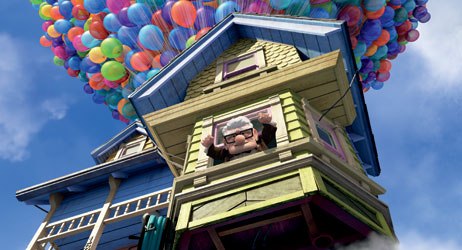
Pixar has taken another risk with its 10th feature, Up, but, judging by the domestic box office performance thus far ($146.8 million), the reigning king of animated features has another artistic and financial triumph.
Up, of course, features a geriatric protagonist mourning his deceased wife. On the surface, there's nothing much wrong with that. Director Pete Docter worked with writer/co-director Bob Peterson (with early story assistance from The Station Agent's Tom McCarthy) to model a grumpy old codger after Spencer Tracy (with a little Walter Matthau thrown in for good measure). As a result, Pixar's newest star, Carl Fredricksen by name, would be an unusual source of humor while appealing to children much in the way their grandpas would. This 78-year-old chap (voiced by Ed Asner) still has dreams and promises to fulfill when most men his age are wearing down, leading to a wild journey to South America in a house made airborne by 10,000 balloons. There is a young lad who accidentally joins the flight as well as a talking dog, but, make no mistake, Up belongs to Carl.
The risk lies in the fact that elderly animated characters have a very scant history as lead characters. Although senior citizens can be found as supporting players in many animated series and films, the stars are for the most part quite young, at the worst middle-aged. A 78-year-old graybeard is a rarity as a star. In fact, with only one notable exception, such has been the case for a very long time.
In animation's early days, a superannuated character was good for a laugh. Some the original stars of animation were not exactly spring chickens. Colonel Heeza Liar, created by J.R. Bray, entertained audiences from 1913-1924, an amazing eleven-year run of popularity (Note that the original run of Felix the Cat cartoons lasted only eight years). Suffice it to say that several decades of life had passed since the Colonel had been Private Heeza Liar. Newspaper cartoonist Sidney Smith adapted his comic strip character Old Doc Yak into a short but popular series that ran from 1913-1915. The character was visibly not a young Doc Yak. One ancient character who managed to survive into the 1940s was Paul Terry's Farmer Al Falfa; calling him a farm boy would be a huge mistake, considering his bald head and scruffy white beard.
Just prior to the advent of sound, elderly characters began to vanish from stardom. As animation techniques improved, it seemed that audiences liked their characters younger and peppier. When Walt Disney launched his Oswald the Lucky Rabbit series in 1927, producer Charles Mintz expressed deep dissatisfaction with the first cartoon (Poor Papa,1927), stating that the rabbit looked too old, among other things.(Interesting that the Up antagonist is named Charles Muntz.) The youth movement in animation was on, and for the most part remains in effect to this day. Older characters in today's cartoons tend to be sages, sensei, or sorcerers, but none of them are headliners. The last cartoon star that appeared close to collecting Social Security was Mr. Magoo, created at UPA studio by the legendary John Hubley in 1949. Behind the crotchety voice of Jim Backus, Magoo went on to become a theatrical star for 10 years before starring in the first animated Christmas special in 1962 and headlining his own prime-time TV series in 1964. Magoo also copped two Oscars (1954 and 1956), making him the "oldest" animated character to win such awards.

There is, of course, a disconnect between chronological age and morphology in animated cartoons. Mickey Mouse may be approaching 71 years of age in chronological time, but a visual check reveals a young rodent in his prime. Minnie is the same "age," but clearly in no need of Botox. Cartoon characters tend not to age and any changes in appearance is squarely the result of artistic evolution over time. No one outside of obsessive-compulsive insomniacs would attempt to calculate how "old" Wally Gator or Quick Draw McGraw might be. Most characters, especially animal ones, seem to be of an indiscriminate, but younger age.
There is a wonderful piece written in 1972 by Umberto Eco (who typically has weightier things on his mind) titled "The Myth of the Superman." Eco notes that in Superman comic books, the notion of continuous, sequential time breaks down; Superman finishes an adventure in one issue and goes on to the next, seemingly with no passage of time evident from issue to issue. Superman appears to stay the same age, as do the other lead characters, suspending the progression through life towards aging and death. Readers accept this, just as they accept that Spider-Man can appear in six different comic book titles in the same month; the narrative overrides temporal reality, and belief is suspended. The same goes for animated characters: It matters little how old Wally Gator is; he does not exist in "realtime."
OK, back to Up. It is possible that Carl is more acceptable to audiences for several reasons: The first is that the population in general is aging, and the original Boomers will be marching in lockstep with Carl in the too-near future. Another factor is the rise of adult-themed animation featuring adult characters. Recent (and not-so-recent) animated prime-time programs have featured middle-aged protagonists and lead characters. The Simpsons, King of the Hill and Family Guy are very popular examples, even though there are kids in the cast. Cartoon Network carries series such as Superjail (among others) that dispense with children entirely. This is a far cry from the days of Saturday Morning, where youth was generously served. Carl may be older than most of the characters in these examples, but audiences may be more ready to accept him these days.
Besides, it has been proven repeatedly that the success of an animated film rests on the quality of story, script and proficiency of characterization. Docter is correct in stating that Carl has "Grandpa appeal" to the kiddies, but consider the inspiration the character will convey to weary, emotionally drained adults examining their own issues with aging. Up the potential to be daringly different: A tale of facing great tasks and taking greater risks in the twilight of life reminds those who are older that there is always something to look forward to. The ravages of grief, time and loneliness may possibly lie ahead, but like Carl, one can still go on living with a sense of purpose and obligation.
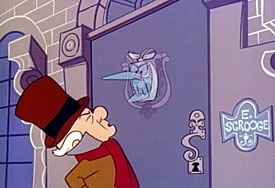
Because of Up, perhaps animators, auteurs, and scriptwriters will begin bringing more mature, even aged characters back to the forefront. Perhaps not. However, there is only so much to be mined from child characters, no matter how cute the animation or how precocious a writer may make them sound. I, for one, applaud Pixar's risk in casting an elderly widower in a lead role, especially when it is so rarely done and Pixar's streak of popularity and excellence is on the line. Casting a septuagenarian lead character proves that there may be snow on the roof, but there's plenty of animated humor, pathos and character still in the tank. I'm sure that Mr. Magoo (Rutgers University, Class of 1902) is standing on the sidelines cheering Mr. Fredericksen on, or would be, if you just turned Magoo in the right direction.
Author's note: As to the probable age of Wally Gator, I offer the following formulations: In terms of developmental progression, anyone above the age of 12 is said to be in Jean Piaget's Formal Operational stage, defined by the ability to think in the abstract. Wally has a defined idea of the difference between freedom and captivity. Erik Erickson would likely place Wally in the Intimacy vs. Isolation stage; Wally yearns for the intimacy of societal contact, not the isolation of the zoo. This stage is typified by young adulthood.
A biological examination reveals the average lifespan of the male American alligator to be roughly 40 years in the wild. The average lifespan of the human male is 76 years. Thus, one alligator year is equal to about two human years. It is probable that Wally Gator at least 12 in alligator years, since he evidences abstract thought. This makes Wally at least 24 in human years. This age demographic would fit neatly into the Ericksonian stage of Intimacy vs. Isolation. In watching Wally Gator, who does appear to be in his younger years, we can assume that Wally Gator's chronological age is 12 at the least and 14 at the most. I hope you know that I stayed up all night working on this, since I never seem to get much sleep anyway.
Martin "Dr. Toon" Goodman is a longtime student and fan of animation. He lives in Anderson, Indiana.