
Dr. Toon continues to take on the deconstructionists about the things they read into classic cartoons.
Read Deconstruction Zone Part 1 (Or: Semiotics Means Never Having to Signify Youre Sorry)
A nice adaptation of conditions will make almost any hypothesis agree with the phenomena. This will please the imagination but does not advance our knowledge. J. Black, 1803
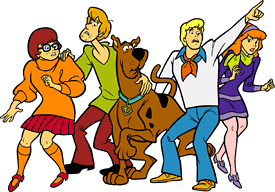
Whos dating whom in Scooby-Doo?: Is there romantic coding here? © Warner Bros. All rights reserved.
In my last column I began to analyze postmodern critique as it is applied to animation. As stated before, the problem is not postmodern theory itself: though the tenets of semiotics are largely incomprehensible to those not grounded in modern linguistic theory, the ideas are not inadmissible. The problem, dear readers, is the adoption of theory as dogma, especially when the proponents fail to research their subject adequately or invoke historical and cultural alternatives that supply equally valid or, in fact better explanations of a given artifact.
Although I have been focusing on a representative text (The Same Thing We Do Every Night: Signifying Same-Sex Desire in Television Cartoons, by Jeffery P. Dennis, Journal of Popular Film and Television, V. 31, No. 3, Fall 2003), I have noted that other semiotic analysts utilize theory to promote ideology. Dr. Dennis, as I have noted, holds several advanced degrees and is certainly no slouch. However, in this article the blind acceptance of semiotics and a blind eye toward animation history and culture seduces a learned author and turns what might have been an interesting thesis into postmodern piffle.
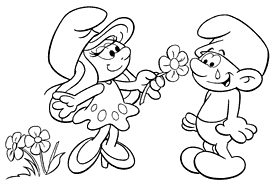
Was Smurfette (left) a beard or just a merchandising ploy? © Cartoon Network.
After postulating that Ruff and Reddy, and most certainly Yogi Bear and Boo Boo were gay romantic partners by reason of codes embedded in their cartoons, Dennis goes on to allege that During the 1970s the increasing visibility of gay identities added romantic partnerships to the conceivable codings of same-sex dyads... forcing producers to defuse the possibility through continuous demonstration of heterosexual desires. As a consequence, same-sex dyads all but disappeared from animation, replaced by characters involved in heterosexual romances... In other words, greater public awareness of gays terrified producers out of making cartoons with same-sex dyads.
It may have been that the HB cartoons and virtually every other cartoon studio turned to the superhero (which Dennis does not mention) and rock-band genres as a result of shifts in tastes among audiences and changing definitions of what would entertain prepubescent consumers in a new decade. Dennis also fails to mention the name Fred Silverman, who was far more influential in what animation presented in the 1970s than Umberto Eco or Roland Barthes would ever be. It is difficult, and in the final analysis somewhat risible to believe that animation changed styles in the 1970s because producers and broadcasters suddenly worried that a generation of cereal-munching kids gained the enlightenment to code cartoon buddies as gay.

Quien es mas macho in Strawberry Shortcake? © 2003 DIC Ent. Strawberry Shortcake character designs & © 2004 Those Characters from Cleveland Inc. Used under license. All rights reserved.
So enamored is Dennis of these ideas that he drags up the conjectures of Saturday Morning Fever authors Timothy and Kevin Burke; Dennis notes that the Burkes suggest possible gay relationships on Scooby-Doo, Where Are You? between Daphne and Velma or even Scooby and Shaggy. However, Dennis, in defense of the alleged heterosexual shift, reaches the conclusion that these relationships do not meet criteria for romantic coding.
Any serious reading of this section in Saturday Morning Fever (pp. 105-111) quickly reveals that the Burkes were, in a most un-academic fashion, goofing. In the preceding paragraphs of said section the Burkes also proffer the idea that Scooby snacks were mind-altering drugs and that the Mystery Machine traversed the country selling dope, with the gang as a crew of dealers. As for any specific statements on the sexual orientations of Scooby and Shaggy, the Burkes plainly dismiss the issue: Sometimes a cartoon character is just a cartoon character (p. 106).
My skepticism gathered momentum when Dennis suggested that the inclusion of Smurfette into the Hanna-Barbera adaptation of The Smurfs was engendered ... specifically to provide an object for the Smurfs heterosexual desire and defuse conjectures that they might be really gay. (The Smurfs, it will be recalled, were an exclusively male enclave in their Belgian incarnation prior to U.S. import.) I noted in the articles bibliography that Dennis used Hal Ericksons outstanding book Television Cartoon Shows: An Illustrated Encyclopedia 1949-1993 as a reference for the article. The author might have turned to page 458, where Erickson informs readers that the inclusion of Smurfette represented ...bowing to merchandising dictates... the better to appeal to little girl toy consumers. Young girls represented all-important network rating points as well.


Do the characters from Tiny Toon Adventures (left, with Furball) and Animaniacs have only dating and sex on their minds? Tiny Toon Adventures © Warner Bros. Ent. All rights reserved; Animaniacs Courtesy of Cartoon Network, © Warner Bros.
Now, guess which Smurf was the most frequently merchandised of the bunch? (Hint: It wasnt Papa Smurf.) In television, economics and profits easily trump nervous assumptions that kids might code The Smurfs as a cheery blue version of Queer Nation. When a highly educated author appears to misinterpret or discount the information found in the very research texts he or she is smurfing, it may be a sign that analytic method driven by subjective viewpoint has taken precedence over the material being analyzed.


Dennis doesnt think Ren and Stimpy are gay, but rather they parody heterosexual relationships. Creator John Kricfalusi, however, outed the characters. The Ren & Stimpy Show © Viacom International, Inc. All rights reserved; Kricfalusi photo courtesy of Spumco.
As Dennis goes on to delineate the Heterosexual Wasteland of cartoons into the decade of the 1980s he notes that most cartoon characters had become aggressively heterosexual. He offers He-Man and the Masters of the Universe, Strawberry Shortcake, Lady Lovelylocks and G.I. Joe: A Real American Hero as examples of gender-polarized, girl-or-boy crazy cartoon fare (Actually, it would be hard to think of examples in which cartoons had less heterosexual content: romance was almost always jettisoned in the service of bang-em-up action or cutesy cooperation). He then offers Steven Spielberg Presents Tiny Toon Adventures and Steven Spielberg Presents Animaniacs as examples of aggressively heterosexual cartoons rife with preoccupation about dating and sex, with occasional outbursts of outright lust.

replace_caption_goodman08_bettyBoop.jpg
Again, a history lesson is in order: Every single example Dennis mentions in the first unlovely group originated as a toy, doll or merchandised figure prior to airing as a cartoon. What really happened here was resultant of Ronald Reagans deregulation policies and subsequent relaxation of Federal Communication Commission rules and guidelines. FCC chairman Mark Fowler gladly allowed extended toy commercials to rule the airwaves both on networks and through the syndication market.
Pushing an aggressively heterosexual, or even implicitly anti-gay agenda was likely the last thing on the minds of executives at Mattel or American Greeting Cards. As for the fare produced by Spielberg, that long-time fan of classic cartoons simply recreated the manic, hypersexual shorts of Clampett and Avery using a talented production team and a well-worn template. If cartoons had indeed become aggressively heterosexual in response to increased awareness of gays, why then did attempts to revive Betty Boop during the 1980s fail? Was she not iconic enough as symbol of heterosexuality? Incidentally, might there be an agenda behind calling this era a heterosexual wasteland?
It is particularly bothersome that these alternate explanations are not considered, apparently in the faith that amorphous codes and signifiers operating at subconscious (or even conscious) levels hold greater validity in terms of cultural meaning. When beliefs become dogmatic, the most scholarly research tends to suffer. Reconceptualizing the history of television animation from 1957 through the present as a constant shifting of homoerotic and homophobic tides may be an intriguing thesis, but in the final analysis, the flaws in such a postulation prove fatal.
This is not an argument denying the merits or even existence of gay cartoons; J.J. Sedelmaier and Xeth Feinberg have already proven that blatantly gay cartoons can be as funny and entertaining as any produced by straight auteurs. My difficulty lies in the fact that if anything can be subjectively coded by anyone, then Yogi Bear cartoons can also be interpreted as fascist, imperialist, hegemonic, antifeminist, pro-ecology whatever any ideologue wishes to construct out of them. That is, if the right signifiers are available and it is claimed that the context is ambiguous enough to allow free play. There may be the assumption that since animation is basically fantasy; the genre is ripe for projection, symbolic and iconic attachment, or hermeneutic acrobatics, but what happens when immutable facts puncture the ideology?
Dennis article runs afoul of this possibility when the author turns his attentions to The Ren & Stimpy Show. Dennis hits it square when he identifies the show as an overt parody of the early 1960s cartoon duos..., but then goes on to state of Ren and Stimpy: They occupy a world in which gay identities cannot exist, so same-sex desire is portrayed as anomalous and perverse. Dennis concludes that despite significant indications of a gay subtext (also noted by many critics and fans of the show), Some of the signs may adhere to the reading of a sexual relationship; however, it is not a gay, or even romantic relationship. They are instead presenting a parody of heterosexual relationships, supposedly funny because they are both men, yet one of them is acting like a woman. Oddly, Yogi and Boo Boo present a more consistently gay relationship.
There is only one problem with this analysis: The shows creator does not seem to agree. One certainly cannot fault Dennis for writing his article well before the debut of Ren & Stimpys Cartoon Party. It was clearly beyond the authors control that in their very first new cartoon, Ren and Stimpy are openly gay. Yet, as the dog and cat anticipate the type of pitching and catching not seen in Yankee Stadium, it can be argued that this is the logical and natural conclusion of Ren and Stimpys evolution as a gay dyad. They have shared a bed; they have discussed their wedding; they actually have lived as significant partners in many of their cartoons. They may have had a love child in the form of a living fart. As if that is not enough, creator John Kricfalusi disclosed to the San Francisco Examiner way back on Jan. 28, 1997 that Ren and Stimpy are a gay couple, in effect outing them.

Dennis delves into same-sex coding in Pinky and the Brain. © Warner Bros. Ent. All rights reserved.
True, the new series made its debut after Dennis article was written, but prior evidence and the creators own testimony seem to show that the new cartoons simply represented the end result of a long developmental process; Ren and Stimpy are gay because Kricfalusi said they were, he produced a cartoon that proved it, and there is no way Ren and Stimpy can deny being gay from this point on. Semiotics can play with viewpoints but cannot erase reality; if it looks like Queer Duck and walks like Queer Duck, it must therefore be Queer Duck.
There may be validity in the idea that we tend to organize a series of codes or subtexts when the original text is nonspecific; humans, by nature, do not like ambiguity and will attempt to impose meanings on unclear texts and events. To be fair, Dennis has some interesting comments about same-sex coding in Steven Spielberg Presents Pinky and the Brain and SpongeBob SquarePants (another cartoon that has drawn the attention of the gay community), and his writing is far more digestible than typical postmodern fare. As I have stated, the problem is not with postmodern criticism or theory. The problem occurs when critics imbue theory with subjective ideology and insist it is truth. Dennis is working on a book about the production of heteronormativity in childrens literature, and I certainly wish him well in that endeavor.
As for other semioticists interested in animation, I offer the following: Observe all the cartoons you can and take note of how they have evolved over time. Study animation history. Read interviews. Place the cartoons you watch in historical and cultural context. There is a place for postmodern studies, but unless semioticists stringently study the history, dynamics, culture, economics, and evolution of animation before attaching their icons, codes and signifiers, animation may not be that place.
Martin Dr. Toon Goodman is a longtime student and fan of animation. He lives in Anderson, Indiana.