
Henry Turner gets Lord of the Rings visual effects supervisor Jim Rygiel to provide a detailed overview of how the groundbreaking work on the trilogy always serviced the storytelling.
An Instant Classic
The Return of the King caps the greatest gamble and greatest victory in modern filmmaking. Not since the original Star Wars trilogy has a film series generated so much enthusiasm. And never before has a fantasy film garnered so much praise, with Oscar nominations for Fellowship and Towers, and The Return of the King right on the threshold of a groundbreaking best picture victory as the odds-on favorite.

Hence, Jim Rygiel, visual effects supervisor on all three Lord of the Rings films, has a right to feel proud. When asked which of the trilogy is his favorite, he pauses long before answering, as if to savor the more than five years’ work he put into perfecting the visual effects of the films. “I have to say Return of the King, because we knew where everything was going. We were so piled up with shots we could barely see, and there’s something beautiful about coming out of that — a pleasure after the pain sort of thing. Just in terms of sheer number, Return of the King has more shots than one and two combined; it’s like 1,450. It was mind-boggling to figure out logistically how to do them all. It’s something you never think you could have done, and you did it — like climbing Mt. Everest.”
Technical Evolution
Rygiel emphasizes how each film grew in scope. “A lot of things sort of amortized over the show. The Massive software got better. Everything got supercharged.”
He identifies Gollum as an element of key importance in the success of the films, but his final evaluation of what made Gollum a popular character is not the average technician’s answer. “When you look at Gollum as just a creature, there were a couple of major components that made him the phenomenon that he is, and one of them was the technology that created the look and texture of his skin, and its flexibility. The other was his motion and how that was achieved. But the main things, which are not technical, is Andy Serkis and what he brought to the role, and also some great lines to deliver. If any one of those things were out of there, I don’t think it would have been as great as it turned out to be.”
Despite Rygiel’s modesty, his teams’ contribution to Gollum was of the utmost importance in terms of creating a successful character — perhaps the first true CG superstar, who, in Return of the King, got a new skin. “We did this really neat technique with our traditional prosthetic guy from Weta Workshop. We had him paint a rubber mask of Gollum, and then we scanned that painting, which we used as the basis for our texture map on Gollum.” Painted using classical techniques, the skin was detailed to reveal thin layers of transparency, conveying the feeling of veins lying deep within the skin.
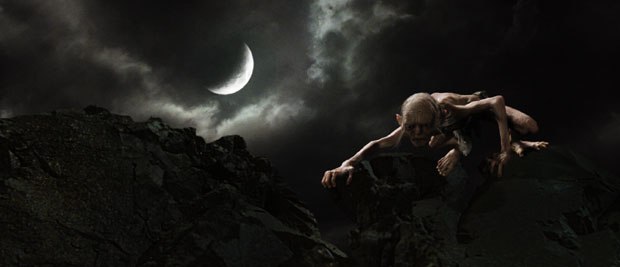
To create Gollums motion on the first two films, Rygiel used rotomation, with keyframe animators mimicking Andy Serkis movements. Also used was a motion capturing stage, in which data was collected during motion-capture rehearsals, after which, the live actors performed to an imaginary Gollum on the real take. And there was much traditional key frame animation. But this year we took an experimental leap I wish we had done it a lot sooner, but it was just as technology was getting to this point. We actually put sensors on Andy Serkis, as he was acting, and we were motion capturing as Peter was shooting the scene. Despite the complexity of setting up equipment and lights, It ended up working perfectly. Theres a scene, for instance, where Gollum is rolling down a hill with Sean Astin, and to do that would have meant probably keyframing, because you couldnt motion-capture just Andy rolling down by himself and get him integrated with Sean youd have to do this almost articulated key-rotomation sort of thing. But with this new motion-capture we caught the motion instantly as Andy did his take. We dressed him in sort of a tan suit to mimic Gollums skin, with tracking markers on it those digital ping-pong balls. When he rolled down, the markers would be tracked in realtime. The first thing we would have to do in post is paint Andy out of the plate wed stick Gollum in there and wed see where Andy would overlap with Gollum, and wed hand paint that all out. Very time consuming in post, but we had Andys animation in there right away. Youre going to see more and more of this technique, its a pretty important breakthrough.
Story First, Effects Second
Rygiel emphasizes that the trilogy was not created as a showcase for effects, but that effects were always in service to the tale. Thats the plan! Exactly to laden it with effects, but not for one second do we want you to be conscious that there are effects in the film.
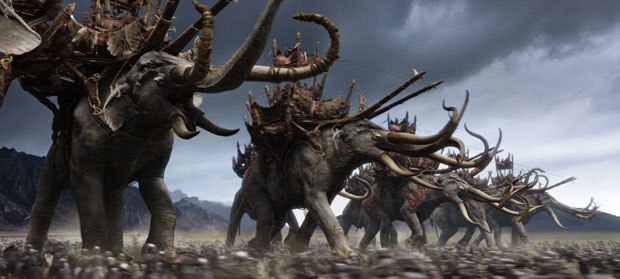
The trilogy is a modern classic and in many ways represents the greatest triumph of visual effects. Because of CGI, one gets the feeling that for the first time in movie history a fantastic story was told that made no compromise in its visual conception. Never do we think that Peter Jackson wanted something grander or more complex, yet had to suffice with less, due to technical infeasibility. Everything is how it should be; never does a setting or character fail to measure up to the highest imaginative standard. Indeed, the films are unthinkable without CGI. Yet, as the greatest compliment to the filmmakers, there was never a moment when the effects overwhelmed the power of the story. We do not come away from the trilogy amazed by how realistic the setting of Helms Deep was, or the animated motion of the mumakils no, what resonates is the emotion of Sams loyalty to Frodo, the fearlessness of Aragorn, the wisdom of Gandalf, the tragic duplicity of Gollum.
Some of the techniques remained the same throughout the course of the productions. To present the hobbits size differences, a lot of it was just camera tricks from the 20s, with forced perspective and simple things such as standing Ian McKellen on an apple box. In some cases, we shot the hobbits separately against a bluescreen and tracked them in and shrunk them down later, and we made digital creations of the hobbits for use in distance shots. But we couldnt get too close to the digital guys because well, theyre digital.


Previsualization, a layered use of digital creations and live-action bluescreen footage all lead to the creation of the epic battles. Photo credit: Pierre Vinet/ New Line Prods. © 2002.


Giant monsters and huge set pieces couldnt have been feasible before the advent of CGI. Photo credit: Pierre Vinet/ New Line Prods. © 2002.
The Truth About CGI
In a time, when certain critics are raging against CGI as perhaps the death knell of live-action filmmaking, one has to look at the flipside of such paranoia and understand the liberating aspects of CGI, which forever frees filmmakers from cheap sets, cheap rear projection, inactive matte paintings and matte lines and, worst of all, bulky men in bulky monster suits, making believe that they are gnomes or dragons. Indeed, until the advent of CGI, visual effects certainly helped expand the concept of suspension of disbelief. But there are always Luddites (such as those anti-industrial revolution fanatics) who want to destroy modern technology. When film was new, the first critics wanted filmed theater, with actors visible from head to toe. Close ups were considered incomprehensible it was thought that audiences couldnt accept half an actor. But audiences learned to accept and enjoy many rapid innovations in the technological novelty that became an art form. Oddly enough, in the case of Lord of the Rings, the new technology is in service to a story that in many ways is anti-industrial itself, a story that conveys Tolkiens wartime trauma, with the Orcs and Saruman representing the encroachment of mechanization, and Frodo, Aragorn and Gandalf representing the pastoral peace of a vanishing era.
Henry Turner is a writer and award-winning filmmaker, whose Lovecraft-inspired horror feature, Wilbur Whateley, won top awards at the Chicago International Film Festival. His writing on film has appeared in the Los Angeles Times, Lecran Fantastique, Variety and many other publications. A longtime film festival executive, he has programmed for the Slamdance Film Festival, and currently heads FilmTraffick L.A.