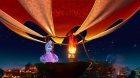
Bill Desowitz takes a look at how Disney Studio France adapted the artwork of Salvador Dali to complete Destino.

Largely produced at Disney Studio France, Destino is the perfect 2D/3D animation hybrid, making a stylish Dali concept both timeless and contemporary.
When Dominique Monfery, a veteran of Disneys now defunct Paris-based animation studio, was asked to direct the Destino short, the multiple festival award-winner bound for Oscar contention, his first reaction was No. He wasnt about to tackle the legendary unfinished collaboration between Walt Disney and Salvador Dali as his directorial debut. It seemed like a no-win situation. But the more he thought about it, the more Monfery liked the challenge of bringing Dalis surrealistic vision to animated life to continue the adventure. Like so many before him, Monfery was entranced by Dalis complex story and art direction, which were fostered by his 15 conceptual paintings and development pieces along with 135 story sketches. The possibilities provided by this beautiful roadmap were too creatively enticing to pass up.
Besides, as producer Baker Bloodworth and exec producer Roy Disney kept insisting, Destino was going to be completed with or without Monfery. So despite the anxiety, Monfrey came onboard, thanks to his animated UNICEF work, compelled to make Destino more understandable: I tried to react really as an audience. And thats why also I didnt want to direct this movie at the beginning because I felt that I dont have enough story vision, I dont know the surrealist art. But I tried to turn this weakness into a strength by approaching it from the standpoint of the audience? Does it make sense for you?


Director Dominique Monfery (left) and producer Baker Bloodworth. Photos courtesy of Walt Disney Pictures.
The Cross-Dissolve and Removing Character Outlines
Visually, Monfrey began by reviewing a rough edit of the original artwork adapted from the song. He had good feeling about the song, which was also redone, and was heartened by the strong visual ideas conceived by Dali and John Hench, the Disney animator that worked alongside him 57 years ago. The first decision was to make the film the way it originally would have been done in 1946, choosing to rely mainly on traditional animated techniques. The first challenge was figuring out how to insert an animated character into a painted environment by analyzing how Dali painted light and shadow.
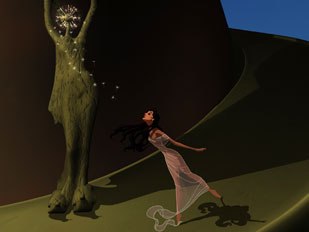
One important fact is that we have 2D character animation but we dont have lines on the character [in keeping with Dali], the director explained. Also, the volume of the character is revealed more by light and shadow than by color. In order to better match Dali, we decided to remove that dark line that usually outlines the character sheet.

The essential technique embraced was the cross-dissolve, part of the montage strategy that Dali intended to utilize in the animation, which Monfrey paired with classical movement and timing to bring clarity to the poetry. The director was very intrigued with both a timeless and contemporary quality about the work: I felt very impressed with the contrast between the old fashioned in terms of the sound and to create some more modern imagery using new technology like 3D.
For instance, a 3D model of the Tower of Babel was created using Maya and Disneys proprietary CAPS system. They also used 3D for complicated camera moves and for the Chronos fight because of the difficulty of preserving the volume of this stone character.
Inevitably, though, Monfrey and his 25 fellow animators applied a hybrid sensibility to this pristine love story containing graphically striking symbolism (a barren landscape, melting clock, a bell tower, a stone pyramid, a floating dandelion). So they used simple texture maps to seamlessly blend the 2D and 3D elements.
Interpreting Light and Shadow
Production designer Thierry Fournier confirmed that the lighting scheme was key in establishing both a surrealistic tone and in driving the narrative. One of the hardest parts but also one of the most interesting is the scene where Dahlia, the female character, lays on the floor and is covered by the shadow of a bell and then it becomes a dress. So all the work when she stands between light and shadow was very hard to figure out. Because its all about shadow and light and at one point the shadow becomes a dress. It was not the technical part that was hard. What was hard was trying to tell this story with a visual logic. It was more about making sure your images make sense. Where do you put the light? Where do you put the shadow?
Fortunately, Monfrey and Fournier had experience with this as well as with creating characters without outlines in their animated experiments with UNICEF. I think one of the reasons we were chosen for this was because of our experiments with light and color. We understood someone who has a really great sense of color, but who also understands how to put light on a character in a way that works easily.
For the director, the biggest realization was that Dali never drew a woman as a sex symbol. There was always something very sincere in the face that he painted or drew, so we tried to approach this more realistically, more true.

A Ballet of Video Conferencing and FedExing
Meanwhile, collaborating with the Burbank studio off and on for two years via video conference went pretty smoothly, according to associate producer David Bossert, who came up with the concept of the opening titles (also in keeping with Dalis distinctively graphic style). I think it was important to obviously bill Salvador Dali and Walt Disney as the two collaborators, and to make sure that we sort of set it up with a little paragraph at the beginning of the piece, because a lot of people outside of animation werent aware of or dont know about the history of Dali, Bossert said. And certainly didnt know why Dali and Disney hooked up. But also a lot of people didnt realize that Dali had made Los Angeles his home for a number of years during the war. Because he fled Europe during World War II.
Aside from that, Bossert added that the greatest challenge was not only making sure that all of the pieces came together properly but also maintaining Monferys vision in context with Dalis. It seemed almost easy. I mean, looking back on it just feels like it was just this interesting ballet of video conferencing and federal express packages just coming and going on a weekly basis, and it all just seemed to fall into place nicely.
Bill Desowitz is the editor of VFXWorld.

Bill Desowitz, former editor of VFXWorld, is currently the Crafts Editor of IndieWire.