
Dr. Toon addresses acting in the latest installment on cultivating critical thought.

In the last installment we explored how character design contributed (or not) to the success of an animated cartoon. This month we will shift from the physical depiction of a character to the important role that character plays as an actor. We will keep in mind the original question underpinning this series: What is a given piece of animation trying to do, and how well does it accomplish that task?
It is not entirely correct to say that a cartoon character in an animated film is analogous to an actor in a live-action film (this is one reason for the dismal failure of features in which live actors attempt to portray animated characters). In many ways, the task of an animated character is actually more difficult than that of a live actor. At first glance, this statement does not seem to make sense, but consider the following:
An animated character is limited to a very small number of roles, and must perform them without much variation. Robert DeNiro, for instance, can star in live-action comedic and dramatic roles across several genres. Bugs Bunny cannot do the same unless he performing a parody. Major alterations to Bugs' established persona essentially destroys the character. Another example: the attempt by UPA to force Mr. Magoo into a variety of literary adaptations (The Famous Adventures of Mr. Magoo, 1964-65). Magoo became a star as a crotchety, nearsighted old coot; watching him portray Gunga Din or Cyrano de Bergerac made little sense to viewers.
Animated characters, whether good, evil, slick or stupid, have a limited amount of time to impact a short, episode or film. There is only a brief window a character has to bloom into a "star." Even with repeating characters, there are typically seven minutes to a short and 22 minutes to a television episode. Unless the series is a long-continuing saga (like The Simpsons or Family Guy), characters are not given time to develop many nuances. Most animated series in the past decade did not survive three seasons. Thus, a character must be memorable from the outset or the short or series may well fail.
We can see, then, that an animated character must be an exceptional actor, creating feelings that resonate with an audience. Even if a character's scope is limited (as is Wile E. Coyote's), it has to leave an emotional mark on an audience. In evaluating any animated character as an actor, a central question would have to be, how consistent is the character's presentation? A character can be proactive or reactive from one cartoon to the next (or even within the same cartoon) but consistency of character is vital. Any animated feature or short where a character behaves inconsistently pretty much dooms the work. That is why, for the most part, animated stories can be wildly implausible and feature talking animals or science-fiction themes; because of character constraints, there can be a loosening of environmental realities so that the character has more situations to play against.
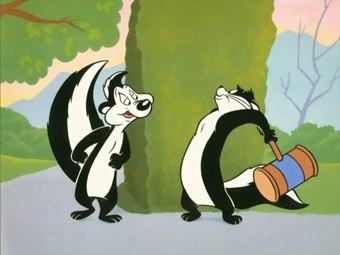
Let's take the example of Chuck Jones' character Pepe Le Pew. Pepe is extremely consistent; he is, in fact, a one-note character. A suave, Gallic skunk, overconfident to the point of extreme narcissism in his amorous abilities, Pepe basically replicates the same plot in every cartoon short he appears in. Many critics praise Jones for getting so much mileage out of what are really carbon copies of his original short, but the cartoons per se don't deserve the praise. From the moment a black female cat is accidentally acquires a white stripe, we know exactly what is going to happen in the cartoon and how.
The shorts really work because Pepe is a well-defined, consistent character (with the help of Mel Blanc's stellar voicework). The fun lies in watching him stay in character, not stray from it. The creative cost to Jones was minimal; Pepe was highly popular but never had to star in any other sort of short. While Jones engineered more flexibility for Bugs Bunny, Porky Pig, and most notably Daffy Duck, Pepe remained Pepe for his entire cinematic life.
If consistency is taken too far, however, this can backfire. Mickey Mouse developed into a character so good-natured and inoffensive that virtually nothing interesting could be done with him within a few years of his debut. It should be noted that anytime Mickey got a bit wild, parents would complain. Some of that may have been due to a feared influence on children, but it would also be remiss to underestimate the power of audiences wanting a Mickey who behaved in a consistent manner.
As a result, Mickey became a bland co-star in many of his own cartoons. He was far too iconic by then to meddle with; that would have been tantamount to sacrilege. It was almost inevitable that the studio came up with a character as irascible as Donald Duck, who had far more opportunities to perform as an actor. Or consider Goofy: His hilarious "How To" and "Sports Goofy" shorts could not have been pulled off by Mickey, who was poorly suited to slapstick or overly physical humor.

One of Bob Clampett's very few missteps was making Bugs Bunny cartoons in which the typically omnipotent rabbit could be defeated, trounced, shamed or made to look stupid. When the Gremlin or Cecil Turtle beat the bunny, there was the sense that something was wrong, that some violation had occurred, even though the cartoons themselves were technically excellent. Bugs, according to the rules, didn't lose, never took a physical beating or was bested at his own game. Bugs Bunny was in control of every situation, and Clampett erred by pitting him against characters who could defeat him, and that was not the Bugs Bunny audiences expected to see.
Fiction writers often insist that villains should have a redeeming feature or an unexpectedly human side. The best comic book villains, for example, adhere to this rule. Doctor Doom, in one storyline, proved to be a more benevolent ruler than his tyrannical usurpers. The Fantastic Four actually fought alongside him to liberate his native Latveria. Animated villains, however, seem to have two choices; they can be monumentally bad (evil villains, like Skeletor) or incredibly stupid (comic villains, like Wally Walrus). Very few animated cartoons and features attempt to vary these roles. A notable exception was Jhonen Vasquez' subtly sophisticated Goth hit, Invader Zim (2001). Zim and his opponent Dib are antiheroes and at times take turns at being both evil and comic villains.
Changing a character's personality is tricky but can be done successfully if the character was originally weak and/or undefined. We turn again to Chuck Jones. Jones was able to redefine Daffy Duck because Daffy was little more than a manic pest for most of his career. Jones was able to redefine Daffy as an insufferable egotist and thus, still a pest at bottom. Porky Pig was able to become a sardonic sidekick because for much of Porky's career he was an eponymous good-guy. It is important to note, however, that once Jones did this, the personalities of Porky and Daffy were set for the rest of their animated lives. They now had consistency of character.
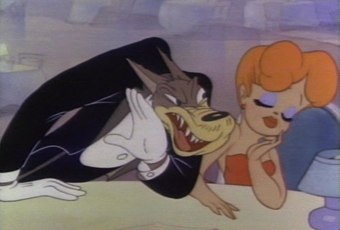
The characters that populated Tex Avery's cartoons were a rare and, at times, startling exception. In the studios where Avery worked, continuing characters developed for stardom were a staple. Avery turned his characters into ciphers. He eschewed continuing characters, choosing to focus on surreal, escalating situations that any eponymous character could appear in. Avery went so far as to neglect to give his characters names in most cases; Droopy Dog was not called such until a few cartoons after his debut, and Screwy Squirrel is a simple descriptive. (He appeared in only four cartoons). Two of Avery's most famous characters are simply referred to as "Red" and "The Wolf."
Avery proved that a cartoon short could succeed without a strong character if the premise of the short can be stretched to ridiculous limits around that character. Most directors were less visionary about comedy, and most audiences seemed to prefer well-recognized icons that mellowed into old cinematic (and later, televised) friends. Once a character "breaks through," audiences can't seem to get enough of it.
Perhaps the most crucial way in which an animated character becomes a star: audiences identify with the character and come to adore it. Why is this? Because the character can behave in ways that we wish we could, say things we could not get away with, and live lives that are filled with fun, adventure, danger or conflicts that usually result with the character coming out on top. In short, they have wonderful fantasy lives that we can live vicariously.
To recap: consistency of a character's presentation is important, although some flexibility can be permitted. Acting ability is de riguer, both onscreen and through exceptional voice work. There must be at least one unique facet of the character's personality or set of mannerisms that audiences find endearing (even in villains), and audiences must come to identify with the character. Because animated characters are so vital to the success of their vehicles, we turn our exploration to how we might critique them. Next month, we will apply the rules and principles discussed above to specific case studies of animated success and failures.
Note to readers: Ms. Bessie Irene Hamrick, who was profiled in last December's column as perhaps America's oldest animation fan, passed away on March 20, 2011 at the age of 107. Every animated character over the past hundred years, from Gertie the Dinosaur to Finn and Jake, asks us to bow our heads for a moment of silence.
Martin "Dr. Toon" Goodman is a longtime student and fan of animation. He lives in Anderson, Indiana.