
Bob Swain reports on the continuing efforts of Cartoon Movie as a facilitator of animation technology, finance and development in the EU.

Cartoon was born as on organization to assist European animation. These days it accesses diverse funding and provides training and development.
When Cartoon Movie began in 1999, the international CG movie revolution was already underway. That kicked off, of course, in 1995 with the landmark release of Pixar's Toy Story. But Europe had to wait until 2001 for its own first fully CG movie, Dygra Films' The Living Forest. It was a film that was originally presented as a development project at the first edition of Cartoon Movie.
Cartoon was thus born in 1989 as an organization to assist European animation, initially funded by the Media section of the European Union. These days it accesses diverse funding, including the continuing support of the EU. Its main functions are to provide training -- with regular master classes in animation technology, finance and creativity -- and development.
The main focus from the very start was on Cartoon Forum -- an annual event that began in 1990 where producers could pitch their new projects for animated series to invited broadcasters and financiers. This was followed in 1999 with the launch of Cartoon Movie -- the same format but for animated features.
"I think Cartoon Movie is the right place to see what is going on in animation features. It provides a crucial role in bringing all the European producers together," says Manuel Cristobal, producer of The Living Forest, who now runs Perro Verde Films in the Spanish region of Galicia.
"But I don't really think it has played a role in specifically promoting CGI. What Cartoon Movie does is to reflect the markets -- it has been a witness to change."
And that change has been substantial with CG finally representing the single largest sector by technique of the presentations made this year. There were 17 CGI projects (up from 14 in 2006), nine 2D (down from 14) and 11 mixed (down from 15).
"I wouldn't be here at all without Cartoon," adds Gorazd Norcic of Qollective in Slovenia -- one of the new countries to join the European Union in 2004.
"What it does is to give you a very good understanding of what is going on and who is who in the industry. Cartoon Movie is the only event in Europe that provides a business environment combined with real projects -- it really is the only place for animation movies.
"I was producing CGI from the beginning so it is difficult to say how much influence it has had in that respect. It is definitely expanding. You now see more CGI projects at Cartoon Movie than even before. I certainly expect that trend to continue.

Europe had to wait until 2001 for its own first fully CG movie, Dygra Films'The Living Forest. © Fantastic Films International Llc.
"I am currently working on a number of CGI projects -- Thumbelina, together with India and China, and WAI as a theatrical feature that will be produced in Europe. That was the first CGI project to be presented at Cartoon Movie from one of the new accession countries to the EU. It received financial support from Media and will make use of our CGI capabilities in Slovenia together with other studios in Europe."
European CGI movies that were presented at Cartoon Movie and then went on to have a successful theatrical release Midsummer Dream from Dygra (Spain), P3K -- Pinocchio 3000 from Filmax Animation (Spain), The Magic Roundabout from Action Synthese (France), The Ugly Duckling and Me and Terkel in Trouble both from A Film (Denmark), Back to Gaya from Ambient Ent. (Germany) and Happily N'ever After from Berlin Animation Film (Germany).
Major CG movies currently in production include Donkey Xote from Filmax Animation, Spirit of the Forest from Dygra Films, The Missing Lynx -- Paws on the Run from Kandor Graphics (Spain), Magic Roundabout 2 from Action Synthese (France), Dragon Hunters from Futurikon (France) and The Way to the Stars from Animaker (Finland).
The latest European country to make a major push into CGI is Italy with the announcement of a 25 million feature based on the successful television series Winx Club, which will be produced at Rome's first CG animated studio, Rainbow CGI. Rainbow is also planning two additional animated features with similar budgets -- well above the standard maximum European animation feature budget of 6 million.
Joint Cartoon founder and manager Corinne Jenart admits that Shrek has had an enormous impact. "The huge success of that film showed the way forward for us here in Europe," she says.
"Cartoon Movie has been a tool for the European producers -- a tool to show what they want to produce. It is an excellent shop window. But the Cartoon Masters are also important because through them we have tried to give producers all the information they need about various aspects of using CGI -- the software, the logistics, studio costs, training for animators, the new jobs and costs of CGI production compared with traditional methods.
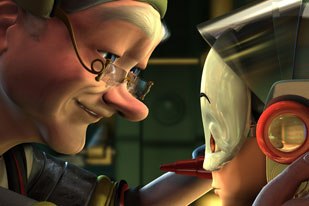
Among the European CG movies that were presented at Cartoon Movie and then went on to have a successful theatrical release is P3K -- Pinocchio 3000 from Filmax Animation. © 2002 CinéGroupe Pinocchio 3001.
"Cartoon Masters are very useful for providing information and above all giving an opportunity to meet with high level professionals from Europe and the States and discuss the making of their films -- both technically and financially. But Cartoon Movie is only a tool -- we don't help with creativity. It is a place where everybody can see what is happening and where everybody can make their own experience with the buyers."
Ariane Payen of Luxanimation, the Luxembourg studio currently working on Dragon Hunters, concurs. "They have had a lot of Masters for CGI animation. In fact, they are very good at promoting animation whatever the technique. Cartoon is there to give a structure to the animation -- and the most important things within Cartoon are Cartoon Forum and Cartoon Movie. There is a real European market now because of these events.
"But I wouldn't say that they have pushed CGI in particular -- that is something bigger than Cartoon. That is the market itself. But Cartoon was there to help and to provide the opportunities.
"There is no longer any kind of a war between 2D and 3D. Cartoon was always very clever not to enter that debate as to whether 2D or 3D was better. They allowed the market to decide. The market has now switched more toward 3D. I think that is largely because European producers wanted to keep control of the process. And 3D allows you to keep nearly everything in Europe."
Adds Cristobal: "With 3D you don't need such a big crew for a feature film. 3D has now overtaken 2D in Europe. 2D is now very hard to produce. From a business point of view, 2D is a very hard sell at the moment."
But it's not just a one-way street with some major 2D animation movies in production such as Lucky Luke at Xilam (France) and The Three Robbers at Animation-X (Germany).
In fact, Piers Godden, European representative of Toon Boom Animation, says he detects a rebirth of 2D in the industry on the back of developments in the technology.

Major CG movies currently in production include Spirit of the Forest from Dygra Films (Spain). © Fantastic Films International Llc.
"Obviously 3D has been very strong over the past few years. But so many of the 3D movies are of a poor quality compared with what you can do with 3D. I think 2D is now going through a resurgence," he adds.
"Most animation movies in Europe are made on a low budget -- 5 million at the most. I think that at that level you are going to get better results with 2D. With the new technology some major companies are looking at 2D again -- but digitally. The technology is what is behind it all. Over the next few years we will see 2D going completely digital. It is just a matter of getting the quality high enough for feature films.
"But it is not just about the technology. It is also about the skills base. It's the same with 3D. But 2D doesn't date so badly. A cheaply made 3D feature often looks awful after a while. 2D is by no means dead and in many ways it is actually stronger now."
"But European feature animation has certainly developed a great deal in recent years and Cartoon Movie has contributed a lot to that. You only have to look at the high number of movies being made compared with a few years ago.
Thus, feature animation is going from strength to strength because you now have the tools to animate digitally. Also, you can combine things with each other. It's not just cut-out animation any more. You are now combining all of these different digital techniques and people are learning how to put them together. When it comes to feature animation, you are starting to see some really good results coming out.
Bob Swain is an animation scriptwriter based at Sidewinder Films in the U.K. He has attended every edition of Cartoon Forum since it began in 1990.