The Oscar contender discusses how his acclaimed short has captured the retro vibe.

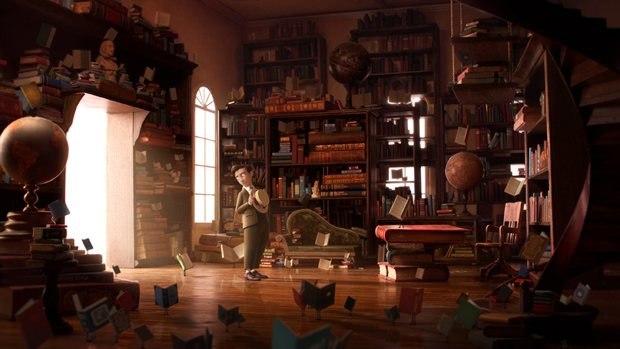
The Fantastic Flying Books of Mr. Morris Lessmore has not only nabbed an Oscar nomination but is also considered the front runner in some circles. That's great for William Joyce and co-director Brandon Oldenburg and their Moonbot Studios in Shreveport, Louisiana. The wild mash-up of Oz and Buster Keaton (silent and in color and black-and-white) has captured the retro zeitgeist, which I discussed with Joyce this week.
Bill Desowitz: You've really captured the zeitgeist with your retro short, considering the similarities with The Artist and Hugo. Have you given this much thought?
William Joyce: Yeah, I guess the first dose I got of it was when Hugo came out and I love Méliès. In fact Brian Selznick [the author] and I are good friends. We had the same editor at Harper Collins back in the day and we love the same stuff, and one of the things we talked about was Méliès and automatons. And I knew all the stuff that had gone on with bringing Hugo to the screen -- my friend, Chris Wedge, worked on it. And then the movie comes out, and they did the Méliès stuff so beautifully and that's when I realized that we were on the same wavelength in revering the past and revering the filmmaking of the past with using miniatures and the Fleischer brothers and the way they did their miniature work on their Popeye cartoons.

BD: You were all going back to the roots of this and making it relevant.
WJ: There's something pure and innocent and hand-crafted about that that seems so direct and strong. It's just so strange how it's all come together this same year. And then The Artist comes out of nowhere. When I saw it -- Brandon and I had studied the silent films when working on Morris so intensely and really learned the language of the pantomime and the camera setups and all that stuff. And, my god, these guys have absorbed all the same stuff and it just felt strange like the zeitgeist had this undercurrent for everybody.
BD: But it makes sense considering the times we live in and what we're grappling with.
WJ: It's so hard and complicated to make a silent film like that. And the artistry that's in place to make The Artist is astonishing. And, actually, when I heard about it, I thought it sounded cool but I couldn't imagine it working. Usually when you try and resurrect an old way of storytelling, especially an old cinematic way of storytelling, it ends up feeling not pure and like a stunt and not emotionally true. It just feels like an exercise in style. And for both Hugo and The Artist, I thought they totally tapped into the thing that made them brilliant and emotional to begin with. And so form became function in a way, but it was completely true to the storytelling experience and that's rare. And it amplified the content. I think shot for shot, The Artist is probably the most thoroughly and thought out film I've seen in a really long time.
BD: So let's bring this back to Morris and what you've achieved.
WJ: We're sort of planting our flag a bit. What I'm surprised at is that it's delighting people. And people seem to be aching for something that feels less labored. There's definitely a story arc and emotion and all the things you look for, but there is a sort of tossed off quality to some of those early films that seems lacking and so we're spending a great deal of time and effort to make it seem like we're improvised these things on the spot.
BD: Working very hard to make it look easy.
WJ: Exactly. I was reading P.G. Wodehouse, who wrote all those Jeeves stories, and he said it took him 90 drafts to make something look like he'd just written it.
BD: What's it been like writing Morris as a book after doing the short and the e-book app?
WJ: You know -- it's a curious thing. This started out as a book, which I got sidetracked before we could finish and then we did the short. It's very close, but, as with the app, it's a different experience. And, for once, I thought it was the reverse of how the book was so much better. There was so much that we had to leave out that was in the movie. There were whole sections that we couldn't get into a picture book unless we wanted to do a graphic novel. I didn't want it to be a perfect replication of the movie anyway. We painted all the pages; they're not screen grabs, and that was time-consuming but also part of the craft of what makes it a book. We're going to turn it into a puppet show next, where you go into this warehouse and you're taken into the puppet show in which you're going from set to set and not just watching it. Action happens all around you and it's a very immersive theatrical experience. And for the stories we want to keep working on, rather than commissioning scripts, we've decided to start developing our long-form stories that are feature-length in this way. We'll be able to write these scenes, form them, see how they play and get a sense of how the story's doing but in a whole different way. It seems intuitive and cool and an interesting way of developing a story idea. Why not? The rules aren't set? I read how Irving Thalberg let the Marx Bros. test their stuff out on the road. So we're going to make films by way of vaudeville.
BD: How is Rise of the Guardians coming along?
WJ: Oh, man. We're less than a year out and it's really coming together. It's true to what I wanted it to be. It's beautiful and the 3-D's really nice. I wasn't that keen on 3-D at the start, but, after seeing Hugo and what we're doing here, I'm becoming more and more of a convert. And, actually, Tintin was very good in 3-D.

BD: You're reinvigorating the superhero genre with an infusion of fairy tales: Santa, the Tooth Fairy, the Easter Bunny, Jack Frost.
WJ: When you think about the fact that most the original comic writers were Jewish and were tapping folklore like The Golem, I'm just bringing it back around again.
--
Bill Desowitz is former senior editor of
AWN and editor of VFXWorld. He has a new blog, Immersed in Movies (www.billdesowitz.com), and is currently writing a book about the evolution of James Bond from Connery to Craig, scheduled for publication this year, which is the 50th anniversary of the franchise.

Bill Desowitz, former editor of VFXWorld, is currently the Crafts Editor of IndieWire.