
The Inception supervisor discusses the challenges and take away of the celebrated Christopher Nolan mind-bender.
Check out the Inception trailers and clips at AWNtv!

After last night's four VES nods, Inception now becomes the front-runner for the VFX Oscar, and Paul Franklin discusses being a contender and why the vfx are a crucial part of the story's fabric.
Bill Desowitz: Did you ever think you'd be the Oscar front-runner?
Paul Franklin: Well, there's still a long way to go, but when I originally read the script for Inception, I thought this was going to be something special, so I knew we'd make something that would impress people and be quite spectacular. But I think the thing that took us all by surprise is the massive public response to the film, from general audiences to more specialized audiences. That's been quite pleasing, to say the least.
BD: In the past, you've emphasized that vfx in Nolan's films have taken a supportive role. That's obviously changed with Inception.
PF: Yes, exactly. One of the things I've mentioned several times in the past with Batman Begins and The Dark Knight is that we did technically impressive digital environment work, but it's always been pushed to the background as part of the fabric of the film. It's not really there to call attention. But the very nature of the story foregrounds the wall-to-wall, spectacular effects work that we put together.
BD: The folding Paris has become the film's iconic image.
PF: It has. When I read that in the script, I thought, "Well, that's going to be very interesting: it's something I've never seen before, taking a real world environment and manipulating it in that way. I mean, I can think of examples of people walking inside cubes, but something like this I thought it was rather special. And very early on we identified this as a shot that would be part of the advertising campaign in the early trailers, so you could see that this was going to become a kind of visual linchpin for the whole movie, really. I think also the zero gravity work went down really well, but if you want to sum it up in a single image, that picture of Leo and Ellen looking up at the city folding up over their heads achieves it.
BD: The layering upon layering upon layering of environments -- folding reality into dreams -- was the challenge, right?
PF: Yes, the fact that there were so many different kinds of environments. You couldn't just build one setup. You build Gotham City and you set it up for day and for night and you've got this universal resource which can be applied across most of the movie in a Batman film. But with Inception, all the environments are self-contained and there were no overlaps between them. Obviously we were sharing common lighting tools, but each sequence had its own specific technical flavor, which was unique.
For instance, zero gravity had this monumental amount of removal that we had to do to take out all the wires and rigs that were supporting the actors, but then rebuilding environments and things that all had to be done in a very consistent and seamless way. A huge amount of manual work went into that with rotoscoping because there was no greenscreen employed at all during the sequence, and finishing the sequence off by adding all sorts of floating CG items to complete the illusion of zero gravity. Getting that movement just right, but at the same time not having it draw attention to itself, was one thing.
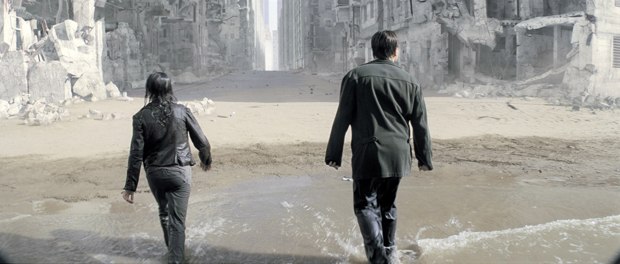
And then with Limbo City, you've got the conceptual challenge of what the design is for this city. We essentially arrived at this procedural method where we combined the structure of a glacier and 20th century architecture to make this strange, mutant city collapsing into the sea and then having to give it a very realistic finish.
BD: And what about the Bond-inspired ski chase?
PF: The ski chase, again, we had to build very convincing environment work there for the set extensions on the fortress, and big, wide aerial shots of the fortress as well. And then there was all the miniature work for the end sequence, where we built a very large, traditional miniature and blew it all up and added digital enhancements working with the guys at New Deal.
And going back earlier, the exploding Paris café, which is a sequence that was designed through the use of visual effects, working very closely with the special effects teams that build those explosives.

BD: By the way, has anyone teased out of Chris the meaning of the end?
PF: You know, I did read recently something that Chris had said that he definitely has an answer about whether it falls or doesn't, but he's not going to tell us. He doesn't want to impose that on people. He wants people to arrive at their own decision. That's part of the appeal of the film. And think of that last shot basically challenging you to re-examine everything you've just seen in the last two-and-a-half hours. I mean, the one thing Chris did say, which perhaps gives an indication, is that Cobb isn't interested in whether it falls or not: he's not looking at it, he's completely absorbed in his children, so make of that what you will.
BD: Dreaming is more comfortable than reality.
PF: But we all know how people can interpret the same event in different ways. Well, imagine if you take that one step further and it encompasses an entire reality.
BD: What do you think about the other contenders?
PF: What's really interesting is that you're seeing work being used in increasingly diverse ways.
BD: Hereafter?
PF: That's interesting because you've got a very objective event that people know quite well and seen footage of -- the tsunami -- and then, of course, the much more impressionistic vision of the afterlife, which is quite a strong contrast within that one film.

BD: Your old friend, Harry Potter, winding down and coming of age?
PF: Yes, absolutely. There's an astonishing range and breadth of work in there with extraordinary attention to detail. And the level of finish that they achieve now is great when you think about the sheer amount of work that goes into those movies. Again, it's a very self-consistent fantasy world that has been created; it lives somewhere between the real world and the rich wizard's universe, which lives on the other side of our reality. And the visual effects are just part of the fabric of the universe and foregrounding the characters and the dramatic action.
BD: Iron Man 2?
PF: You might say it's a more traditional application of visual effects with robots and explosions and things, but it's done so well that it produces this seamless, consistent universe and everything feels like it fits in there.
BD: And Alice in Wonderland?
PF: A truly astonishing amount of work in that film. Every single surface is crafted. Again, it's a fantasy film, but has a very consistent feel and is a totally different universe from Harry Potter. And its craziness is very rich, almost illustrational version of a fantasy world. But I loved it and the way they played around with the scale of humans, and I thought some of the character work was very good, particularly the frog, which I thought were fantastic.
BD: What is the take away from Inception as you head into The Dark Knight Rises?
PF: I guess the key thing, first off, is the working relationship that we established with Chris: this a very, very close, integrated way of working where I could quite happily show him stuff at early stages that in the past I might've hesitated to show to a director. But because he had an understanding of where we're going to go from an early animatic or a very simple setup that he has the confidence that we're going to turn this into something which is photorealistic a few weeks or a month down the line. And so that made a huge difference from having to wait for a shot to be nearly finished.
BD: What new wrinkles do you have at your disposal for this Dark Knight?
PF: There's a bunch of things we developed on Inception, which will have application on Dark Knight Rises. I think our environment work reached a new level of photorealism, particularly the daylight stuff. And I guess having gone through the mill on Inception creating all these extraordinary surreal images and doing our best to deliver the best quality photorealism that we could manage. There's nothing that gets me too worried about environment work anymore. Chris is an inventive person and is definitely going to come up with some things that are going to stretch us and push a little bit harder. There's no standing still with Chris Nolan.
Bill Desowitz is senior editor of AWN & VFXWorld.

Bill Desowitz, former editor of VFXWorld, is currently the Crafts Editor of IndieWire.